


Listen to the article
Data Center Race Heats Up in Southern Arizona as Projects Clear Major Hurdles
After Marana approved rezoning for a new data center Tuesday night and Pima County finalized the land sale for Project Blue on Christmas Eve, Southern Arizona now finds itself with two major data center projects advancing simultaneously. Both projects have cleared significant regulatory hurdles and are poised to potentially become the region’s first large-scale data centers.
The Marana Town Council voted unanimously to approve rezoning for two parcels totaling approximately 600 acres for data center development. Council member Herb Kai, whose family owns one of the parcels, was not present for the vote. The project, developed by Beale Infrastructure, promises substantial economic benefits including $5 billion in capital investment, $145 million in town tax revenue, and 4,200 construction jobs.
“Marana cannot be the community that ignores opportunities,” said Mayor Jon Post during the meeting. “We are going to create an area in our community where jobs are going to come.”
Meanwhile, Project Blue, also being developed by Beale Infrastructure on land east of Tucson, moved forward with the closing of a $27 million land sale on December 24, according to county documents.
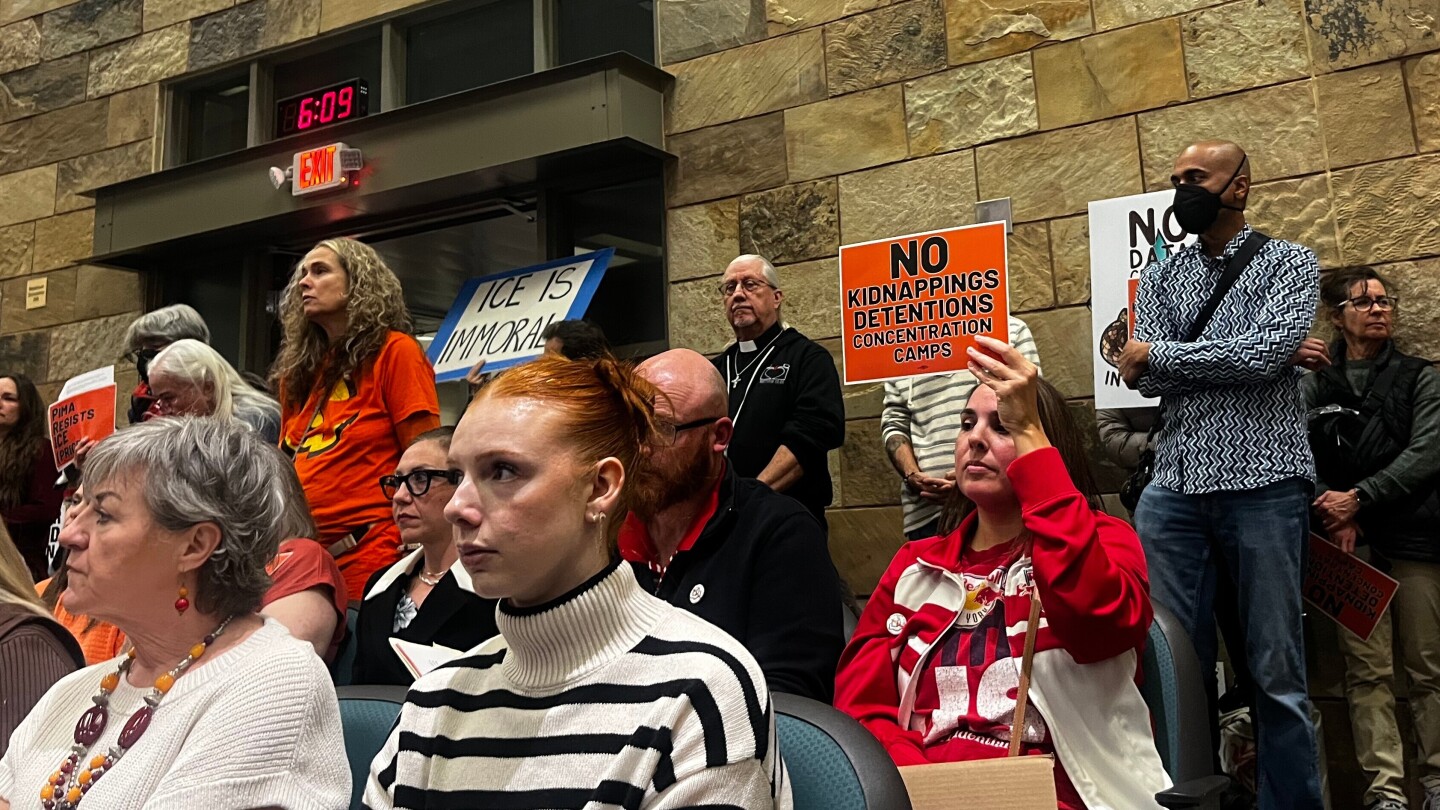
Both projects face significant opposition from the No Desert Data Center Coalition, which has emerged as a formidable organizing force since its first meeting last summer. The group has mobilized hundreds of residents concerned about energy consumption, water usage, and environmental impacts of these facilities.
Tuesday’s Marana Town Council meeting highlighted the deep community divisions, with chambers packed beyond capacity. Supporters in bright orange safety vests emphasized the economic benefits and construction jobs, while opponents displayed signs questioning the long-term impacts on utility rates and environmental resources.
Data centers house rows of servers and storage systems that form the backbone of internet infrastructure. The recent boom in artificial intelligence has accelerated demand for larger facilities capable of handling increased workloads. These centers require substantial energy to operate and typically use water-intensive cooling systems, though air-cooled alternatives exist.
Unlike neighboring jurisdictions, Marana had proactively established regulatory frameworks for data centers. In 2024, the town introduced an ordinance requiring developers to conduct noise studies, ensure sufficient electricity, assess future energy needs, estimate water consumption, and identify water sources.
During Tuesday’s meeting, council members raised concerns about noise impacts and emissions from backup generators. Patrick Cavanaugh, who ultimately voted for the project despite his reservations, said: “I think the noise is going to be a lot greater than you think, and the soot and smoke coming out of those [generators] is not going to be pretty.”
Arnaud Dusser, development director for Beale Infrastructure, emphasized that data centers are critical infrastructure comparable to hospitals, requiring continuous power. He noted that county regulators would oversee environmental compliance.
The public comment period lasted several hours, with strong representation from building trade unions including the Western States Regional Carpenters Union, Local 1184 of the Laborers International Union, and SMART Local 359.
“When our members are working, the benefits extend off the job site,” said Fernando Lebron, a business representative with SMART Local 359. “We support local businesses, contribute to tax revenue and invest in the community where we live.”
Project Blue faces additional challenges as Arizona Attorney General Kris Mayes, the City of Tucson, and local activists have filed petitions with the Arizona Corporation Commission (ACC) requesting a rehearing on the energy agreement between Tucson Electric Power and Humphrey’s Peak Power LLC.
In her December 30 filing, Mayes criticized ACC members for “rubber-stamping” the energy agreement, arguing that it improperly allows TEP and the data center to set their own rates. “The stakes are high: deals whereby a data center or large load customer does not pay its fair share can result in the shifting of their significant costs to other ratepayers,” she wrote.
ACC Chair Kevin Thompson disputed Mayes’ characterization, calling it “performative band wagoning theater” and arguing that the special contract actually provides enhanced protections for ratepayers. TEP spokesperson Joseph Barrios similarly stated that “the assertions put forward by the Attorney General do not align with the facts.”
Beale Infrastructure expects Project Blue to break ground sometime this year, though no exact date has been set. Additionally, the U.S. Air Force continues to solicit proposals for a potential data center at Davis-Monthan Air Force Base, with requirements for minimizing community impacts regarding energy, water, and communications resources.
For opponents like Sue Ritz, a U.S. Army National Guard veteran, the fight isn’t over. She hopes to organize a citizen referendum on the Marana rezoning vote. “The point of the referendum is to allow the citizens in the town of Marana to make a decision of what they want,” she said, citing concerns about PFAS “forever chemicals” and water rate increases.
Fact Checker
Verify the accuracy of this article using The Disinformation Commission analysis and real-time sources.

16 Comments
The fact that one of the parcels is owned by a council member’s family raises some eyebrows. I hope the approval process has been transparent and that all potential conflicts of interest have been properly addressed.
That’s a fair concern. Maintaining impartiality and public trust will be crucial as these high-stakes projects move forward.
Interesting to see the data center race heating up in Southern Arizona. Rezoning and land sales are important first steps, but there will likely be ongoing battles over power, water, and the broader impacts on the local community.
You raise a good point. Sustainability and resource management will be key considerations as these projects move forward.
The approval of these data center projects marks a significant milestone, but the real work is just beginning. I hope the local authorities and the developers can find ways to balance growth, sustainability, and the community’s long-term well-being.
Well said. The path forward will require careful planning, compromise, and a commitment to the region’s overall prosperity.
Data centers can bring significant investment and jobs, but their environmental footprint is a concern. I’m curious to see how the local authorities plan to mitigate the impacts on water, energy, and the broader ecosystem.
Good point. Rigorous environmental assessments and sustainability measures will be essential for these projects to gain broad community support.
It’s interesting to see the data center race heating up in this region. The potential economic benefits are substantial, but the local community will need to ensure their interests are well-represented in the decision-making process.
Agreed. Transparency and inclusive stakeholder engagement will be key to navigating the complex tradeoffs ahead.
I’m curious to see how the water and power issues get resolved. Data centers are notoriously thirsty and energy-intensive, so the local authorities will have to balance those needs with the broader community’s interests.
Good question. Sustainable solutions on the water and power fronts will be essential for these projects to gain full community support.
With two major data center projects advancing in the region, it’s clear Southern Arizona is positioning itself as an attractive hub. But the local leaders will need to navigate the complexities carefully to ensure balanced and responsible growth.
Well said. Striking the right balance between economic development and community impact will be the key challenge.
The economic benefits touted, like $5 billion in investment and 4,200 construction jobs, sound substantial. But the local community will need to weigh those against potential downsides around infrastructure, environment, and growth management.
Absolutely. The long-term tradeoffs and impacts on the region will be critical to evaluate as these data centers take shape.