


Listen to the article
GOP Lawmakers Struggle to Advance SAVE America Act Despite Presidential Pressure
President Donald Trump has made passage of the SAVE America Act a cornerstone priority for his administration, repeatedly urging congressional Republicans to approve the legislation that would require proof of citizenship to vote in federal elections.
“The Republicans MUST DO, with PASSION, and at the expense of everything else, THE SAVE AMERICA ACT,” Trump declared in a recent Truth Social post, signaling the importance he places on the measure. During his State of the Union address, he implored lawmakers to approve the act “to stop illegal aliens and other unpermitted persons from voting in our sacred American elections.”
While the House narrowly approved the plan last month in a 218-213 vote, the legislation faces significant hurdles in the Senate, primarily due to the chamber’s filibuster rules that effectively require 60 votes to advance most legislation.
This procedural obstacle has created tension between House and Senate Republicans, with some conservative House members taking the unusual step of publicly pressuring their Senate colleagues to modify filibuster rules to ensure passage of the bill.
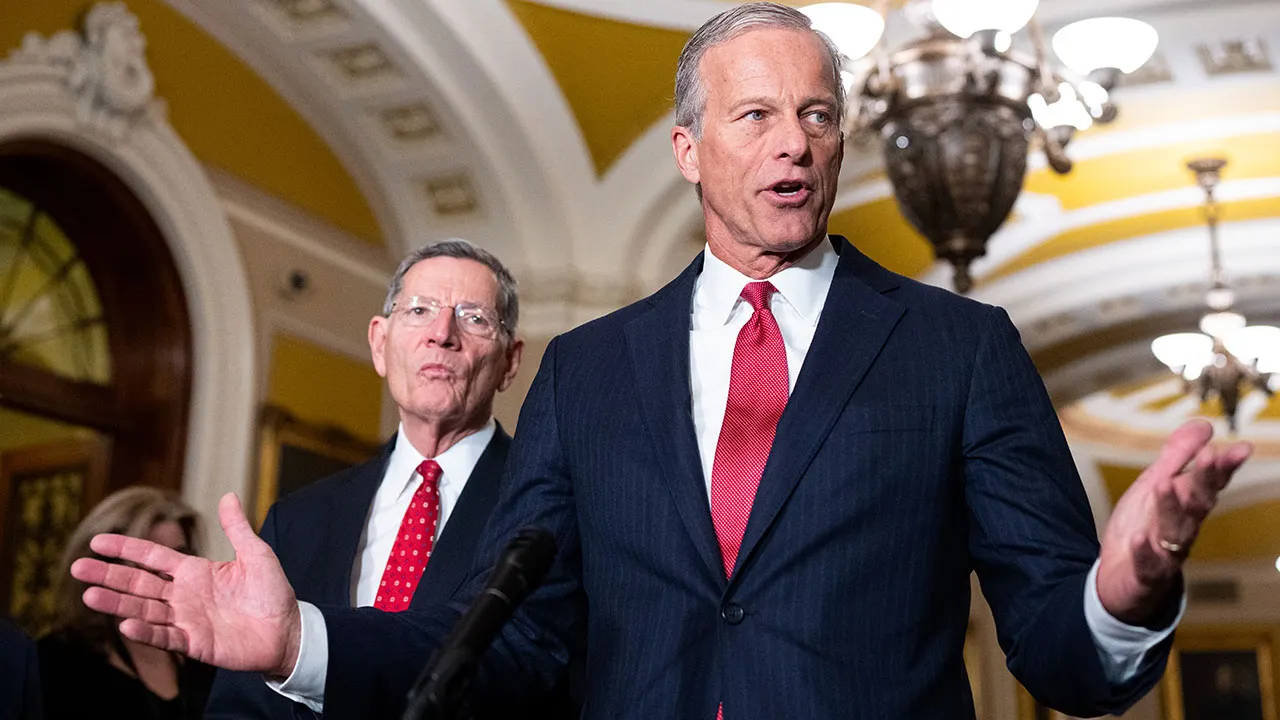
Senate Majority Leader John Thune (R-SD) has expressed skepticism about proposed workarounds, particularly the idea of forcing Democrats to conduct what some Republicans call a “talking filibuster” rather than blocking legislation through procedural votes.
“This process is more complicated and risky than people are assuming at the moment,” Thune warned, noting the practical challenges of such an approach.
The talking filibuster concept harks back to the dramatic scenes familiar to many Americans from films like “Mr. Smith Goes to Washington.” In theory, it would require opponents of legislation to physically hold the Senate floor with continuous speeches to block a vote, rather than simply signaling their opposition behind the scenes.
Senate Rule XIX allows senators to speak no more than twice on any single “question” during a legislative day. Some Republicans argue that if Democrats were forced to conduct a talking filibuster, they would eventually exhaust their speaking opportunities, allowing the Senate to proceed to a simple majority vote on the SAVE Act.
However, the parliamentary reality is far more complex. The definition of a “question” can apply to the bill itself, amendments, or procedural motions. This could potentially allow each Democratic senator multiple speaking opportunities. Additionally, the concept of a “legislative day” differs from a calendar day, creating further complications.
“If you don’t think Democrats have a laundry list of amendments, talking about who won the 2020 election, talking about the Epstein files — if you don’t think they have a quiver full of these amendments that they’re ready to get Republican votes on the record, then I’ve got a bridge to sell you,” warned George Washington University political science professor Casey Burgat.
Forcing a prolonged talking filibuster would also prevent the Senate from addressing other priorities, including Department of Homeland Security funding and the confirmation of Sen. Markwayne Mullin (R-OK) as Homeland Security secretary.
When asked if President Trump understands the parliamentary challenges, Thune responded, “We’ve conveyed that to him. It’s about the math. And, for better or worse, I’m the one who has to be a clear-eyed realist about what we can achieve here.”
Thune effectively dismissed the talking filibuster strategy on Tuesday, stating bluntly, “We don’t have the votes either to proceed, get on a talking filibuster, nor to sustain one if we got on it. I understand the president’s got a passion to see this issue addressed.”
The standoff illustrates the ongoing tension between Trump’s policy demands and the practical realities of Senate procedure. Despite the president’s forceful directive and the bill’s significance to his election integrity agenda, the parliamentary hurdles appear insurmountable without the 60 votes needed to overcome a traditional filibuster.
As debate over the SAVE America Act continues, the outcome will likely hinge not on parliamentary maneuvers but, as Thune summarized, on simple arithmetic: “It’s about the math.”
Fact Checker
Verify the accuracy of this article using The Disinformation Commission analysis and real-time sources.

12 Comments
Requiring proof of citizenship to vote is a significant change that could impact voter access, especially for marginalized groups. I’m curious to see the data and rationale behind the SAVE Act, as well as analyses of its potential effects.
Requiring proof of citizenship to vote is a significant change that could impact voter access, especially for marginalized groups. I’m curious to see the data and rationale behind the SAVE Act, as well as analyses of its potential effects.
That’s a good point. Robust public debate and thorough, impartial assessment of the bill’s impacts will be crucial before any major changes to voting requirements are enacted.
This SAVE Act seems like a controversial and politically-charged issue. While election integrity is important, I wonder if this bill strikes the right balance between security and accessibility. It will be interesting to see how the Senate debate unfolds.
Agreed, the Senate vote will be a real test. Modifying the filibuster rules to push this through could set a concerning precedent, even if the intent is to address perceived voting vulnerabilities.
The SAVE Act seems to be a partisan issue, with Republicans strongly in favor and Democrats largely opposed. I hope the Senate can move past political posturing and focus on crafting effective, fair election policies.
Agreed. Reducing voting barriers and protecting election integrity shouldn’t be partisan goals. Constructive, bipartisan dialogue is needed to find balanced solutions.
While the intent behind the SAVE Act may be to address perceived vulnerabilities, the partisan nature of the debate raises concerns about its fairness and effectiveness. Nonpartisan election experts should be heavily involved in evaluating this proposal.
The tension between the House and Senate Republicans highlights the political complexities around this issue. I hope cooler heads can prevail and that lawmakers focus on finding common ground to strengthen election security while preserving access to voting.
Voting rights are a fundamental part of democracy, so any proposed changes need to be scrutinized very carefully. I’m interested to learn more about the specific problems the SAVE Act aims to address and the evidence supporting its approach.
The Trump administration’s insistence on this legislation highlights how divisive and partisan voting rights issues have become. Reasonable people can disagree on the best approach to ensure secure and fair elections.
Absolutely. With such strong feelings on both sides, I hope lawmakers can find a compromise that upholds democratic principles while addressing legitimate concerns about election integrity.