


Listen to the article
Trump Orders Christmas Day Airstrikes Against ISIS in Northwest Nigeria
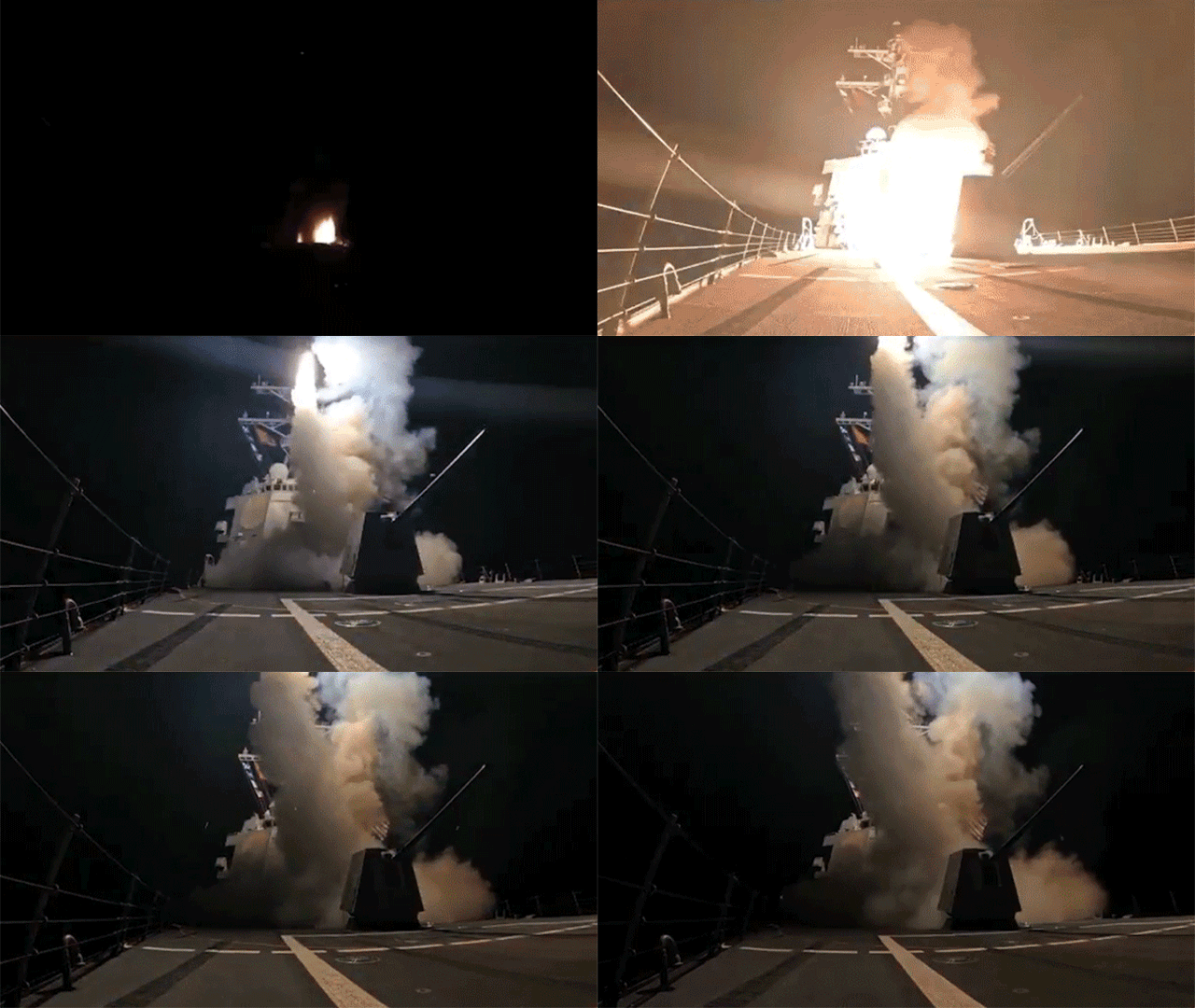
President Donald Trump authorized airstrikes targeting Islamic State militants in northwest Nigeria on Christmas Day, following through on earlier warnings that he would take action against terrorist groups responsible for violence against Christians in the region.
The strikes occurred in Nigeria’s Sokoto State along the border with Niger, targeting the Islamic State’s Sahel Province, which has expanded its operations into Nigeria from its primary bases in Mali, Niger, and Burkina Faso.
“I have previously warned these Terrorists that if they did not stop the slaughtering of Christians, there would be hell to pay, and tonight, there was,” Trump announced on Truth Social on Thursday. “The Department of War executed numerous perfect strikes, as only the United States is capable of doing.”
According to U.S. Africa Command (AFRICOM), initial assessments confirm that “multiple” ISIS terrorists were killed in the operation, though specific casualty figures have not been released. Trump described the strikes as “deadly” and precisely executed.
The Sahel region has become what Marine Corps Gen. Michael Langley, head of AFRICOM, described as “the epicenter of terrorism on the globe” during a briefing in May. He warned that extremist groups are gaining ground and “expanding their ambitions,” increasing potential threats to U.S. homeland security as these organizations build “capability and capacity” across the region.
Security experts note that the Islamic State’s presence in northwest Nigeria represents just one of several jihadist groups operating in the country and broader region. According to Caleb Weiss, an editor with the Foundation for the Defense of Democracies’ Long War Journal, multiple terrorist organizations have increasingly converged their operations.
“In addition to IS Sahel, there is also IS West Africa Province, which supports and coordinates with IS Sahel in northwest Nigeria; the so-called Boko Haram; and the Al-Qaeda groups of Ansaru and the Group for Support of Islam and Muslims,” Weiss explained. The latter group, also known as Jama’at Nasr al-Islam wal Muslimin or JNIM, is primarily based in Mali and Burkina Faso but has expanded into Nigeria, effectively merging the Sahelian and Nigerian conflicts.
The U.S. military action follows a disturbing pattern of violence against Christian communities in Nigeria. In November, gunmen raided the Christ Apostolic Church in Eruku, Kwara State, killing two people and kidnapping dozens, who were later freed. That same month, armed attackers stormed St. Mary’s School in Niger State, abducting more than 300 students and staff. While approximately 50 students managed to escape, over 250 students and 21 teachers reportedly remain in captivity.
The Trump administration moved to designate Nigeria a “country of particular concern” in November, highlighting what U.S. officials describe as persistent religious persecution. Nigerian officials have pushed back against this designation.
The Christmas Day strikes represent a significant military response to terrorist activities in Africa, a region where violence by extremist organizations has surged in recent years. The Sahel, comprising Nigeria, Niger, Burkina Faso, and Mali, has become increasingly unstable as groups affiliated with both ISIS and al-Qaeda compete for territory and influence.
U.S. security officials have long maintained that terrorist activities in the region could eventually threaten American interests at home and abroad if left unchecked. The Biden administration had maintained counterterrorism operations in Africa, though with a somewhat reduced footprint compared to previous administrations.
As the situation continues to develop, security experts will be monitoring whether these strikes represent a one-time response or signal a broader shift toward more direct U.S. military involvement in countering terrorist groups operating across the Sahel region.
Fact Checker
Verify the accuracy of this article using The Disinformation Commission analysis and real-time sources.

14 Comments
The Sahel is quickly becoming a new epicenter of terrorism, so I’m glad to see the US taking action to disrupt ISIS operations in the region. However, a comprehensive regional strategy will be needed to truly stabilize the area.
Airstrikes alone won’t solve the complex security challenges in the Sahel. Coordinated efforts with local partners to address poverty, governance issues, and other root causes will be crucial.
Christmas Day strikes against ISIS in Nigeria are a bold move by the Trump administration. It demonstrates a commitment to protecting vulnerable Christians and disrupting terrorist activities in the Sahel.
While these strikes may provide a temporary setback for ISIS, a sustained counterterrorism campaign will be required to truly defeat the group’s presence in the region.
Christmas Day airstrikes against ISIS in Nigeria are a bold move, but the security situation in the Sahel remains extremely fragile. Continued US engagement and support for local partners will be critical.
I hope these strikes are just the beginning of a sustained effort to degrade ISIS’s capabilities and protect vulnerable populations in the Sahel.
This is a significant development in the fight against ISIS in the Sahel region. Targeting their strongholds in Nigeria is a critical step to curb the group’s expansion and protect vulnerable Christian communities in the area.
Decisive military action against ISIS is necessary, but long-term solutions to address the underlying drivers of extremism in the Sahel will also be key.
Targeting ISIS in Nigeria is an important step, but the Sahel’s security challenges go beyond just this one terrorist group. A comprehensive regional approach is needed to address the interlinked factors driving instability.
I hope these airstrikes are part of a broader US strategy to support local security forces and promote economic and political reforms in the Sahel.
Targeting ISIS in Nigeria is an important step, but the Sahel’s security challenges are complex and multifaceted. A comprehensive regional strategy will be needed to truly address the drivers of instability.
While these airstrikes may provide a temporary setback for ISIS, a long-term, whole-of-government approach is required to build resilient security forces and promote good governance in the Sahel.
The US has clearly decided to take a more assertive approach to combating ISIS in the Sahel. These strikes in Nigeria demonstrate a willingness to act decisively against the group’s expansion in the region.
While military action is necessary, a holistic strategy addressing the root causes of extremism will be essential for long-term stability in the Sahel.