


Listen to the article
Republicans Move to Reshape Majority-Black Congressional District in Tennessee
Republican lawmakers in Tennessee are advancing a controversial redistricting plan that could dismantle the state’s only majority-Black congressional district, currently centered around Memphis. The proposal, scheduled for a vote Thursday, represents part of a broader Republican strategy to maintain control of the U.S. House of Representatives in the upcoming November elections.
The Tennessee effort follows a recent U.S. Supreme Court ruling that significantly weakened the federal Voting Rights Act. The Court determined that Louisiana had placed too much emphasis on race when creating a second Black-majority House district. This decision upended decades of precedent, providing Republicans with legal grounds to challenge and potentially eliminate majority-Black districts that have traditionally elected Democratic representatives.
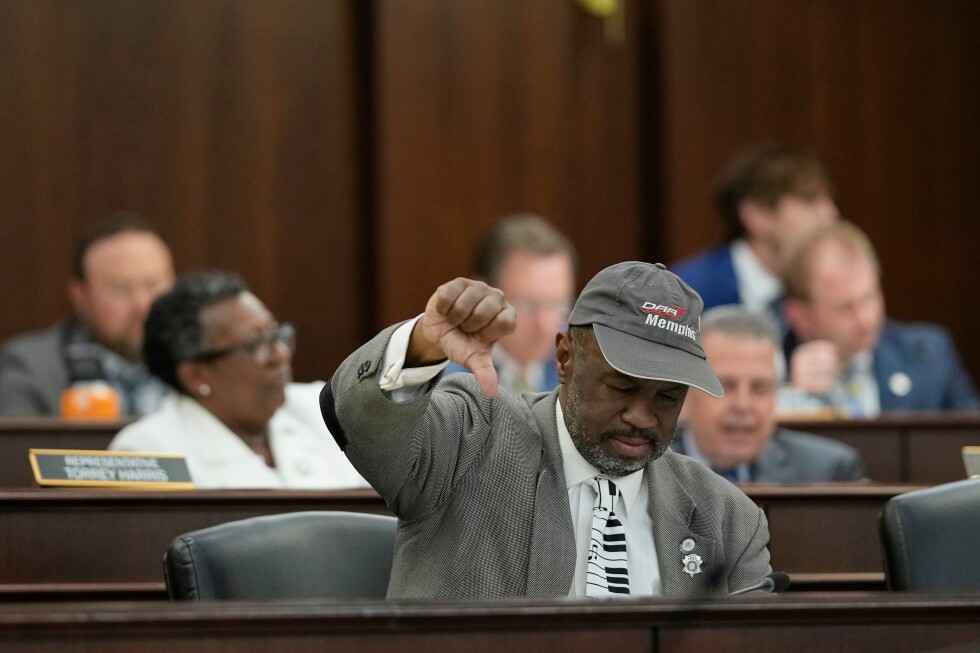
Despite vocal protests during legislative hearings Wednesday, Tennessee Republicans pushed the redistricting bills forward for a potential final vote in both the House and Senate. The proposed legislation would overturn a state law prohibiting mid-decade redistricting and reopen the candidate qualifying window, allowing new entrants into primaries and enabling existing candidates to switch districts.
The plan would fragment Tennessee’s lone Democratic-held district, creating a cascade of boundary changes throughout western and central parts of the state. House Speaker Cameron Sexton defended the proposal, claiming the new districts were drawn based on population and political considerations rather than racial data.
Democrats and civil rights advocates have strongly condemned the effort. Sekou Franklin, a political science professor at Middle Tennessee State University and NAACP member, described the proposal as “Black vote dilution at an industrial scale.” Democratic lawmakers highlighted that the Tennessee Supreme Court rejected a challenge to the current map in April 2022, ruling it was too close to the election to implement changes. With even less time before the August 6 primary this year, they warn of significant voter confusion.
Tennessee is not alone in this redistricting push. Similar efforts are underway across multiple Southern states. In Alabama, the state House passed legislation Wednesday authorizing special congressional primaries as Republicans seek to replace a court-ordered map that created a district with a near-majority of Black voters. That district recently elected Rep. Shomari Figures, a Black Democrat.
The Alabama bill passed along party lines after four hours of heated debate, during which Black legislators drew parallels to historical voter suppression tactics. Democratic state Rep. Juandalynn Givan characterized the legislation as “a calculated political maneuver born out of fear, a fear that is of Black people and most importantly Black political power.”
Alabama’s primaries are scheduled for May 19, but if courts approve the state’s request, the legislation would invalidate results for congressional seats and require the governor to schedule a new primary under revised district boundaries.
In South Carolina, the state Senate is considering a resolution that would allow lawmakers to reconvene later to redraw congressional districts, potentially eliminating the state’s only Democratic-held seat. The proposal passed the House on Wednesday and requires a two-thirds vote in both chambers to advance.
Republican House leaders in South Carolina plan to introduce a new map Thursday and hold committee meetings Friday. During debate, Democrats pressed Republicans on why they were willing to halt the June 9 U.S. House primary after candidates had already filed and questioned the cost of rescheduling the primary.
These state-level redistricting battles contribute to an intense national fight over congressional maps. Since former President Donald Trump urged Texas to redraw its districts last year, eight states have adopted new congressional boundaries. Political analysts suggest Republicans could gain as many as 13 seats from these changes, while Democrats believe they might secure up to 10. However, competitive races mean neither party may achieve all their redistricting goals in November.
As these redistricting efforts progress through state legislatures, they face potential legal challenges and practical hurdles, including tight timelines before upcoming primaries. The outcome will significantly impact the partisan composition of the U.S. House and the political representation of minority communities across multiple Southern states.
Fact Checker
Verify the accuracy of this article using The Disinformation Commission analysis and real-time sources.

14 Comments
This is a complex issue with far-reaching implications. I hope Tennessee’s legislators can navigate the redistricting process in a way that promotes fair and equitable representation for all citizens.
Well said. Redistricting should be driven by principles of fairness and democratic participation, not partisan interests. It will be important to closely monitor this situation.
Redistricting is a sensitive issue, and it’s important that the process is fair and nonpartisan. I hope Tennessee’s lawmakers can find a solution that upholds democratic principles.
Absolutely. Gerrymandering to gain a political advantage undermines the integrity of our elections. I’ll be closely following this situation to see how it unfolds.
Interesting to see the political maneuvering around redistricting in Tennessee. It’s a complex issue with implications for fair representation. I’ll be curious to see how this plays out and what the potential impacts might be.
Agreed, redistricting can be a contentious process. It’ll be important to closely monitor the situation and ensure the democratic process is upheld.
Redistricting is always a politically charged process, but it’s important that the final maps reflect the will of the people, not just party interests. I’ll be watching this situation closely.
I agree completely. Gerrymandering to entrench one party’s power is undemocratic and undermines faith in the political system. Hopefully, Tennessee can find a fair, nonpartisan solution.
The potential dismantling of the state’s only majority-Black congressional district is concerning. Voters should have fair representation that reflects the diversity of the population.
I agree, any efforts to dilute the voting power of minority communities are deeply troubling. Transparent and impartial redistricting is essential for a healthy democracy.
The Supreme Court’s recent ruling on the Voting Rights Act is concerning, as it could make it easier to challenge majority-minority districts. I hope Tennessee lawmakers prioritize fair representation over partisan interests.
That’s a valid point. The Voting Rights Act has been a crucial safeguard, and any weakening of it is worrying for democracy. Transparent and impartial redistricting will be key.
This seems like another example of the ongoing battle over voting rights and political representation in the US. I hope Tennessee’s legislators can find a way to uphold democratic principles in their redistricting process.
Well said. Protecting the voting rights of all citizens, regardless of race or political affiliation, should be the top priority. Transparent and inclusive redistricting is crucial.