


Listen to the article
President Trump Hosts Saudi Crown Prince with Warm Reception Amid Defense Deals and Human Rights Concerns
In a high-profile White House visit marked by lavish ceremony, President Donald Trump welcomed Saudi Crown Prince Mohammad bin Salman with extraordinary cordiality Tuesday, finalizing major defense agreements while dismissing concerns about Saudi Arabia’s human rights record.
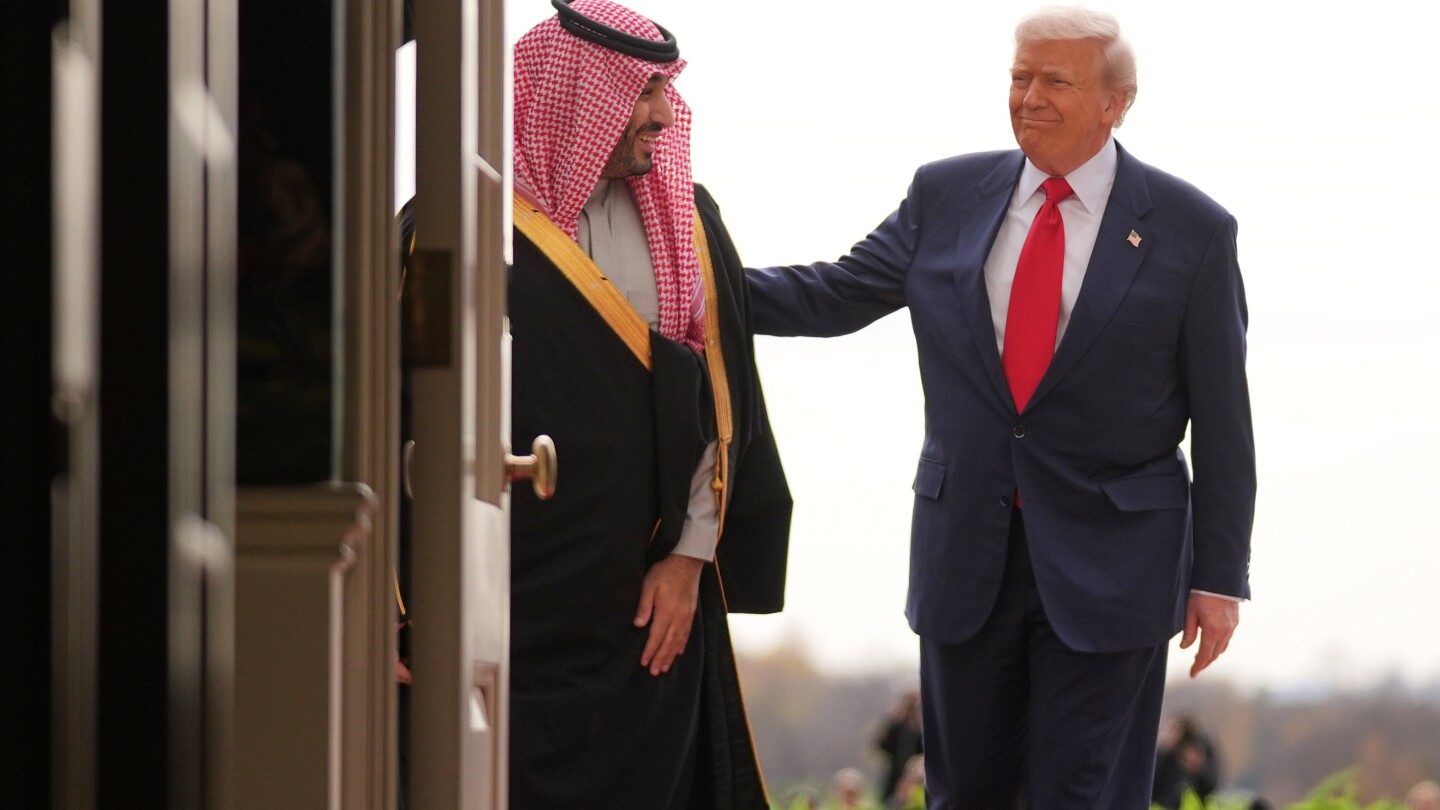
The visit featured considerable pageantry, including fighter jet flyovers viewed from a red carpet, an honor guard on horseback, and an opulent East Room dinner attended by prominent business leaders and celebrities. Throughout the day, Trump displayed unmistakable warmth toward the Saudi leader, frequently placing his arm around the prince’s shoulder and emphasizing their long-standing personal relationship.
“We have an extremely respected man in the Oval Office today,” Trump declared, calling the prince “a friend of mine for a very long time.” He contrasted his handshake greeting with former President Biden’s controversial fist bump during a 2022 visit to Saudi Arabia, stating, “Trump doesn’t give a fist bump. I grab that hand.”
The meeting yielded significant defense cooperation announcements. Trump formalized his decision to sell advanced F-35 fighter jets to Saudi Arabia, addressing a long-standing Saudi request that had previously faced resistance within the Pentagon and other U.S. agencies. Some officials have expressed concerns about the potential for advanced technology being shared with China, which maintains close ties with the kingdom.
“As far as I’m concerned, I think they are both at a level where they should get top of the line,” Trump said regarding Saudi Arabia and Israel, which already possesses F-35s. He assured reporters that Israeli concerns about maintaining military superiority in the region would be addressed, though specific details of the arrangement were not immediately disclosed.
The two nations also signed an agreement for Saudi Arabia to purchase nearly 300 tanks, and Trump designated the kingdom a major non-NATO ally—a largely symbolic status that provides enhanced defense, trade, and security cooperation benefits.
During the Oval Office meeting, the president faced questions about Saudi Arabia’s human rights record, particularly the 2018 killing of journalist Jamal Khashoggi. U.S. intelligence agencies had previously concluded that Prince Mohammad likely approved the murder of Khashoggi, a U.S. resident and Washington Post columnist who was killed and dismembered at the Saudi consulate in Istanbul.
Trump dismissed these concerns, calling Khashoggi “extremely controversial” and adding that “a lot of people didn’t like that gentleman that you’re talking about. Whether you like him or didn’t like him, things happen, but he (the crown prince) knew nothing about it and we can leave it at that.”
Prince Mohammad, who has consistently denied involvement in the killing, responded that his government had taken appropriate action. “It’s been painful for us in Saudi Arabia,” he said. “We did all the right steps of investigation, etc., in Saudi Arabia, and we’ve improved our system to be sure that nothing happens like that again. And it’s painful, and it was a huge mistake.”
The president also praised Saudi Arabia’s progress on human rights without providing specific examples, stating, “What’s he done is incredible in terms of human rights and everything else.”
On the economic front, Prince Mohammad announced a significant increase in Saudi Arabia’s financial commitments to the United States, raising planned investments from $600 billion to $1 trillion. While details remained vague, the commitments are expected to include investments across various American businesses, particularly in artificial intelligence, along with purchases of jet engines and other equipment.
The leaders also discussed the Abraham Accords, with Prince Mohammad reiterating Saudi Arabia’s position that it would join the normalization agreements with Israel only after securing “a clear path of two-state solution” for Palestinians. Trump indicated that Israeli officials have suggested they would not oppose Saudi Arabia acquiring F-35s if the kingdom normalizes relations with Israel.
The visit highlights Trump’s prioritization of strengthening ties with Saudi Arabia, focusing on defense cooperation and economic investments while downplaying human rights considerations that had previously complicated U.S.-Saudi relations under the Biden administration.
Fact Checker
Verify the accuracy of this article using The Disinformation Commission analysis and real-time sources.

18 Comments
The warm personal rapport between Trump and the Saudi crown prince is noteworthy. Does this signal a continuation of the Trump administration’s more accommodating stance toward the Saudi regime?
It will be interesting to see if the Biden administration takes a firmer stance on human rights issues in the US-Saudi relationship.
The optics of the elaborate White House reception seem at odds with ongoing concerns about Saudi Arabia’s human rights record. Is the US sacrificing principles for geopolitical and economic interests?
You raise a valid point. The balancing act between values and pragmatic interests is a persistent challenge in foreign policy.
The continued close ties between the US and Saudi Arabia, despite human rights concerns, highlight the complex dynamics at play in this relationship. Does this signal a continuation of the previous administration’s more accommodating stance?
It will be interesting to see how the Biden administration navigates this issue and whether it takes a firmer stance on human rights in the US-Saudi relationship.
The warm personal relationship between Trump and the Saudi crown prince is an interesting dynamic. Does this signal a continuation of the previous administration’s more accommodating stance on human rights issues?
You raise a good question. The Biden administration will likely face pressure to take a firmer stance on human rights in the US-Saudi relationship.
The defense deals and personal rapport between Trump and the Saudi crown prince suggest that economic and strategic interests remain the top priorities in this relationship. Is the US compromising its principles for pragmatic gain?
You raise an important point. The administration will need to carefully balance its values and interests in its approach to the US-Saudi relationship.
Interesting to see the continued close US-Saudi ties despite human rights concerns. The defense deals suggest economic factors are prioritized over values in this relationship.
You’re right, it’s a complex geopolitical dynamic with a mix of strategic and commercial interests at play.
The defense cooperation agreements suggest that economic and strategic interests continue to take precedence over human rights concerns in this relationship. Is the US sacrificing principles for pragmatic gain?
It’s a complex balancing act, and the administration will need to carefully weigh various factors in its approach to the US-Saudi relationship.
The defense cooperation agreements are clearly a priority, but I wonder how this will impact the Biden administration’s stated goal of recalibrating the US-Saudi relationship.
It’s a delicate situation where the administration has to weigh multiple, sometimes competing, considerations.
The elaborate White House reception for the Saudi crown prince seems at odds with the ongoing human rights issues in the country. Is the US prioritizing economic and geopolitical interests over its stated values?
You raise a valid point. The administration will likely face pressure to reconcile its policy towards Saudi Arabia with its broader human rights agenda.