


Listen to the article
States Establish Penny-Free Cash Guidelines Following Production Halt
Months after the United States minted its final 1-cent coins, states are beginning to implement their own solutions to the penny problem by establishing rounding guidelines for cash transactions.
President Donald Trump announced the end of penny production early last year, citing the wasteful economics of the coin. According to the U.S. Mint, each penny cost 3.7 cents to manufacture in 2024, making their production financially unsustainable. This decision led to a shortage of pennies in cash registers last summer, forcing businesses and consumers to adapt to a new reality where making exact change has become increasingly difficult.
While the Treasury Department has committed to keeping the approximately 114 billion existing pennies in circulation “for as long as possible” and confirmed that the coins must still be accepted as legal tender, the practical challenges of a diminishing penny supply remain.
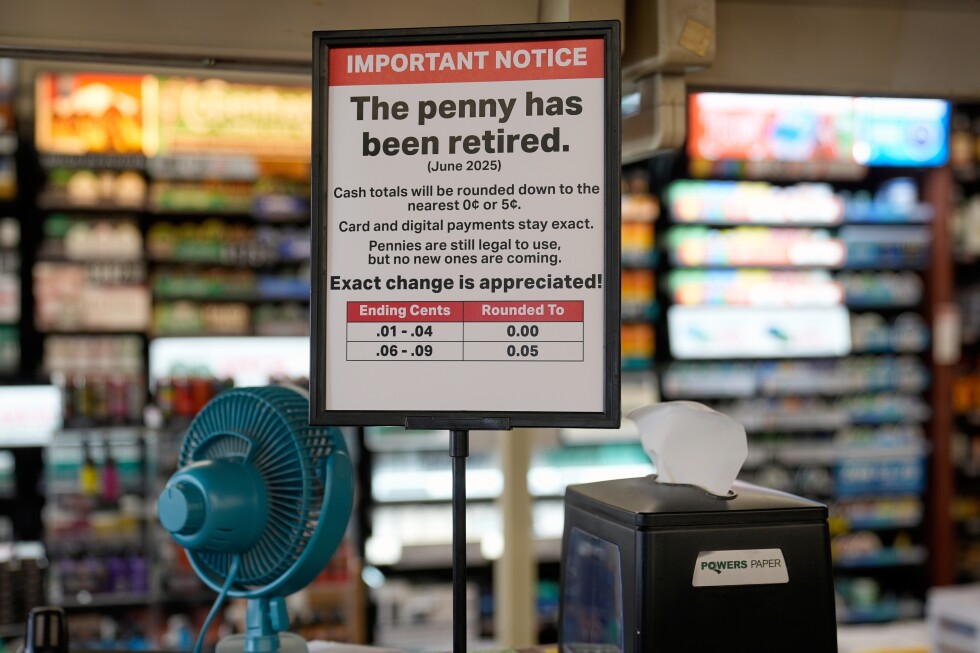
The most common solution emerging is “symmetrical rounding” to the nearest nickel. Under this approach, if the final price after taxes ends in one, two, six, or seven cents, the payment rounds down. For example, $1.91 or $1.92 becomes $1.90. Conversely, if a price ends in three, four, eight, or nine cents, the payment rounds up, making $1.98 or $1.99 an even $2.00.
A federal bill introduced last year has passed the House financial services committee and would implement symmetrical rounding nationwide. Rep. Lisa McClain (R-Mich.) emphasized the importance of federal legislation to prevent a “confusing patchwork of state policies.” However, the bill still needs full House approval and Senate passage before reaching the President’s desk.
In the absence of federal action, states are moving forward with their own solutions. Bills addressing cash transactions in a penny-free economy have passed both legislative chambers and await governors’ signatures in Arizona, Florida, Oregon, Tennessee, Virginia, and Washington. The approaches vary, with some states proposing optional rounding while others consider making it mandatory.
Indiana has been particularly active on this issue. Republican Gov. Mike Braun recently signed a bill requiring businesses to round cash purchases for transactions not ending in zero or five. However, lawmakers subsequently passed a revision making rounding optional, which would take effect if signed into law.
The Indiana legislation allows businesses to choose their rounding method: always rounding up to the nearest nickel, always rounding down, or employing symmetrical rounding based on the amount.
In Tennessee, Republican-led legislation provides businesses with legal protection under state consumer protection laws when implementing symmetrical rounding, though it doesn’t mandate the practice. “It is to provide safe harbor for private businesses,” explained Republican Rep. Charlie Baum during floor debate.
According to an Associated Press analysis using the bill-tracking service Plural, rounding legislation has been introduced in approximately two dozen states since late 2023. Beyond legislative action, some state agencies have published guidelines specifying that rounding should occur after tax calculations, ensuring that full tax amounts still go to state coffers.
Despite the rise of electronic payment methods, cash remains significant in the U.S. economy. A 2024 Federal Reserve survey found about 80% of U.S. adults had recently used cash, with higher usage rates among older adults and lower-income households.
The Treasury Department has stated that prices would be “rounded down just as often as they will be rounded up, so there should be no overall effect on consumer prices.” However, researchers at the Federal Reserve Bank of Richmond found that retail prices not ending in zero or five were especially likely to end in eight or nine cents, suggesting consumers might lose more pennies than they gain through rounding.
This potential disparity has fueled public skepticism. Some Americans have expressed frustration on social media, feeling nickel-and-dimed even if just by a penny or two per transaction.
Connecticut resident Nikki Capozzo-Hennessy, who frequently pays with cash to monitor her spending, noticed a rounding adjustment on her $8.73 grocery receipt. In her case, the store rounded down, saving her three cents. While acknowledging that consistent rounding is practical—especially for her own food truck business—she recognized how small amounts can accumulate over time.
“At the end of the day it’s three cents, but I can imagine with all the purchases that you make, it can add up,” Capozzo-Hennessy noted.
Washington state Representative April Berg, who introduced rounding legislation, acknowledged consumer frustrations but emphasized the practical necessity given the penny’s elimination. “We did make sure that everyone is allowed to pay exactly what they owe,” Berg said, referring to her legislation’s provisions.
Looking ahead, the Treasury Department estimates that ending penny production will save $56 million annually. However, increased demand for nickels presents another challenge, as each 5-cent coin currently costs nearly 14 cents to manufacture. The proposed federal legislation includes a potential solution: allowing the Treasury to adjust the nickel’s composition to use cheaper zinc and nickel alloys instead of the current copper-nickel blend.
Fact Checker
Verify the accuracy of this article using The Disinformation Commission analysis and real-time sources.

8 Comments
The economics behind the penny’s demise make sense, but I’m curious to see how consumers and businesses adjust to the new rounding rules. Will there be any unintended consequences, like price inflation from rounding up?
The end of penny production is an interesting development, and the state-level rounding rules are a practical response. I’m curious to see how this plays out for businesses and consumers in the long run.
It makes sense for states to establish rounding guidelines as pennies become scarce, but I wonder if there are any alternative approaches being explored beyond the standard nickel rounding. Innovative solutions could help ensure an equitable transition.
While the economics of penny production may be unsustainable, I hope the rounding doesn’t lead to unintended consequences like price inflation or inconveniences for consumers. It will be important to monitor the impacts closely.
As a consumer, I don’t mind the penny going away, but I hope the rounding doesn’t lead to higher prices or inconveniences. It will be important for states to ensure a smooth transition to the new cash handling policies.
Interesting to see how states are adapting to the end of penny production. Rounding to the nearest nickel seems like a practical solution, though I wonder how it will impact small cash transactions and businesses that rely on precise change.
This is a pragmatic move by states to address the penny shortage, but I wonder if there are any alternative solutions being considered besides the standard rounding approach. It would be interesting to see more innovative ideas emerge.
I appreciate the states taking proactive steps to address the penny problem, but I hope the rounding doesn’t disproportionately impact lower-income consumers. Equitable cash handling should be a key consideration.