


Listen to the article
California’s Controversial Solar Plant Continues to Face Environmental Scrutiny
More than a decade after its celebrated opening, the Obama-era Ivanpah Solar Power Plant in California’s Mojave Desert continues to face mounting criticism over its environmental impact, including the deaths of thousands of birds annually and its ongoing reliance on fossil fuels.
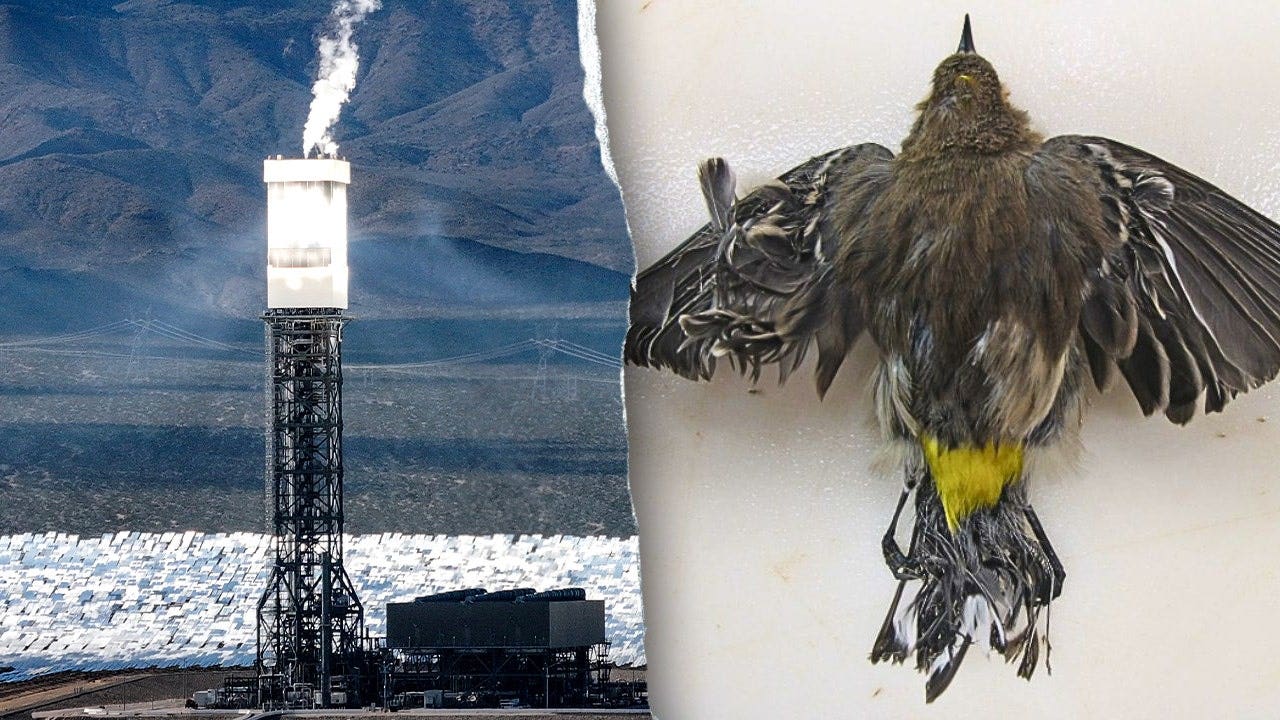
The massive facility, situated near the California-Nevada border, employs an impressive array of approximately 350,000 mirrors mounted on 170,000 heliostats to reflect sunlight toward three towering structures. This innovative design generates intense heat to produce electricity, but the same concentrated solar beams that power the facility have proven deadly for wildlife.
Federal researchers have documented a disturbing phenomenon dubbed “streamers,” where birds fly through the plant’s concentrated solar rays—known as solar flux—and suffer severe injuries as their feathers burn. Video evidence released by the U.S. Geological Survey shows birds trailing smoke as they pass through these intense beams of reflected sunlight.
“Public estimates are that thousands of birds are killed every year by this single facility,” said Lewis Grove, director of wind and energy policy at the American Bird Conservancy. He added that the environmental trade-off is “generally not worth it for birds,” noting that newer photovoltaic solar systems have significantly lower impacts on wildlife.
A 2016 study by the U.S. Fish and Wildlife Service found evidence of birds suffering feather damage and trauma consistent with exposure to the intense heat near the towers. Monitoring reports filed with California regulators continue to document hundreds of bird and bat deaths at the site each year.
Julia Dowell of the Sierra Club has called the project “a financial boondoggle and environmental disaster” that “killed thousands of birds and tortoises,” emphasizing that “not all renewable technologies are created equal.”
Beyond bird mortality, the project’s environmental footprint includes significant habitat disruption. The site was once considered high-quality desert habitat according to federal environmental reviews conducted before construction. The development cleared large areas of land, displacing protected desert tortoises and other wildlife, raising concerns about their long-term survival. Early monitoring reports showed dozens of protected desert tortoises went unaccounted for during initial operations.
Perhaps most surprisingly for a facility marketed as clean energy, Ivanpah relies on natural gas to start up operations each day. While the original design assumed limited gas use, actual operations often require several hours of gas-burning to bring the system online. The plant burns enough natural gas to produce approximately 25,000 to 30,000 metric tons of carbon dioxide annually—roughly equivalent to the emissions from several thousand U.S. homes.
This level of emissions places the “solar” facility under California’s cap-and-trade program, which requires major polluters to pay for their carbon output. While Ivanpah produces fewer emissions than a conventional natural gas plant, its carbon footprint remains significantly higher than modern solar farms that generate electricity without burning fossil fuels.
The project was built with more than $1.6 billion in federally backed loans and additional taxpayer-funded incentives, with hundreds of millions of dollars still outstanding. The U.S. Department of the Treasury also provided a $539 million grant to help build the facility, covering about 30% of construction costs.
“If oil and gas spills a drop, literally a drop, the entire operation is shut down. And to an extent that’s a good thing,” Daniel Turner, founder of energy advocacy group Power The Future, told Fox News Digital. “But you label something ‘green’ or ‘clean’ and all regulations are waived.”
Despite documented wildlife impacts and financial concerns, the plant continues to operate. California regulators have declined efforts to shut it down, arguing it is still needed to support the power grid, even as officials under both the Trump and Biden administrations have supported closing the facility, citing the high cost of its electricity compared to newer alternatives.
NRG Energy, which operates the facility, has stated it remains committed to providing renewable electricity but declined to provide additional comment regarding environmental issues. The California Energy Commission maintains that the project remains in compliance with its environmental requirements, with wildlife impacts addressed through ongoing monitoring and coordination with federal and state agencies.
More than a decade after it opened, Ivanpah stands as a complex symbol of the trade-offs in the push for clean energy—where efforts to reduce emissions can also bring significant environmental costs and raise questions about how “green” energy projects are evaluated and monitored.
Fact Checker
Verify the accuracy of this article using The Disinformation Commission analysis and real-time sources.

5 Comments
It’s disappointing to hear that this solar plant is still relying on fossil fuels and causing harm to birds. Renewable energy should be a win-win for the environment, not creating new problems. I wonder what alternatives or design changes could make this type of facility more eco-friendly.
This solar plant seems to have some significant environmental downsides. While the intent to generate renewable energy is admirable, the bird mortality and fossil fuel usage are concerning. I wonder if there are ways to improve the design to make it more wildlife-friendly.
This is an interesting case study on the tradeoffs involved in large-scale renewable energy projects. While the intent is admirable, the unintended consequences of bird deaths and fossil fuel use are concerning. I hope engineers can find ways to make concentrated solar power more wildlife-friendly.
Wow, this solar plant sounds like it has some major issues that need to be resolved. Thousands of bird deaths annually is a huge environmental cost that shouldn’t be ignored. I’m curious to learn more about what design changes or new technologies could make this type of facility more sustainable.
Renewable energy projects should aim to minimize their environmental impact as much as possible. The high bird mortality at this facility is troubling and needs to be addressed. I hope researchers can find solutions to make concentrated solar power more sustainable for wildlife.