


Listen to the article
Senate Democrats Face Internal Strife Following Record Government Shutdown
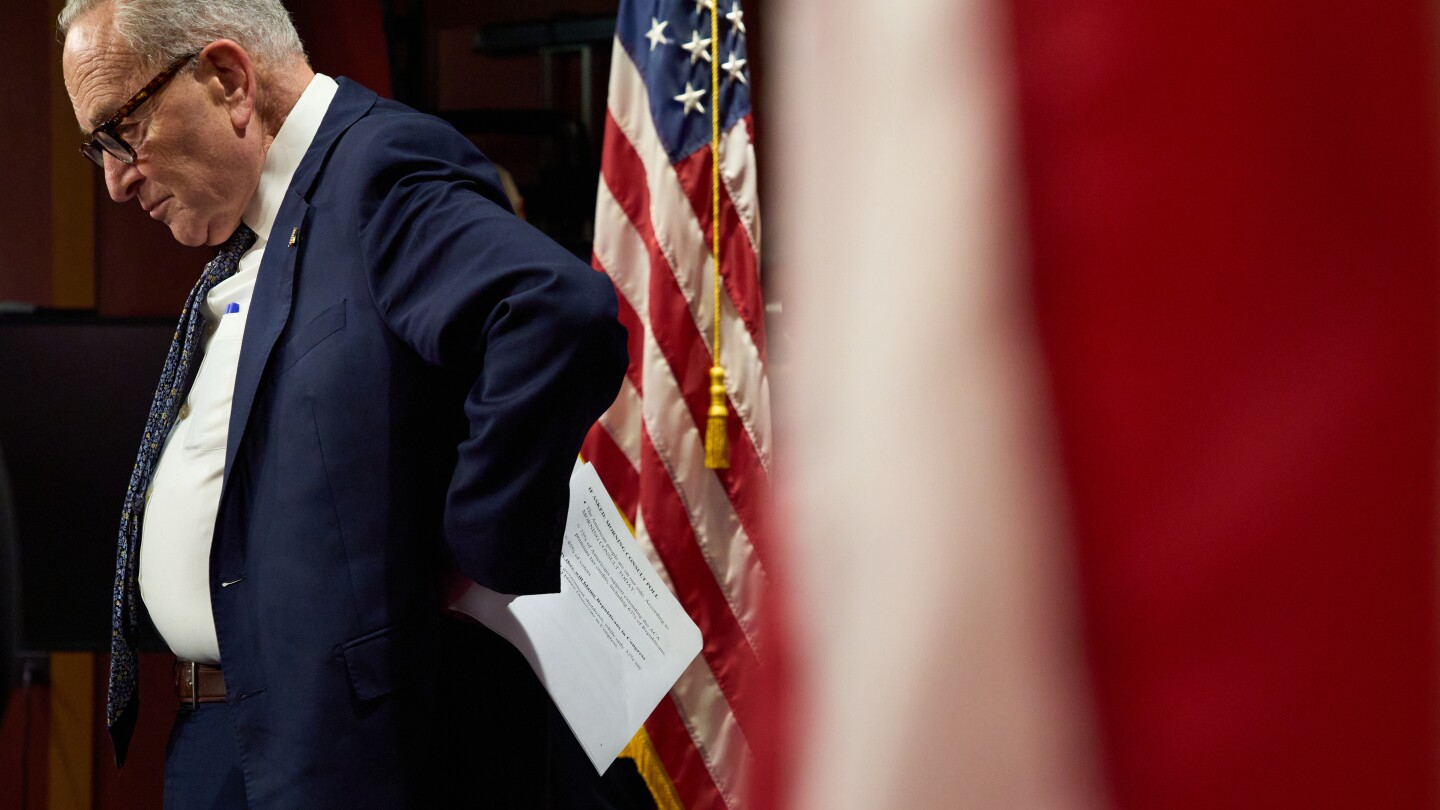
Senate Democratic leader Chuck Schumer finds himself navigating treacherous political waters after leading his party through a record-breaking government shutdown that ended with a split in Democratic ranks. The shutdown concluded when a small group of moderate Democratic senators broke with leadership and voted alongside Republicans to reopen the government without securing the health care subsidies Democrats had demanded for weeks.
The fallout has exposed fractures within the Democratic caucus, with progressives criticizing Schumer for not fighting harder while moderates defend the difficult position he faced with limited leverage. It’s the second time this year Schumer has faced backlash from his party’s base, following similar criticism in March when he voted with Republicans on a previous funding measure.
“The American people asked us over and over to fight for health care and to lower our costs overall,” said Massachusetts Senator Elizabeth Warren, who notably declined to say whether she still had confidence in Schumer’s leadership. “Obviously that broke apart at the end. Our job is to deliver for the American people. We need to do that more effectively.”
Vermont Senator Peter Welch, who voted against reopening the government, defended Schumer’s handling of the situation. “It’s an impossible job,” Welch said. “In my view, he did it well.” Welch emphasized that Democrats succeeded in elevating the issue of health care subsidies set to expire at year-end, despite Republican resistance to negotiate.
The shutdown’s resolution came after Senate Majority Leader John Thune (R-SD) promised a mid-December vote on extending the health care subsidies. However, with no guaranteed outcome, many Democrats viewed the concession as insufficient, fueling frustration toward both Republicans and Schumer.
Some Democrats outside the Senate have called explicitly for new leadership. Rep. Mike Levin (D-Calif.) posted on social media that “Chuck Schumer has not met this moment and Senate Democrats would be wise to move on from his leadership.” Michigan state senator and U.S. Senate candidate Mallory McMorrow stated she would not support Schumer remaining in his role if elected next year, declaring, “We need new leadership.”
Connecticut Senator Chris Murphy, who had strongly advocated for continuing the shutdown, bluntly assessed that Schumer “tried” but “didn’t succeed.” Following Monday’s final vote, several Senate Democrats declined to comment on Schumer’s leadership or his role in the shutdown’s resolution, indicating potential unresolved tensions within the caucus.
Despite these criticisms, Schumer’s position as Democratic leader appears secure for now. Illinois Senator Dick Durbin, the second-ranking Democrat who was among those voting to reopen the government, expressed confidence in Schumer’s standing: “He handled a very tough situation very well. I think he’s solid in the caucus.”
Schumer has also worked to repair his relationship with House Democratic Leader Hakeem Jeffries, who had previously declined to express confidence in his New York colleague after the March funding vote. After the recent shutdown, Jeffries redirected criticism toward Republicans, saying, “Donald Trump and the Republican Party own the toxic mess they have created in our country and the American people know it.”
The political dynamics reflect broader challenges Democrats face with limited power in Washington. “We get into the Capitol and the reality of us having 47 votes doesn’t change, and that puts some limitations on what we can accomplish,” Senator Welch noted.
Schumer’s next significant test will be the promised December vote on health care subsidies. The COVID-era subsidies for coverage in the Affordable Care Act marketplaces expire January 1, potentially triggering sharp premium increases for millions of Americans. Reaching a bipartisan agreement faces steep obstacles, as Republicans have consistently demanded substantial changes to the ACA.
Colorado Senator John Hickenlooper urged Democrats to remain focused on the health care issue rather than internal leadership disputes. “It’s not about whether Schumer did a good job or a bad job,” Hickenlooper said. “We’ve got to stay focused on this health care issue.”
New Hampshire Senator Jeanne Shaheen, who led negotiations among moderates and was one of the five who switched votes, emphasized redirecting attention to Republican opposition. “It’s President Trump, it’s Speaker Johnson, it’s the Republican majorities that have failed to address health care. That’s what we need to stay focused on.”
As the December health care vote approaches, Schumer must now navigate both repairing internal party divisions and developing a strategy to secure the subsidies Democrats fought for during the shutdown, all while facing continued scrutiny of his leadership in a deeply polarized Washington.
Fact Checker
Verify the accuracy of this article using The Disinformation Commission analysis and real-time sources.

14 Comments
While I’m no fan of Schumer’s politics, I have to give him credit for navigating a very difficult situation. Leading a divided party with such narrow margins is no easy task. The mining and energy sectors will be hoping the Democrats can find a way to work together and provide some policy clarity.
This is an important test for Schumer’s leadership. He needs to prove he can unite the party and deliver results, especially on economic issues like energy and mining policy that impact jobs and investment. Voters will be watching closely.
This shutdown saga highlights the challenges of leading a diverse Democratic caucus. Schumer had a tough balancing act, trying to appease both progressive and moderate members. It will be interesting to see if the party can unite around a clearer message and strategy going forward.
You’re right, maintaining party unity is no easy task. Schumer will need to work on improving communication and finding common ground if the Democrats want to be an effective opposition force.
Curious to see if this emboldens more moderate Democrats to challenge Schumer’s leadership. The party’s left wing has been pushing hard, but they may need to compromise to get anything done in a divided Congress. It’s a delicate balancing act.
That’s a good point. Schumer will have to walk a fine line between appeasing progressives and keeping moderates on board. Careful negotiation and coalition-building will be essential.
The mining and energy sectors will be watching closely to see how this all plays out. Regulatory and policy stability is key for these industries, so they’ll want to see the Democrats get their act together. Hopefully this doesn’t lead to further uncertainty.
Agreed. Investors in mining, metals, and energy equities need a predictable policy environment to make informed decisions. Political dysfunction creates market volatility, which is never welcome.
It’s concerning to see the Democratic party so divided on key issues like health care and government funding. As an investor in mining and energy equities, I’m hoping they can find a way to work together and provide some policy stability for our industries.
The mining and energy sectors will be hoping for a swift resolution to this political impasse. Regulatory certainty is crucial for long-term planning and investment in capital-intensive projects. Hopefully the Democrats can find a way to move forward in a pragmatic manner.
This situation highlights the challenges of governing with a narrow majority. Schumer will need to be a skilled negotiator to keep his caucus unified and deliver meaningful results. The mining and energy sectors will be closely watching to see if the Democrats can get their act together.
Absolutely. Effective leadership and compromise will be essential if the Democrats want to translate their electoral success into tangible policy outcomes. Investors in the mining and energy space will be hoping for a more stable and predictable political environment.
I’m a bit skeptical that Schumer’s job is truly safe, despite the reports. The progressive wing of the party seems increasingly dissatisfied, and they may push for new leadership if the Democrats can’t start delivering concrete policy wins soon.
That’s a fair assessment. Schumer will need to demonstrate strong leadership and an ability to bridge the divides within his party if he wants to keep his position secure. The coming months will be crucial.