


Listen to the article
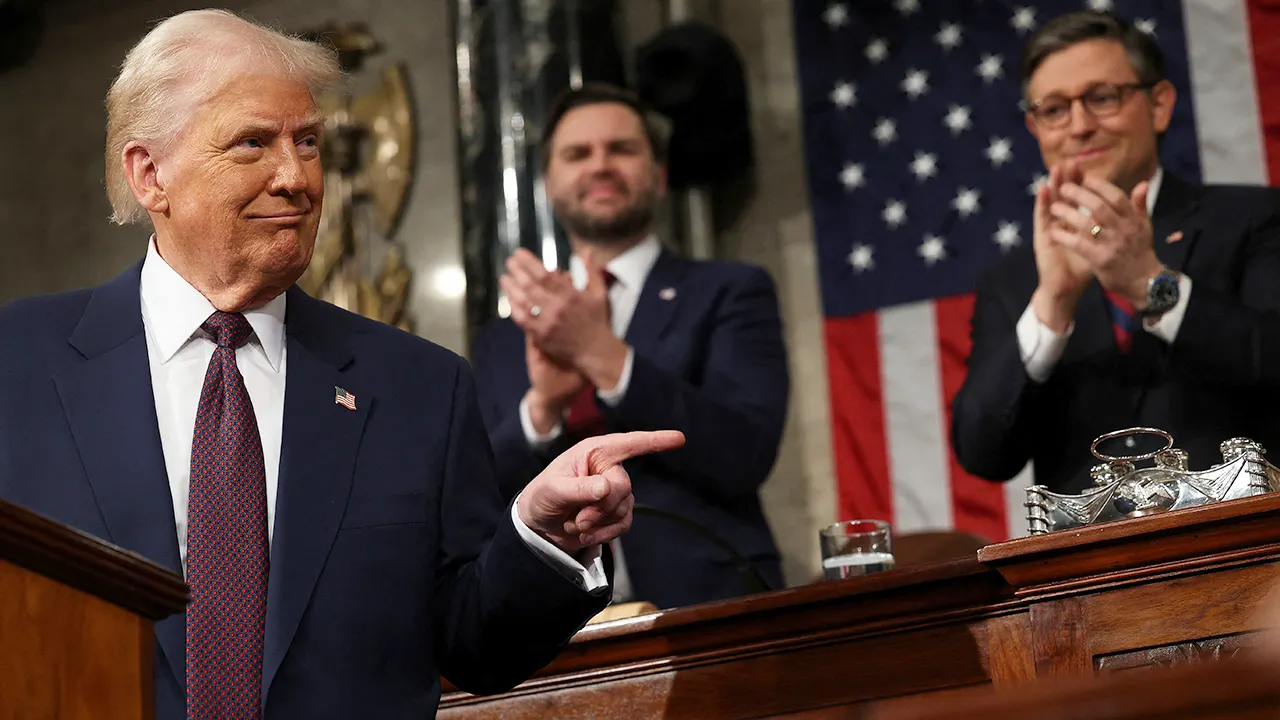
In an escalating political showdown, House Speaker Mike Johnson accused Democrats of displaying “Trump Derangement Syndrome” as they plan multiple counter-events during President Donald Trump’s first State of the Union address since returning to office.
Speaking at the House GOP leadership’s weekly press conference, Johnson criticized Democratic lawmakers for organizing five separate counter-events instead of attending the president’s address to Congress.
“This evening, the entire country will hear an update on the full scope of President Trump’s transformational and historic first year back in office. The results speak for themselves,” Johnson said. “Why does he have so much to talk about? Because inflation is down, wages are up, investment is booming. The GDP is exceeding every expectation.”
The Speaker’s comments highlight the deepening partisan divide in Washington as the administration approaches the end of its first year. Johnson characterized the Democratic response as theatrical and obstructionist rather than substantive.
“For all of these theatrics, it doesn’t matter how many little gatherings they have or where they stand or how high the volume is on the microphones, they have nothing to offer, nothing but their TDS agenda, the Trump Derangement Syndrome, and it’s on full display,” Johnson said.
One of the most prominent counter-events, dubbed the “People’s State of the Union,” is scheduled near the Lincoln Memorial. Organized by progressive groups MeidasTouch and MoveOn Civic Action, the rally aims to present critiques of Trump’s policies and governance during his return to office. Several Democratic senators, including Ed Markey of Massachusetts, Jeff Merkley of Oregon, Chris Murphy of Connecticut, Chris Van Hollen of Maryland, and Tina Smith of Minnesota, are expected to participate.
Meanwhile, another group of Democrats plans to attend the “State of the Swamp” event at the National Press Club, further splintering the opposition’s response to the presidential address.
Johnson condemned the boycotting of the State of the Union as unprecedented and inappropriate. “It’s shameful that they would boycott an address. We don’t do that. Republicans don’t do that,” he asserted. “It doesn’t matter if there’s a president from the opposing party. We don’t skip out. Our constituents want and need us to be here.”
The Speaker characterized Democratic opposition as a continuation of longstanding political tactics. “All they can say, all they can tell you about, is how they oppose President Trump and thwart his agenda and shut down the government and protest everything from the president’s joint address to basic immigration enforcement, and they obstruct any meaningful progress for the sake of obstruction,” he said. “It’s the same tired playbook that Democrats have been running for a decade now.”
The political tensions come amid a partial government shutdown affecting the Department of Homeland Security, which has now entered its second week. Negotiations over funding have been complicated by several factors, including concerns over security threats from Iran and partisan disagreements ahead of the State of the Union address.
The dueling events reflect the intensifying political polarization that has characterized American politics in recent years. While Trump’s supporters point to economic indicators as signs of success during his first year back in office, his critics remain firmly opposed to his policies and leadership style.
Tonight’s State of the Union address is viewed by political analysts as a critical test for the administration as it attempts to outline its vision and accomplishments. The president is expected to highlight economic gains, border security measures, and foreign policy initiatives, while Democrats plan to offer their alternative assessment of the nation’s current condition through their counter-programming efforts.
As the evening approaches, the competing narratives underscore the challenges of governance in an era of deep partisan division, with each side increasingly operating in separate political realities.
Fact Checker
Verify the accuracy of this article using The Disinformation Commission analysis and real-time sources.

10 Comments
The Democrats’ decision to hold counter-events during the State of the Union seems like a missed opportunity to directly engage with the president’s agenda and priorities. While they may have valid criticisms, boycotting the event entirely could further polarize the political landscape.
Interesting to see this partisan clash over the State of the Union. While I appreciate the Democrats wanting to voice their own perspectives, it’s important for all representatives to engage constructively with the president’s address. Focusing on economic progress could be a productive angle for discussion.
Agreed, there needs to be a balance between partisan messaging and substantive policy debate. Hopefully both sides can find ways to engage meaningfully, even if they have different views.
Curious to see how the Democratic counter-events will frame the economic progress highlighted by the president. While the GDP and job numbers may look good, there are often nuances that get overlooked. A balanced assessment from multiple perspectives could provide a more complete picture for the public.
I’m curious to see how the economic data and policy claims made during the State of the Union address will be scrutinized and analyzed by the Democratic counter-events. Fact-checking and providing nuanced perspectives on complex issues like inflation and GDP growth could be valuable for the public.
Agreed, a balanced and evidence-based analysis from multiple angles is important for citizens to make informed judgments. Partisan grandstanding should be set aside in favor of constructive policy discussions.
The partisan tensions around the State of the Union are concerning, but not surprising given the current political climate. I hope both sides can find ways to move past political theatrics and have a substantive, fact-based discussion about the real issues facing the country.
Well said. Productive dialogue and a willingness to consider different viewpoints is crucial, even when there are strong disagreements. Focusing on facts and solutions rather than partisan point-scoring would be a welcome change of pace.
The State of the Union is a key moment for the president to outline their agenda and vision. While the Democrats may have their own priorities, boycotting the event entirely seems like a missed opportunity for dialogue. Perhaps they could attend and ask probing questions during the Q&A portion.
That’s a fair point. Engaging directly, even if critically, is usually preferable to complete boycotts which can further entrench partisan divides. Open and honest debate is important for a healthy democracy.