


Listen to the article
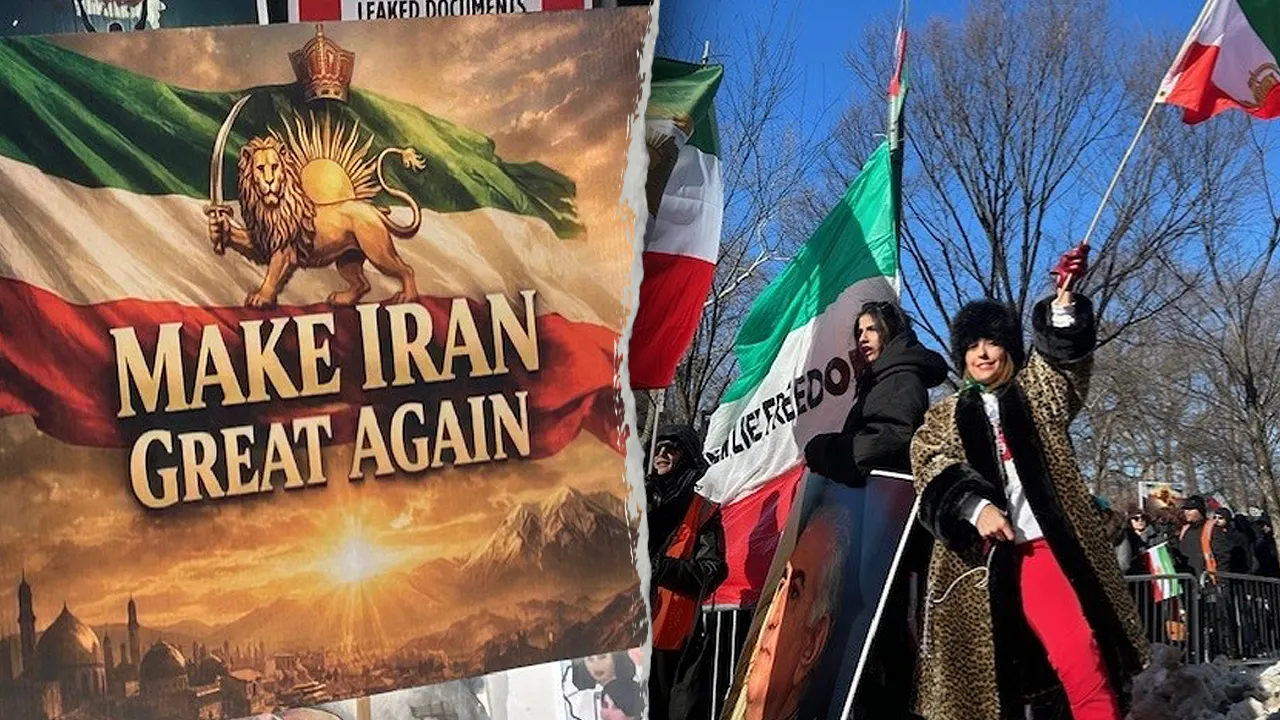
Hundreds of anti-Iranian regime protesters gathered on New York’s Fifth Avenue Saturday afternoon, calling for U.S. intervention against Tehran’s theocratic government. Demonstrators assembled across from the residence of Iran’s ambassador to the United Nations, their chants of “Trump act now!” filling the air as they demanded action against the regime.
“We want freedom for the Iranian people,” said protester Sarah Shahi. “We want this theocracy that has been taking people’s rights away to be taken out with whatever means necessary. We need help when so many people have been killed.”
The demonstration took place at a historically significant location. The ornate 19th century limestone townhouse that serves as the Iranian UN ambassador’s residence was originally purchased during the reign of Shah Mohammad Reza Pahlavi, who ruled Iran from 1941 until the 1979 revolution. Located in one of Manhattan’s most exclusive neighborhoods on the Upper East Side, the building sits diagonally across from the Metropolitan Museum of Art and near the former home of Jacqueline Kennedy Onassis.
Overnight, someone had vandalized the building’s facade, spray-painting the words “terrorists” and “killers” on its front. One protester carried a sign featuring a photograph of current Iranian UN Ambassador Amir Saeid Iravani with the caption “A terrorist lives here.”
“For the people of the Islamic republic to be residing here is just so unjust,” Shahi noted. “But it is the closest thing we have to an embassy” as a protest location. Since Iran and the United States do not maintain diplomatic relations, this building represents the only Iranian government-owned property in the country, making it a focal point for demonstrations.
The protest comes at a time of escalating tensions between the U.S. and Iran. President Trump has ordered American warships to within striking distance of Iran as his administration considers potential attacks against the regime’s nuclear program, oil facilities, and military targets. This military buildup is in response to Iran’s continued support of terrorism and its brutal suppression of domestic protests.
Human rights groups estimate that as many as 30,000 people have been killed for participating in anti-regime demonstrations within Iran. The crackdown has drawn international condemnation but has not deterred protesters either inside Iran or abroad.
Many of the New York protesters identified themselves as supporters of Crown Prince Reza Pahlavi, son of the late shah, who has become increasingly vocal against the current Iranian regime. Pahlavi has lived in exile for 47 years, since his father fled during the Iranian revolution that brought the hardline religious anti-American government of the Mullahs to power.
The passion of the New York demonstrators mirrored that of protesters inside Iran. Signs throughout the crowd carried messages including “End the regime in Iran,” “Brave Iranians are fighting on the ground. The U.S. and Israel must act against a common enemy now,” “No to the Islamic Republic regime,” and “Make Iran Great Again.”
The demonstration represents the growing frustration among Iranian expatriates and their supporters with what they perceive as insufficient international action against Tehran’s government. While the Biden administration has imposed sanctions on Iran for various human rights abuses and its nuclear program, many protesters believe more direct intervention is necessary.
The rally also underscores the complex geopolitical considerations surrounding U.S.-Iran relations, with protesters explicitly calling for military action—a step that would mark a significant escalation in an already volatile region. For these demonstrators, however, such intervention represents the only path toward freedom for the Iranian people after decades of authoritarian rule.
As one protester put it, they are waiting for President Trump to take military action against the regime so that Iran “can finally taste freedom.”
Fact Checker
Verify the accuracy of this article using The Disinformation Commission analysis and real-time sources.

8 Comments
The protesters raise valid concerns about human rights abuses in Iran. However, military intervention or regime change is unlikely to be the solution. Sustained pressure through diplomatic channels, economic measures, and support for civil society may be a more effective approach.
This protest reflects the deep divisions within Iranian society. While the desire for greater freedoms is understandable, the path forward is complex. Constructive dialogue and incremental reforms may be more effective than sudden, forced regime change.
Well said. Imposing change from the outside often backfires. The Iranian people must drive the reform process in a way that respects their unique history and culture.
The vandalism of the Iranian ambassador’s residence is concerning and counterproductive. Resorting to violence or property damage is unlikely to advance the protesters’ cause. A measured, lawful approach is more likely to bring positive change.
This protest highlights the ongoing tensions between the US and Iran. While regime change is a complex issue, the Iranian people’s desire for more rights and freedoms is understandable. Hopefully this can lead to productive dialogue and positive change.
You raise a fair point. Any changes should ultimately be driven by the Iranian people, not outside intervention. A peaceful, diplomatic solution that respects their sovereignty would be ideal.
Protesters seem to be calling for a more assertive US response to the Iranian government’s human rights abuses. However, direct military action could risk escalating tensions further. Careful diplomacy and supporting civil society may be a wiser approach.
I agree that a diplomatic solution should be the priority. Unilateral regime change often has unintended consequences. The US and international community should work to empower Iranian citizens while respecting their right to self-determination.