


Listen to the article
Congressional Spending Disputes Emerge Over ICE Funding and Foreign Policy Concerns
Progressive Democrats are calling for using the upcoming government funding deadline as leverage to defund or restrict Immigration and Customs Enforcement (ICE) following a controversial shooting in Minnesota. This push highlights growing tensions between different factions within the Democratic Party over immigration enforcement policies and military operations abroad.
The power of the purse represents one of Congress’s most fundamental constitutional authorities. Several liberal lawmakers are now urging party leadership to exercise this power by imposing restrictions on ICE in the next round of government funding. Some have even suggested they would support a government shutdown over the Minnesota incident where an ICE agent shot Renee Good.
Beyond immigration concerns, certain Democrats are also seeking to limit the administration’s military maneuvers related to Venezuela and potential operations in Cuba, Mexico, Colombia, and Greenland. Congress has yet to address funding bills for the Pentagon or State Department for fiscal year 2026.
The immediate challenge comes as funding for nine distinct sections of the federal government expires on January 30, including the Department of Homeland Security (DHS). The House may debate the DHS funding bill in the coming days, coinciding with growing calls from some Democrats to impeach Homeland Security Secretary Kristi Noem.
“We should use every means at our disposal to do it, including the appropriations process,” said Rep. Jamie Raskin (D-Md.) regarding efforts to restrict ICE operations through funding mechanisms.
This week, the House approved a “minibus” spending package covering energy and water programs, the Department of Interior, Commerce and Justice departments, and science programs. The Senate is expected to align with the House on these bills, but Congress will likely need to approve another continuing resolution (CR) to maintain government operations in other areas after January 30.
A continuing resolution would simply extend current funding levels, allowing Congress to approve the spending bills they’ve finalized while avoiding a shutdown by placing everything else under the temporary measure.
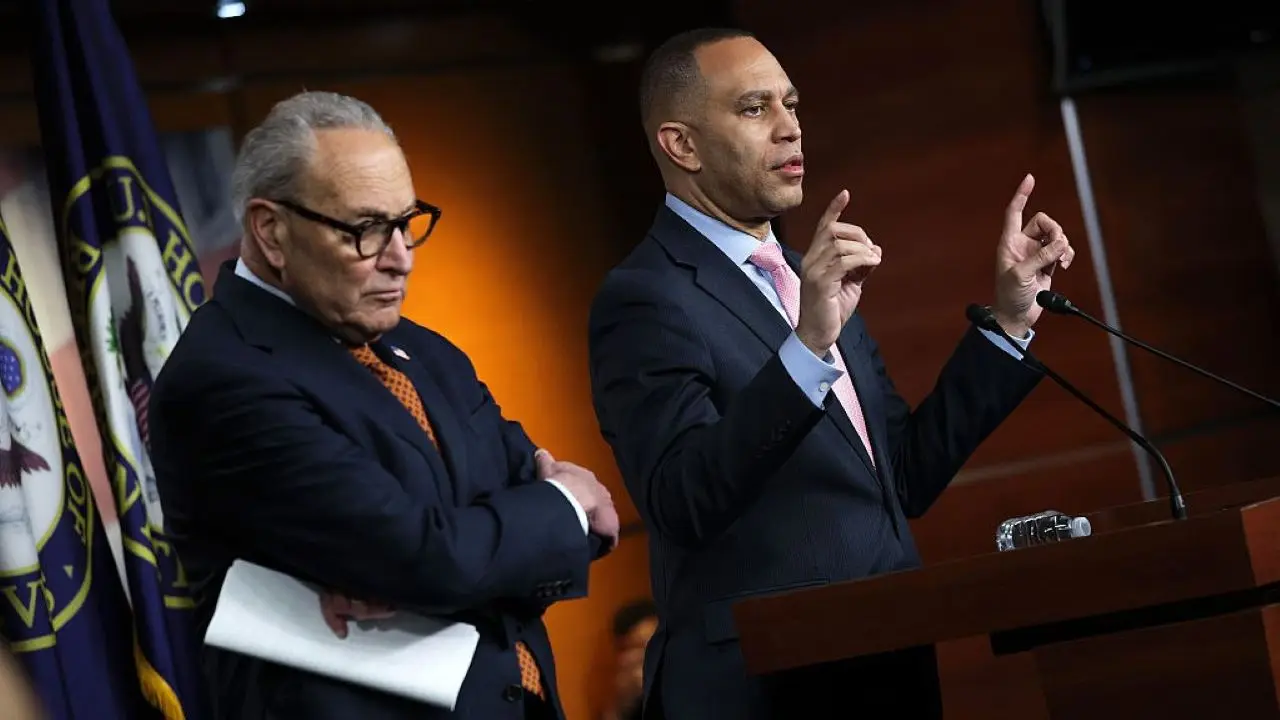
However, House and Senate Democratic leadership have decided against pushing for a shutdown during this funding cycle. When questioned about using appropriations to curtail ICE operations, House Minority Leader Hakeem Jeffries (D-N.Y.) avoided directly addressing the issue, stating: “Our focus right now, in terms of the appropriations bill, are getting the three bills that are going to be on the floor today over the finish line, and then we’ll turn to the Homeland Security.”
When pressed further about ICE and DHS funding, Jeffries responded sharply: “No, what I’m focused on right now, Chad, is to make life better for the American people.”
Senate Minority Leader Chuck Schumer (D-N.Y.) finds himself in a similar position, acknowledging: “I have lots of problems with ICE,” but sidestepping questions about using appropriations as leverage on immigration enforcement or Venezuela policy.
Even Rep. Alexandria Ocasio-Cortez (D-N.Y.), a vocal critic of current immigration enforcement policies, provided some room for Democratic leadership on this issue. “They’re responsible for leading an entire caucus that elects members from across their country. So they’re in a different position,” she said of Jeffries and Schumer.
Ocasio-Cortez noted that funding for ICE “exploded virtually overnight, and we are seeing the ramifications of it in terms of the abuse of power that is happening.” She suggested Democrats could pursue cutting ICE funding in a future appropriations cycle.
The tensions within the Democratic Party reflect broader national divisions over immigration enforcement, use of military force abroad, and congressional authority in establishing spending priorities. As the January 30 deadline approaches, lawmakers must balance these competing pressures while avoiding a potentially damaging government shutdown.
Fact Checker
Verify the accuracy of this article using The Disinformation Commission analysis and real-time sources.

8 Comments
Interesting political dynamics at play here. The push to leverage funding as a way to limit ICE and foreign policy actions signals deeper divides within the Democratic party. I’m curious to see how this plays out in the upcoming budget negotiations.
You’re right, the party seems to be pulling in different directions on these sensitive issues. It will be important to see how they balance competing priorities and interests during the funding talks.
This highlights the challenges of governing with a narrow majority. The progressives appear to be flexing their muscle, but will they be able to force concessions from party leadership? The potential for a government shutdown over these disputes is concerning.
Agreed, the threat of a shutdown is worrying. These funding battles often get very heated, and it can be hard to find common ground. We’ll have to see if cooler heads can prevail.
The use of funding as leverage to influence immigration and foreign policy is a bold move by the progressives. It speaks to the deep ideological divides within the Democratic party on these hot-button issues. I’m curious to see how this all shakes out.
The tensions within the Democratic party over immigration and foreign policy are boiling over into the budget process. This reflects the broader ideological divides that the party is struggling to manage. It will be interesting to see if they can find a way to bridge these gaps.
This is a complex issue that touches on some of the most contentious political debates of our time. The progressives are clearly looking to exert their influence, but the risk of a government shutdown is very real. It will be important to see if compromise can be found.
Absolutely, the potential for gridlock and dysfunction is quite concerning. These funding battles often devolve into partisan posturing rather than pragmatic problem-solving. I hope the leaders on both sides can find a way to reach an agreement.