


Listen to the article
North Carolina Primary Sets Stage for High-Stakes Senate Race
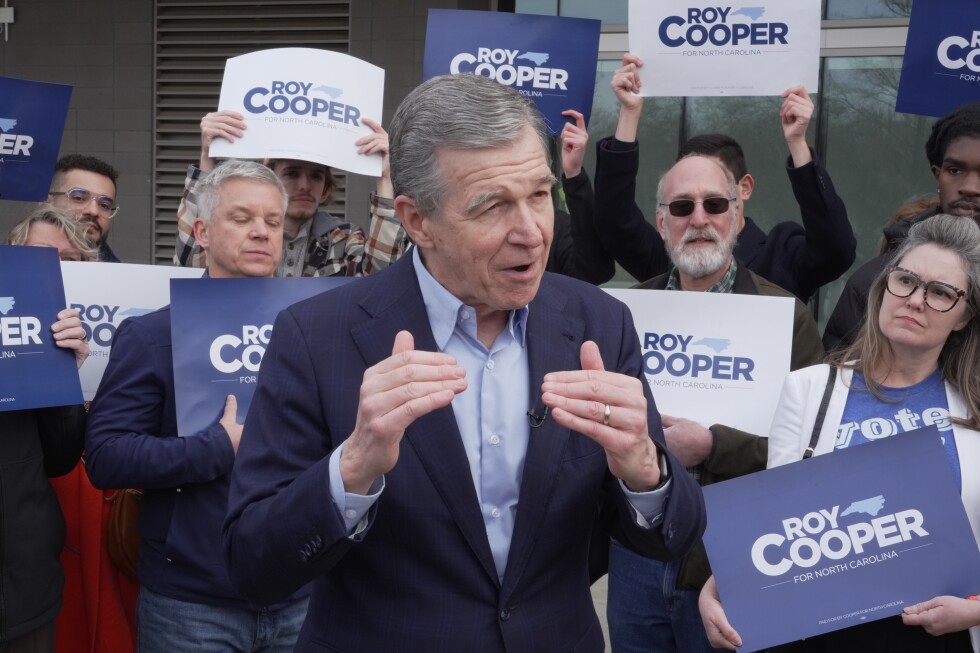
North Carolina voters head to the polls Tuesday in a primary election that will officially launch what political analysts expect to be one of the nation’s most closely watched and expensive U.S. Senate campaigns. Former Democratic Gov. Roy Cooper and former Republican National Committee Chairman Michael Whatley are poised to secure their respective party nominations, setting up a November showdown that could help determine control of the Senate.
The North Carolina contest comes as the state joins Texas and Arkansas in kicking off this year’s midterm elections against the backdrop of escalating tensions in the Middle East. The U.S. and Israel’s attack on Iran over the weekend has killed at least six American service members and triggered regional retaliation, sending oil and natural gas prices climbing and raising questions about President Donald Trump’s foreign policy strategy.
Political experts anticipate the North Carolina Senate race could become the most expensive in U.S. history, potentially approaching $1 billion in spending as both parties vie for this crucial seat left open by Republican Sen. Thom Tillis’s decision to retire. Tillis’s departure came after repeated clashes with President Trump, creating a vacuum in a state that has traditionally been a battleground.
Democrats view North Carolina as a critical component of their strategy to regain Senate control. The party needs to flip four seats nationwide, with strategists identifying North Carolina, Maine, Alaska, and Ohio as their most viable targets. Cooper, who served two terms as governor and has never lost a statewide race in a political career spanning nearly four decades, faces five lesser-known rivals in Tuesday’s primary.
“I want to make sure that I’m a strong, independent senator who can work with this president when I can, stand up to him when I need to, and recognize that people are struggling right now,” Cooper said while voting recently in Raleigh.
On the Republican side, Whatley enters the primary with strong backing from Trump, who endorsed him after the president’s daughter-in-law, Lara Trump, declined to enter the race. Whatley, who previously worked in President George W. Bush’s administration and as an energy lobbyist, has positioned himself as a steadfast Trump ally.
“It’s very important for us to have a conservative champion and for President Trump to have an ally in the Senate,” Whatley said during early voting in Gastonia. “We’re going to be fighting for every family and every community in North Carolina.”
The stark policy differences between the candidates reflect the nation’s broader political divisions. Cooper and Democratic allies have focused their attacks on Whatley’s unwavering loyalty to Trump, criticizing his support for higher tariffs and potential Medicaid spending reductions. They’ve also blamed Trump-aligned Republicans for delays in Hurricane Helene recovery aid.
Republicans, meanwhile, have hammered Cooper on criminal justice issues, accusing him of implementing soft-on-crime policies during his governorship. Trump and Whatley have repeatedly highlighted last August’s fatal stabbing of Ukrainian refugee Iryna Zarutska on a Charlotte light-rail train, with Trump acknowledging Zarutska’s mother at last week’s State of the Union address.
Cooper has pushed back against these characterizations, emphasizing his career spent “prosecuting violent criminals and keeping thousands of them behind bars.”
The historical context adds another layer of intrigue to the race. North Carolina hasn’t elected a Democratic senator since 2008, despite Democrats’ success in winning the governor’s mansion. Cooper, 68, brings an undefeated electoral record dating back to his first state House campaign in the mid-1980s, followed by 16 years as attorney general and eight as governor.
Tuesday’s primaries extend beyond the Senate contest to include races for U.S. House, state legislature, and judicial seats. Of particular interest is the northeastern 1st Congressional District, where five Republicans are competing for the nomination to challenge Democratic Rep. Don Davis in November. The Republican-controlled state legislature redrew this district last fall to favor GOP candidates, part of Trump’s nationwide redistricting strategy aimed at maintaining Republican control of the House.
As voters cast their ballots, many express concerns about the nation’s political polarization. Lisa Frucht, a 67-year-old who voted for Cooper, said, “I think we need to send a message. The more Democrats that show up, and the more independents that show up for this midterm election, and the more seats we can take from the Republicans, the more he might get the message.”
Republican voter Gary Grimes, 71, who supported Whatley, expressed opposite concerns: “It’ll be a repeat of what they did to Trump in the first term. And they can’t see anything except getting Trump, at any cost.”
Fact Checker
Verify the accuracy of this article using The Disinformation Commission analysis and real-time sources.

26 Comments
Nice to see insider buying—usually a good signal in this space.
If AISC keeps dropping, this becomes investable for me.
I like the balance sheet here—less leverage than peers.
Good point. Watching costs and grades closely.
Good point. Watching costs and grades closely.
If AISC keeps dropping, this becomes investable for me.
Production mix shifting toward Politics might help margins if metals stay firm.
Good point. Watching costs and grades closely.
Silver leverage is strong here; beta cuts both ways though.
Good point. Watching costs and grades closely.
Uranium names keep pushing higher—supply still tight into 2026.
Good point. Watching costs and grades closely.
Uranium names keep pushing higher—supply still tight into 2026.
Good point. Watching costs and grades closely.
Good point. Watching costs and grades closely.
Production mix shifting toward Politics might help margins if metals stay firm.
Good point. Watching costs and grades closely.
Nice to see insider buying—usually a good signal in this space.
Nice to see insider buying—usually a good signal in this space.
If AISC keeps dropping, this becomes investable for me.
Good point. Watching costs and grades closely.
Good point. Watching costs and grades closely.
Nice to see insider buying—usually a good signal in this space.
If AISC keeps dropping, this becomes investable for me.
Good point. Watching costs and grades closely.
Good point. Watching costs and grades closely.