


Listen to the article
More than 80,000 American service members remain missing in action from previous conflicts, but advances in technology and research methods are offering new hope. The Defense POW/MIA Accounting Agency estimates that the remains of approximately 38,000 fallen veterans could potentially be recovered, and nonprofit organization Project Recover is partnering with the agency on complex underwater recovery missions.
“This is a great American story here,” said former Navy Rear Admiral Tim Gallaudet, who serves as a Project Recover advisory council member. “Our work is to use technology, like underwater drones and scuba diving gear, to find the platforms that these members perished on, and then do the DNA analysis of detecting and recovering their remains and matching them to those that are missing.”
The organization was founded by Dr. Patrick Scannon after a transformative experience in 1993. While touring the Palau islands with his wife, Scannon discovered the wreckage of a World War II aircraft. “That 65-foot wing essentially changed my life,” Scannon later recalled in an interview.
Since then, Project Recover teams have located dozens of aircraft sites around the Palau Islands associated with nearly 100 service members who went missing in action. The recovery process is painstaking and methodical.
“The recovery is difficult. We first have to find the aircraft or ships,” Gallaudet explained. “And then we’ve got to go determine if there are any remains there, and then ID them, match them to the service members.”
The Palau islands hold significant historical importance in American military history. In 1944, U.S. officials determined these islands were crucial to their larger mission of liberating the Philippines. The battle for Peleliu, which held an airfield that could potentially be used to launch attacks during the Philippine liberation campaign, turned into one of the bloodiest conflicts of the Pacific War.
Initially expected to last just days, the battle stretched on for 74 days. Despite dropping more than 600 tons of bombs, American forces faced determined Japanese resistance from troops hiding in coral caves and mine shafts. The U.S. conducted nine major air campaigns across the Palau Islands, losing approximately 200 aircraft.
The human toll was devastating: 1,800 Americans killed in action, over 8,000 wounded or missing, and nearly all of the 10,000 Japanese defenders killed.
One of Project Recover’s success stories involves the crew of a plane shot down during pre-invasion strikes in September 1944. Lt. Jay Manown, AOM1c Anthony Di Petta, and ARM1c Wilbur Mitts were conducting bombing missions in preparation for the Peleliu invasion when their aircraft was struck by enemy fire.
“The plane was hit by enemy fire and it burst into flames,” recalled Di Petta’s niece Suzanne Nakamura.
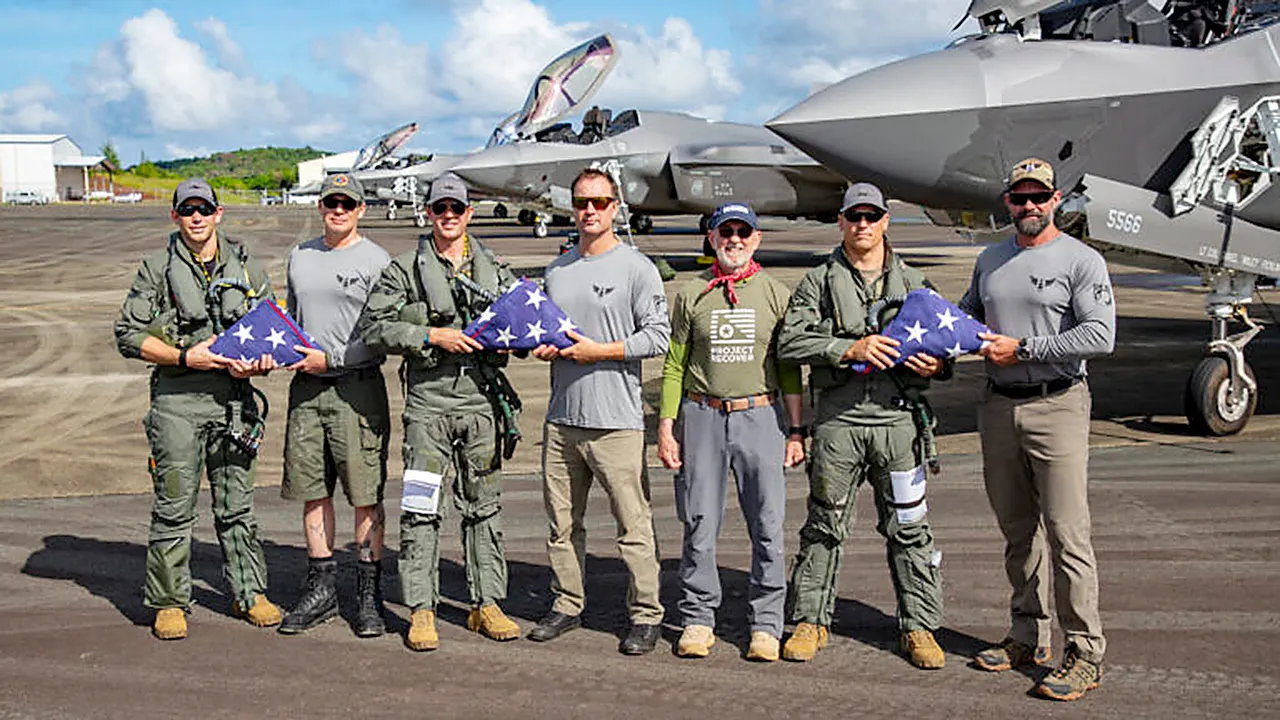
Project Recover located the plane in 2015. After more than a dozen investigative dives, teams began recovering the remains of all three service members. Lt. Manown was the last to be repatriated, with a ceremony held in his hometown in West Virginia attended by relatives of all three crew members.
The recovery process has created profound connections among the families of the fallen. The nieces of the three airmen have formed what they describe as a sisterhood through their shared experience.
“We’ve communicated beautifully and become friends through this experience and almost a sisterhood of type,” said Rebecca Sheets, Manown’s niece. Diana Ward, Mitts’ niece, added: “We’ve talked so much by phone and feel so close. This is just a joy to meet each other in person and we’re just sharing the emotion we’ve felt about bringing our uncles home.”
Since its founding, Project Recover has completed over 100 missions across 25 countries, repatriating 24 missing Americans and locating more than 200 missing service members awaiting recovery efforts.
The organization is currently fundraising for a 2026 mission to search for a B-52 aircraft that disappeared during a training accident off the Texas coast in February 1968. The bomber, carrying eight crew members, vanished from radar during a routine training mission. Despite an extensive nine-day search along the flight path, only three pieces of debris washed ashore in Corpus Christi.
This case presents unique challenges because the Defense POW/MIA Accounting Agency cannot allocate funds toward searching for the eight men since the crash occurred during a non-combat training accident.
“Not having found the wreck yet, we don’t know what the cause of the failure was. And so it’s our goal to find that wreckage and then take the remains and repatriate them to the families,” Gallaudet said. The organization has raised more than $300,000 for the mission but estimates another $200,000 is needed to complete the search.
Beyond the 80,000 service members missing from combat operations, an additional 20,000 are missing from training accidents. If Project Recover can locate the B-52 wreckage, the Defense POW/MIA Accounting Agency will then be able to allocate resources for a full recovery effort.
Fact Checker
Verify the accuracy of this article using The Disinformation Commission analysis and real-time sources.

7 Comments
I’m glad to see the Defense POW/MIA Accounting Agency partnering with nonprofits like Project Recover on these complex underwater recovery missions. Advanced tech like underwater drones can make a big difference.
Absolutely. Every recovered service member deserves a proper burial and to have their sacrifice honored. This work is so important.
Fascinating work by Project Recover to use modern technology to locate and recover the remains of missing service members. Bringing closure to families after so many years is truly admirable.
This is an inspiring example of how advances in technology can be leveraged to help bring closure and honor the memory of fallen service members. Kudos to all involved in this important work.
The story of Dr. Scannon discovering that WWII aircraft wreckage is really powerful. It’s great that it inspired him to found an organization dedicated to this critical mission.
I’m curious to learn more about the specific underwater recovery techniques and technologies that Project Recover is using. It must be incredibly challenging work.
Agreed, the use of underwater drones and scuba gear to locate and access these sites is quite impressive. I’d be interested in the operational details as well.