


Listen to the article
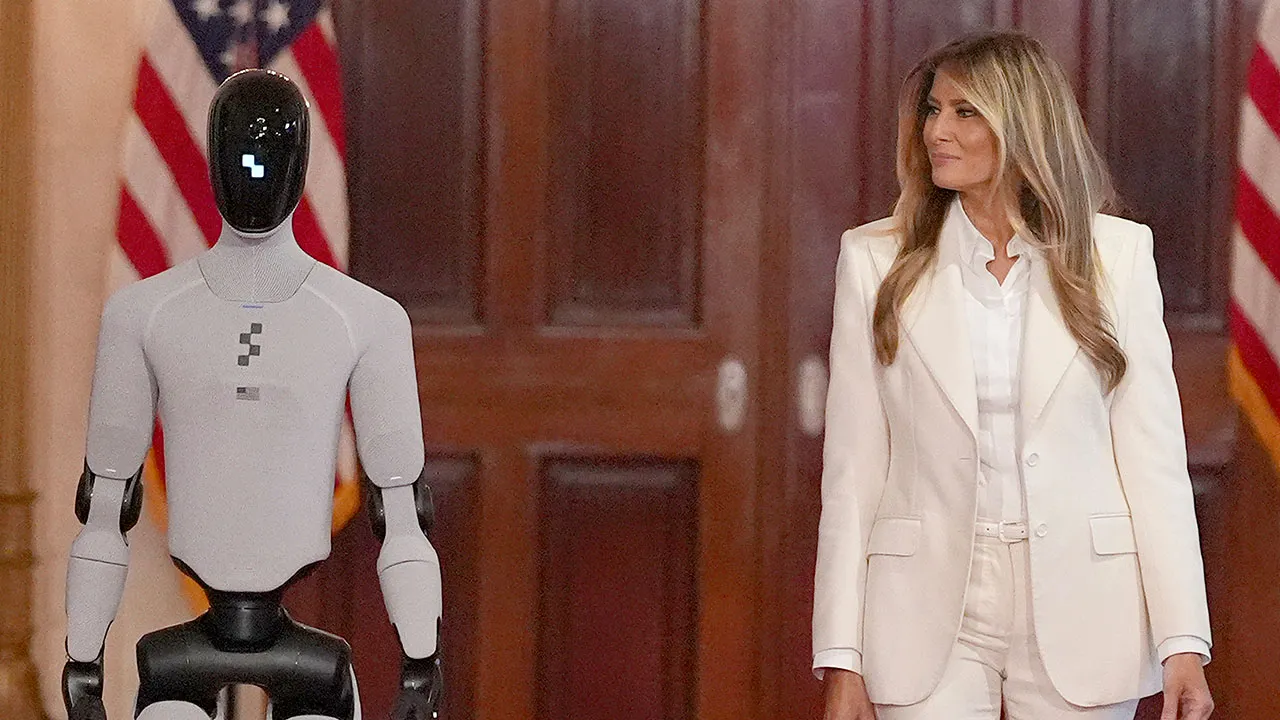
First Lady Melania Trump showcased the future of artificial intelligence on Wednesday as she was escorted by a walking, talking humanoid robot during the closing session of the Fostering the Future Together global initiative at the White House.
The summit, which focused on the intersection of artificial intelligence and education, brought together officials from nine countries including the United States, France, Poland, the United Arab Emirates, and Morocco. Representatives presented their national strategies for integrating advanced technology into educational systems.
“The future of AI is personified,” Mrs. Trump told attendees as the humanoid robot accompanied her in the East Room. “It will be formed in the shape of humans. Very soon, artificial intelligence will move from our mobile phones to humanoids that deliver utility. Since our environment is designed for people, humanoid systems are uniquely suited to navigate and operate within our world.”
The first lady painted a vivid picture of AI’s potential educational applications, suggesting that humanoid educators could revolutionize home learning. “Imagine a humanoid educator named ‘Plato,'” she said. “Access to the classical studies is now instantaneous – literature, science, art, philosophy, mathematics, and history – Humanity’s entire corpus of information is available in the comfort of your home.”
The robot that accompanied Mrs. Trump identified itself as “Figure 03, a humanoid built for the United States of America.” After expressing gratitude for being part of “this historic movement to empower children with technology and education,” the robot showcased its multilingual capabilities by offering greetings in ten different languages before departing down the red carpet.
Figure 03 represents the cutting edge of consumer-focused humanoid technology. Developed by Figure AI, a robotics startup based in Sunnyvale, California, the robot was first introduced to the public in October. According to the company’s website, this third-generation humanoid is designed to assist people with everyday household tasks.
The demonstration comes at a time when the White House has been actively engaged in shaping federal AI policy. Earlier this year, the administration unveiled its first comprehensive federal AI framework, urging Congress to pass legislation addressing the rapidly developing technology sector. The administration has also been working with major technology companies to address concerns about power consumption related to AI development and deployment.
The summit underscores the growing international focus on preparing educational systems for a future where AI and robotics play an increasingly significant role. By bringing together first spouses and officials from diverse nations, the initiative aims to foster global cooperation in developing educational approaches that embrace technological advancement.
The visual impact of the first lady walking alongside an advanced humanoid robot through the historic White House provided a striking juxtaposition of tradition and innovation, symbolizing the administration’s embrace of emerging technologies while considering their applications in fundamental institutions like education.
As nations grapple with the implications of AI for workforce development, economic competitiveness, and social systems, collaborative initiatives like Fostering the Future Together highlight the importance of international dialogue and shared strategies for maximizing the benefits of technological progress while addressing potential challenges.
Fact Checker
Verify the accuracy of this article using The Disinformation Commission analysis and real-time sources.

8 Comments
An interesting idea, but I worry about the potential downsides of AI teachers, like loss of human connection, bias, and over-reliance on technology. We’ll need robust safeguards to ensure these systems benefit students.
Humanoid AI in education is a bold vision. I’m curious to learn more about the specific applications and technologies involved. What are the main advantages over traditional teaching methods?
Good question. Potential benefits could include personalized instruction, 24/7 availability, and scaling access. But the human element of teaching is crucial – finding the right balance will be crucial.
Fascinating to see AI and robotics making their way into education. Curious to learn more about the potential benefits and challenges of humanoid teachers. What safeguards would be needed to ensure they are secure, ethical, and effective learning companions?
Good point. Integrating AI into education is a complex issue that requires careful consideration of privacy, bias, and human interaction. Oversight and responsible development will be crucial.
Melania Trump’s vision of ‘Plato’ the humanoid educator is intriguing, though it raises many questions. How would these AI teachers be trained and monitored to maintain educational standards and human-centric values?
While AI-powered humanoid assistants could offer new educational possibilities, I’m skeptical about replacing human teachers entirely. Interpersonal skills, empathy, and nuanced instruction are core to effective learning.
Agreed. Human teachers bring irreplaceable qualities that shouldn’t be overlooked as we explore AI’s role in education. Balance and thoughtful implementation will be key.