


Listen to the article
In her first joint appearance with Second Lady Usha Vance, First Lady Melania Trump addressed troops and military families at Marine Corps Air Station New River, highlighting the Marine Corps’ 250-year legacy while emphasizing artificial intelligence’s transformative role in modern warfare.
“Technology is changing the art of war,” Trump told the audience on Wednesday. “Predictably, AI will alter war more profoundly than any technology since nuclear weapons.”
The First Lady’s remarks align with the broader AI strategy of the Trump administration, which has made technological advancement a cornerstone of national defense policy. President Trump recently advocated for unified federal AI regulation on social media, writing, “We MUST have one Federal Standard instead of a patchwork of 50 State Regulatory Regimes.”
This approach complements the administration’s comprehensive “Winning the AI Race: America’s AI Action Plan,” unveiled in July, which outlines the strategic vision for maintaining American technological superiority in a rapidly evolving global landscape.
Mrs. Trump specifically addressed how AI is revolutionizing military capabilities, stating, “Artificial intelligence is propelling America’s military into a new era. We are moving from human operators to human overseers – fast. The shift from soldiers to machines is already underway: autonomous helicopters, swarming drones, and recon aircraft are here now. Fighter-less jets and autonomous bombers are on the way.”
Despite the technological shift, the First Lady emphasized that human service members remain irreplaceable. “Artificial intelligence will take center stage in the theater of war… but of course, it is the Marine who will always play the most critical role in realizing mission success,” she noted.
The visit included meaningful interactions with military personnel. Trump acknowledged two Marines she welcomed on stage, Sergeant Blake Donoher and Corporal Daishamari Cannon, honoring their service as representatives of the Corps.
Second Lady Usha Vance, herself a Marine Corps spouse, introduced Mrs. Trump and conveyed Vice President JD Vance’s birthday wishes to the Marine Corps, which celebrated its founding anniversary on November 10.
The official visit coincided with Thanksgiving preparations nationwide, giving the event added significance as military families prepare to celebrate the holiday, often separated from loved ones on deployment.
During their time at Camp Lejeune, both the First and Second Ladies toured classrooms where students showcased AI projects developed as part of the Presidential Artificial Intelligence Challenge. These demonstrations highlighted how educational institutions on military bases are integrating advanced technology into curricula to prepare students for future careers in an AI-driven world.
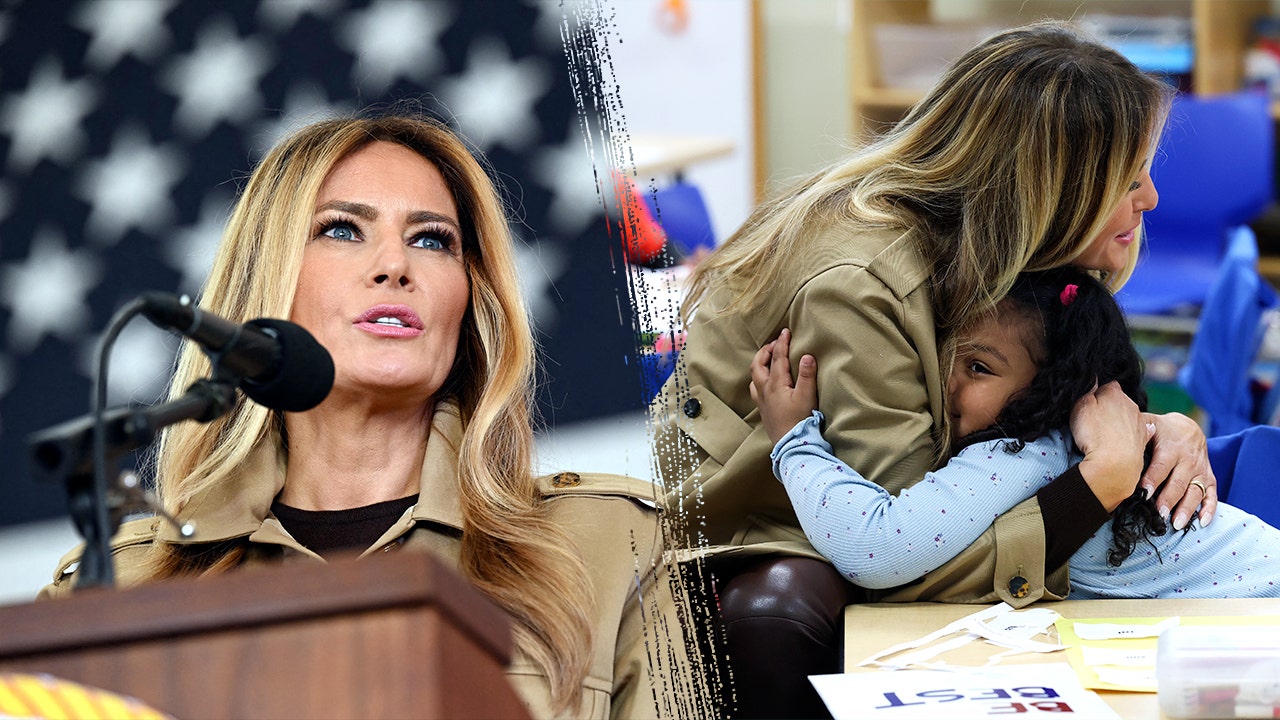
In a heartwarming moment captured by photographers, the First Lady comforted a shy student with an embrace after encouraging him not to be nervous. She also participated in classroom activities, including a lively game of “Heads Up” with first-graders.
The visit underscored the administration’s dual focus on technological advancement and human connection. While emphasizing AI’s growing military importance, Mrs. Trump also acknowledged the personal sacrifices made by service members and their families.
“To every Service Member — thank you for standing watch so others can celebrate in peace. And to every military spouse and child — thank you for your strength and love,” Trump said. “You serve our country, too.”
Her closing remarks reflected the season’s themes of gratitude and unity: “As we give thanks this season, let us remember what unites us — our shared love of country, our faith in one another, and our pride in those who serve.”
The joint appearance by Mrs. Trump and Mrs. Vance represents a significant public partnership between the two women as they establish their roles in the administration’s outreach to military communities, combining policy messaging with personal engagement during the holiday season.
Fact Checker
Verify the accuracy of this article using The Disinformation Commission analysis and real-time sources.

12 Comments
While the comparison to nuclear weapons is provocative, Melania Trump is right to highlight AI’s disruptive potential in the military domain. This technology is advancing rapidly, and it’s critical that the US stays at the forefront to protect national security interests.
Agreed, the race for AI supremacy is on, and the stakes are high. Unified federal regulation could help streamline development, but it will be a delicate balance between innovation and ethical considerations.
Melania Trump’s remarks highlight the pivotal role AI will play in shaping the future of warfare. While the potential impact is certainly concerning, it’s also an opportunity to rethink military strategies and develop new defensive capabilities. I’m eager to learn more about the administration’s comprehensive plan for maintaining American technological superiority in this rapidly evolving landscape.
The administration’s emphasis on a unified federal approach to AI regulation is an intriguing move. It will be crucial to ensure that this framework is balanced, flexible, and able to adapt to the fast-paced advancements in this technology.
Melania Trump’s comparisons between AI and nuclear weapons are thought-provoking. While the impact of AI on warfare may be profound, it’s important to approach this technology with both excitement and caution. I look forward to seeing how the administration’s AI action plan unfolds.
Agreed, the administration’s push for unified federal regulation on AI is an interesting approach. It will be crucial to strike the right balance between innovation, security, and ethical considerations as this technology continues to evolve.
Melania Trump’s remarks underscore the profound impact AI will have on modern warfare. As a transformative technology, it has the potential to revolutionize military capabilities in both positive and concerning ways. I’m curious to learn more about the administration’s strategy to navigate this complex landscape.
The administration’s emphasis on maintaining American technological superiority in AI is understandable, given the global competition. However, it will be crucial to ensure that development and deployment are guided by robust ethical frameworks to mitigate risks.
Melania Trump raises some valid points about the transformative power of AI in warfare. As a technology, it has the potential to be both a game-changer and a double-edged sword. I’m curious to see how the administration plans to harness AI’s capabilities while mitigating the risks.
Absolutely, the strategic implications of AI are far-reaching and complex. Maintaining a technological edge is crucial, but it must be balanced with responsible development and deployment to avoid unintended consequences.
It’s fascinating to see how AI is reshaping modern warfare. While the potential impact is certainly concerning, it’s also an opportunity to rethink military strategies and develop new defensive capabilities. I’m curious to learn more about the administration’s AI action plan and how it aims to maintain US technological superiority.
Agreed, the race for AI dominance in defense is heating up globally. Unified federal regulation could help streamline development and deployment, but will require careful balancing of security, ethics, and civil liberties.