


Listen to the article
The Legacy of Words: Rev. Jesse Jackson’s Most Powerful Speeches
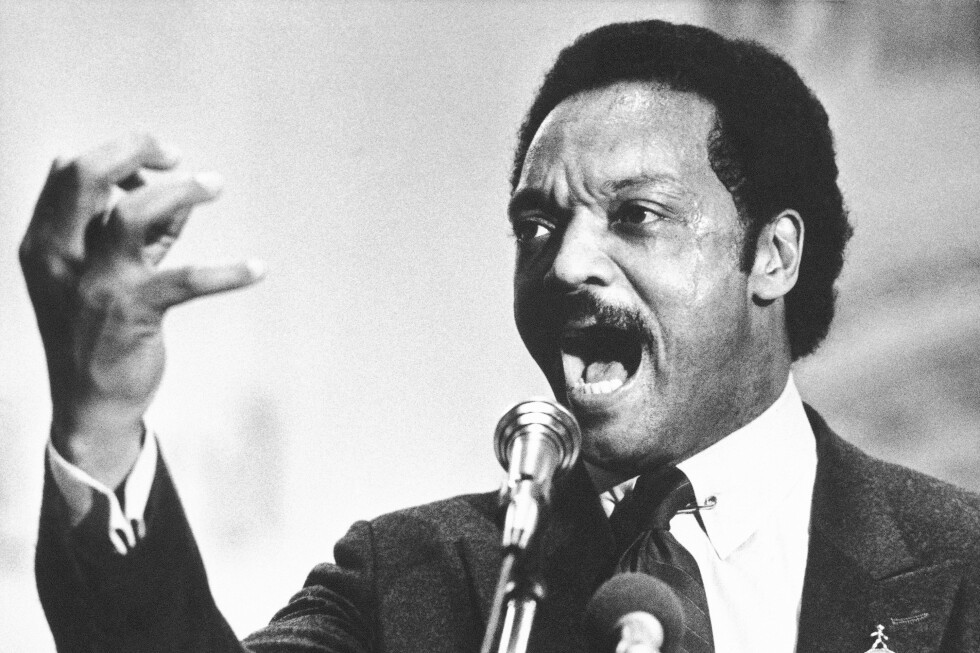
The Rev. Jesse Jackson, who died Tuesday at the age of 84, leaves behind a rich legacy of powerful oratory that helped shape civil rights discourse in America for decades. Known for his dynamic speaking style, Jackson used words as tools for change, advocating tirelessly for the poor and marginalized on issues ranging from voting rights to housing inequality.
Throughout his storied career as leader of the Rainbow/PUSH Coalition and as a two-time presidential candidate in the 1980s, Jackson delivered countless speeches that galvanized audiences and inspired action. His influence extended from the Civil Rights Movement of the 1960s through to the more recent Black Lives Matter movement, demonstrating his enduring commitment to social justice.
Jackson’s oratorical style combined rhythmic cadence with memorable phrases that often became rallying cries for the movements he led. Perhaps none was more recognizable than “I Am — Somebody,” a simple yet powerful poem that, while not written by Jackson, became synonymous with him. At rallies throughout the 1960s and even during a 1972 appearance on “Sesame Street,” Jackson would lead crowds in reciting: “I may be poor, but I am Somebody. I may be young, but I am Somebody. I may be on welfare, but I am Somebody.”
Education remained a cornerstone of Jackson’s advocacy. During a speech in Chicago in the 1970s for his PUSH Excel education initiative, he articulated the connection between education and civic engagement: “Senior high school graduation must be seen as a passage of rites into adulthood. On that graduation day or night, we must put a diploma in one hand symbolizing knowledge and wisdom, and put a voter registration card in that other hand symbolizing power and responsibility.”
Jackson was known for distilling complex ideas into accessible aphorisms that resonated with diverse audiences. “Both tears and sweat are salty, but they render a different result,” he once remarked. “Tears will get you sympathy; sweat will get you change.” This practical, action-oriented philosophy underpinned much of his work.
During his historic 1984 presidential campaign, Jackson delivered a memorable speech at the Democratic National Convention that presented a unifying vision of America’s diversity: “America is not like a blanket — one piece of unbroken cloth, the same color, the same texture, the same size. America is more like a quilt: many patches, many pieces, many colors, many sizes, all woven and held together by a common thread.”
Perhaps Jackson’s most famous rallying cry came during his 1988 presidential campaign, when he nearly captured the Democratic nomination. Addressing the party convention, he urged perseverance with the phrase that would become his signature: “Keep hope alive.” The refrain—repeated with increasing intensity—embodied his unwavering optimism in the face of struggle.
As the social landscape evolved in the 1990s, Jackson adapted his message while maintaining his core principles. Speaking to students at Kansas State University in November 1993, he addressed growing concerns about crime and social decay: “At this stage we are on the defensive as a struggle, as a humane struggle. Fear: it is pushing hope back. Cowardice is pushing courage back… When youth come alive, you have the energy, the strength, the need, and the moral authority to make America better.”
In September 2008, Jackson connected the physical and metaphorical meanings of bridges at the dedication of the Martin Luther King Jr. Bridge in Virginia. “It must lead to more futures and fewer young funerals,” he said. “A bridge that leads us from racial battleground to economic common ground. It leads us to healing.” This concept of moving from racial division to economic unity represented an evolution in civil rights strategy that Jackson championed.
Even in his later years, Jackson continued encouraging young people to think beyond present circumstances. Speaking to students at the Cambridge Union Society in England in 2013, he urged: “Keep reaching beyond your grasp, keep dreaming beyond your circumstances, keep dreaming of a new Europe. When young people move, the world changes.”
Jackson’s words, spanning more than half a century of American history, remain powerful testaments to his vision of a more equitable society. Through oratory that combined moral clarity with practical calls to action, he helped articulate the aspirations of movements for social change while inspiring generations of activists and leaders who followed in his footsteps.
Fact Checker
Verify the accuracy of this article using The Disinformation Commission analysis and real-time sources.

26 Comments
I like the balance sheet here—less leverage than peers.
Good point. Watching costs and grades closely.
Good point. Watching costs and grades closely.
I like the balance sheet here—less leverage than peers.
Good point. Watching costs and grades closely.
Exploration results look promising, but permitting will be the key risk.
Good point. Watching costs and grades closely.
Good point. Watching costs and grades closely.
If AISC keeps dropping, this becomes investable for me.
I like the balance sheet here—less leverage than peers.
Good point. Watching costs and grades closely.
Good point. Watching costs and grades closely.
Interesting update on Key quotes from the Rev. Jesse Jackson that define his politics and legacy. Curious how the grades will trend next quarter.
Good point. Watching costs and grades closely.
The cost guidance is better than expected. If they deliver, the stock could rerate.
Good point. Watching costs and grades closely.
Good point. Watching costs and grades closely.
Nice to see insider buying—usually a good signal in this space.
Uranium names keep pushing higher—supply still tight into 2026.
Silver leverage is strong here; beta cuts both ways though.
Good point. Watching costs and grades closely.
If AISC keeps dropping, this becomes investable for me.
Good point. Watching costs and grades closely.
I like the balance sheet here—less leverage than peers.
Good point. Watching costs and grades closely.
Silver leverage is strong here; beta cuts both ways though.