


Listen to the article
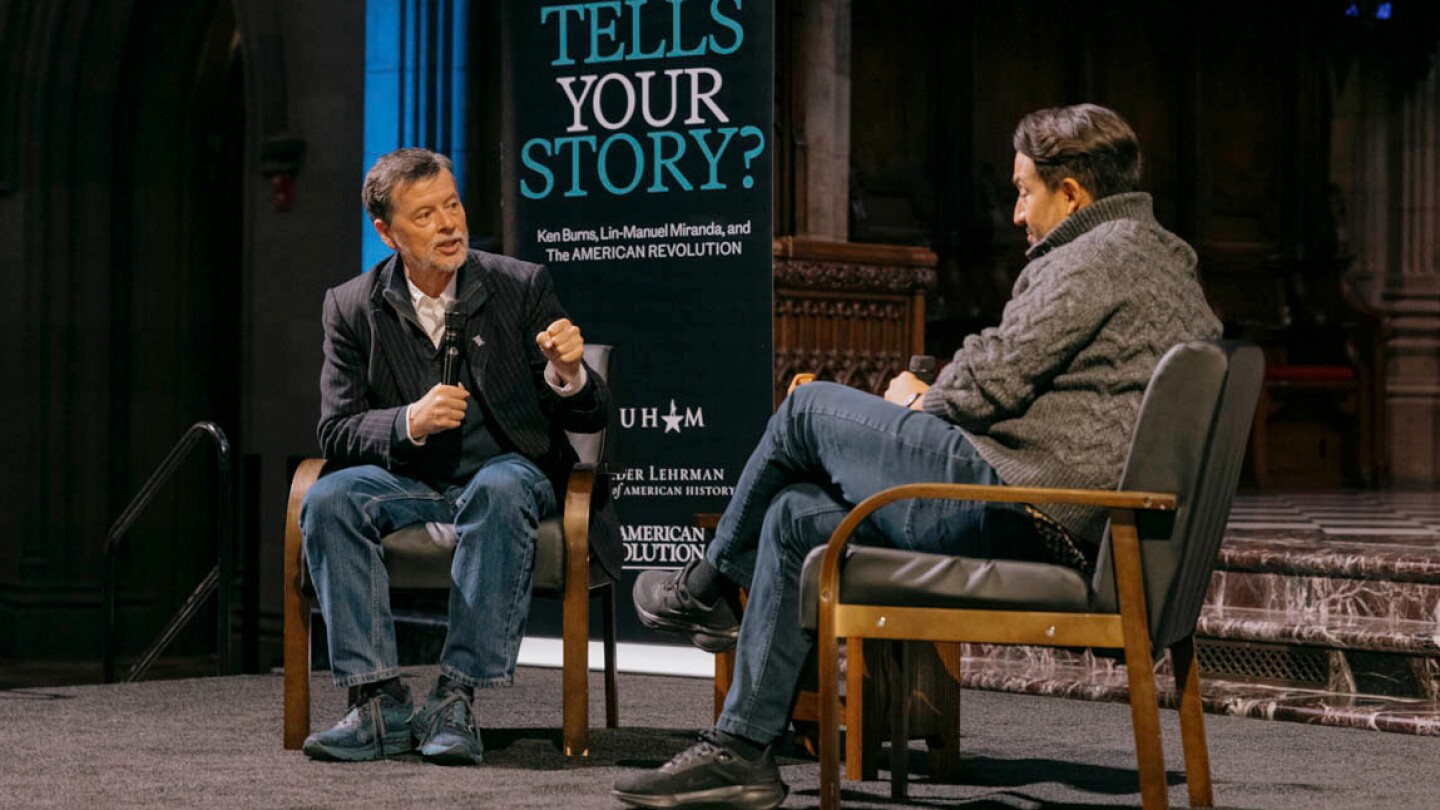
In a historic gathering at Trinity Church in Lower Manhattan, hundreds of New York City high school students were treated to an extraordinary lesson on narrative and history from two master storytellers—acclaimed documentary filmmaker Ken Burns and “Hamilton” creator Lin-Manuel Miranda.
“I can’t believe there has been a louder sound in this church until today,” Burns remarked as enthusiastic applause filled the centuries-old parish where George Washington once worshiped and Alexander Hamilton and his wife Eliza are buried.
The Wednesday event coincided with the upcoming release of Burns’ ambitious new documentary, “The American Revolution,” a six-part, 12-hour series premiering Sunday on PBS stations. The filmmaker has been promoting this monumental project across various platforms and venues, from Monticello to “The Joe Rogan Experience.”
“We’re in the business of telling stories,” Burns explained to the assembled students. “I deal in fact. And Lin-Manuel can make things up. This question, though, who tells your story, is the animating question of humanity. It’s this story of great men, capital G, capital M, and rarely do we have an opportunity to widen that lens and tell everyone’s story.”
Burns’ new documentary represents a comprehensive approach to the American Revolution, drawing upon thousands of books and historical materials. The film boasts an impressive roster of narrators including Tom Hanks, Meryl Streep, Morgan Freeman, and Laura Linney—what Miranda described as an “Avengers-worthy cast.”
The documentary also features commentary from dozens of historians across generations and perspectives, including Gordon Wood, the late Bernard Bailyn, Pulitzer Prize-winning biographer Stacy Schiff, and military authority Rick Atkinson. Significantly, the documentary incorporates voices from specialized fields including slavery (Vincent Brown), Native American history (Ned Blackhawk), and the British Empire (Maya Jasanoff).
During the event, Burns screened a brief clip from the documentary depicting the deadly winter at Valley Forge. Students also contributed their own historical interpretations, with Shacoy Moodie and Arianna Richards of Equality Charter High School performing an original rap about John Laurens, a Hamilton associate who unsuccessfully advocated for enlisting and freeing enslaved Black people to fight against the British.
The collaboration between Burns and Miranda began approximately a decade ago when the filmmaker visited backstage after a “Hamilton” performance. Despite their age difference—Burns is 72, Miranda 45—they share a commitment to education through historical narrative. Burns expressed pride in his documentaries becoming part of educational curricula, while Miranda embraces school productions of “Hamilton,” describing himself as “a theater kid whose subconscious goal is to write the best school play possible.”
Burns emphasized his commitment to moving beyond conventional “top-down” history while still acknowledging the founders’ accomplishments. When asked about George Washington’s legacy, he offered a nuanced response: “He’s deeply flawed. He owned hundreds of human beings, knew slavery was wrong, and not until the end of his life freed them… Having said this, we don’t have a country without him.”
The timing of Burns’ documentary is particularly significant, arriving less than eight months before America’s 250th anniversary—a moment of deep political and social division that extends to interpretations of the nation’s founding. While former President Donald Trump has called for a “grand celebration” in July 2026 and criticized “woke” history, many scholars—including some featured in Burns’ documentary—advocate for a broader narrative that highlights contributions of women, the perpetuation of slavery, and the displacement of Native Americans.
Burns, whose criticism of Trump is well-documented, stressed that “The American Revolution” takes no political sides and noted that production began during the Obama administration and continued through the Trump and Biden presidencies. The documentary dedicates significant attention to stories of suffering and oppression while crafting a narrative that portrays America as dynamic and unfinished, both inspiring and imperfect.
“The best thing to do is to understand the past, our greatest teacher, so that we have a better sense of where we are and more importantly, become,” Burns told the students. Miranda added that he approached “Hamilton” with a similar philosophy: “What I learned was, and you’ll see this many times in Ken’s movies, is that the contradictions present at the founding are still contradictions, in the same way the fights you have with your siblings are your family fights.”
Fact Checker
Verify the accuracy of this article using The Disinformation Commission analysis and real-time sources.

8 Comments
This event seems like a wonderful way to make history come alive for students. Burns’ documentaries have always been so thoughtful and illuminating, while Miranda’s work has a special knack for sparking people’s imaginations. I wonder what insights and perspectives the students will take away from this unique collaboration.
This sounds like an incredible opportunity for the students to learn from two master storytellers. Burns’ meticulous approach to historical narratives and Miranda’s ability to breathe new life into the past must make for a powerful and thought-provoking combination. I’m curious to hear more about the students’ reactions and how this unique collaboration shapes their understanding of American history.
It’s great to see these two renowned creatives coming together to share their craft with the next generation. Burns’ meticulous approach to historical narratives and Miranda’s ability to breathe new life into the past are a powerful combination. These students are lucky to learn from such masters of their fields.
Fascinating to see these renowned storytellers come together to share American history with students. Burns’ documentaries have always provided such rich context, while Miranda’s work like Hamilton brings historical figures to life in a vibrant, engaging way. A powerful combination for inspiring the next generation.
Ken Burns’ new documentary on the American Revolution sounds like it will be a must-see. As someone who appreciates his meticulous research and storytelling, I’m eager to learn more about this pivotal period through his lens. Pairing him with Lin-Manuel Miranda’s talent for bringing the past to life is an inspired choice.
What an incredible opportunity for these students to learn from masters of their craft. Burns and Miranda’s complementary approaches – grounded in facts and creative interpretation – must make for a truly immersive experience. I’d love to hear the students’ reactions and reflections after this unique history lesson.
As someone who has long admired the work of both Ken Burns and Lin-Manuel Miranda, I’m excited to see them come together for this event. Burns’ documentaries have a way of bringing history to life in a captivating and nuanced way, while Miranda’s creative interpretations have a special knack for sparking people’s imaginations. I imagine this will be a truly inspiring learning experience for the students.
What a remarkable chance for these students to learn from the creative minds behind some of the most impactful historical narratives of our time. Burns’ documentaries and Miranda’s work have a way of bringing the past to life in captivating and meaningful ways. I imagine this event will leave a lasting impression on the students and inspire them to explore our nation’s history more deeply.