


Listen to the article
Justice Thomas Becomes Second-Longest Serving Supreme Court Justice, Marking Era of Conservative Influence
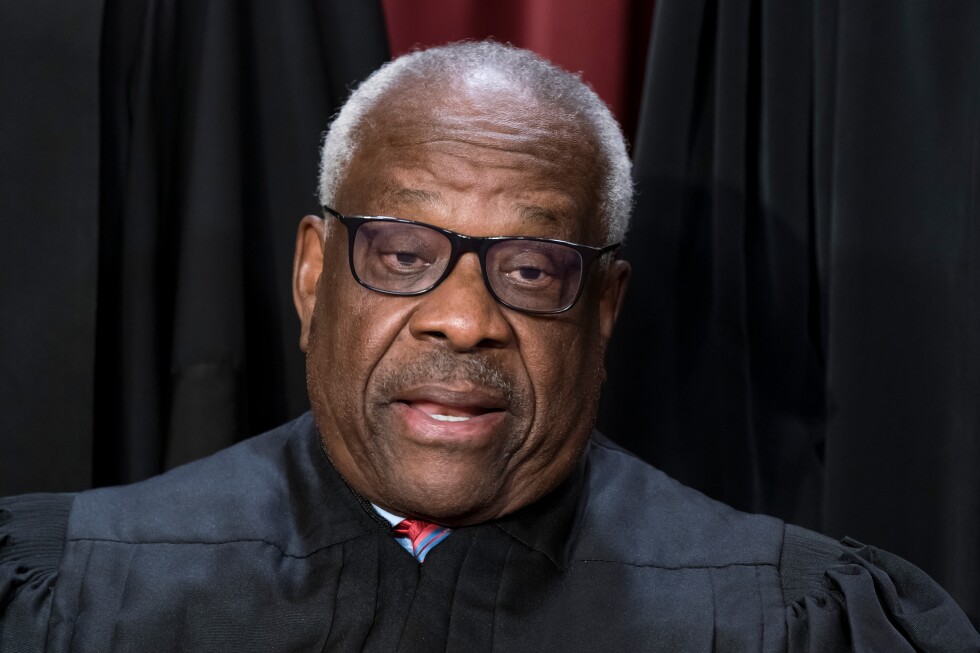
The first baby boomer on the Supreme Court reached a significant milestone Thursday as Justice Clarence Thomas became the second-longest serving justice in U.S. history, cementing his remarkable transformation from an outlier to one of the court’s most influential members.
Only liberal William O. Douglas, who served for 36 years and 7 months, has had a longer tenure. Thomas would overtake that record in 2028 if he remains on the bench—and according to close associates, he shows no signs of slowing down.
“I think he’s more energized and excited now than when I first met him,” said John Yoo, a law professor at the University of California, Berkeley, who served as a Thomas clerk three decades ago before working in the George W. Bush administration.
Thomas’s 34-year tenure has witnessed a dramatic shift in his position within the court. Once frequently writing solo dissents from the sidelines, the 77-year-old justice now finds himself at the center of a conservative supermajority that has fundamentally reshaped American law in recent years.
Following the appointment of three justices by former President Donald Trump, Thomas—as the most senior conservative member—now wields considerable behind-the-scenes influence. When Chief Justice John Roberts is not part of a conservative majority, Thomas has the power to assign who writes the court’s opinion, a procedural advantage that can shape both the scope and language of landmark decisions.
“The court has radically moved in his direction over the course of his time on the court,” said Stanford University law professor Pamela Karlan. “His seniority means he can decide who writes an opinion if he’s part of a majority that doesn’t include Chief Justice John Roberts, a factor that can nudge other votes behind closed doors.”
Thomas’s path to this position of influence was far from certain. His 1991 confirmation hearings were among the most contentious in history, featuring sexual harassment allegations from law professor Anita Hill that he vehemently denied. He was ultimately confirmed by the Senate with a narrow 52-48 vote after being nominated by President George H.W. Bush.
In recent years, the court’s rightward shift has aligned with many of the positions Thomas has advocated throughout his career. The conservative majority has overturned Roe v. Wade, eliminating the constitutional right to abortion; ended affirmative action in college admissions; and significantly curtailed the power of the Voting Rights Act—all positions Thomas had long championed.
Perhaps his most significant personal achievement came in 2022 when he wrote the majority opinion in New York State Rifle & Pistol Association v. Bruen, a landmark Second Amendment case that established a broad right to carry firearms in public.
Thomas has also evolved in his approach to oral arguments. Once known for remaining silent during questioning for years at a time, he now regularly speaks up and often asks the first questions when the justices hear cases.
His influence extends well beyond the bench. Thomas has built a vast network of former clerks who have gone on to prominent positions throughout the federal judiciary and government. Many served in the Trump administration, and an increasing number now sit as federal judges themselves.
“That is an important legacy that he will leave,” noted Sarah Konsky, director of the Supreme Court and Appellate Clinic at the University of Chicago Law School. “Even as justices’ own time on the court winds down, significant influence lives on through their clerks.”
Thomas’s tenure hasn’t been without controversy. He has faced scrutiny over undisclosed luxury trips funded by Republican megadonor Harlan Crow and questions about the political activities of his wife, Virginia “Ginni” Thomas, who supported efforts to overturn the 2020 presidential election. Thomas has maintained he wasn’t required to disclose the trips and has rejected calls to recuse himself from cases related to the election.
Despite these controversies, Thomas appears to have no intention of stepping down. In a recent speech at the University of Texas that drew a standing ovation from a conservative audience, he connected America’s founding principles to a vision of limited government while criticizing progressive policies.
“He’s incredibly consistent,” said Scott Gerber, author of “First Principles: The Jurisprudence of Clarence Thomas.” While Thomas was once known primarily for his solo dissents, “now he writes majority opinions” that shape American law and society for generations to come.
Fact Checker
Verify the accuracy of this article using The Disinformation Commission analysis and real-time sources.

9 Comments
Thomas’s long service has allowed him to become a towering figure on the Court, for better or worse. As the Court continues to shift rightward, his influence will only grow, with profound implications for the nation.
Love him or hate him, Justice Thomas has left an indelible mark on American law. His lengthy service is a reminder of the outsized role the Supreme Court plays in shaping the country’s future, for better or worse.
Well said. The Court’s growing conservative tilt under Thomas’s influence will certainly have far-reaching consequences, whether one agrees with his jurisprudence or not.
Interesting milestone for Justice Thomas. His long tenure on the Supreme Court has certainly shaped conservative jurisprudence over the past few decades. It will be fascinating to see how his influence evolves as the Court continues to shift rightward.
Justice Thomas’s record-breaking tenure is a testament to the enduring impact a single jurist can have on the nation’s highest court. While his conservative views may be controversial, his dedication and longevity are undeniable.
As the second-longest serving justice, Thomas has witnessed seismic shifts in the Court’s composition and ideology. His staunch conservatism has helped drive the rightward lurch of American jurisprudence in recent years.
That’s a fair assessment. Thomas’s longevity has allowed him to cement his influence, for better or worse. The long-term impacts of his tenure will be a topic of debate for years to come.
Justice Thomas’s historic tenure is a reminder of the power and permanence of the Supreme Court. Whether one agrees with his jurisprudence or not, his impact on American law is undeniable.
Absolutely. The Supreme Court’s outsized role in shaping society is both a strength and a weakness of the American system. Thomas’s legacy will be heavily scrutinized for decades.