


Listen to the article
In an unprecedented political battle taking place far from Washington, President Donald Trump has launched a campaign to oust Indiana state senators who defied his demand to redraw the state’s congressional map. The effort has transformed typically low-profile state primary races into a high-stakes test of Trump’s influence within the Republican Party.
The May 5 Indiana primaries have become the battleground for this unusual power struggle, with Trump endorsing seven primary challengers to incumbent state senators. National organizations like Turning Point Action and pro-Trump groups have poured more than $4.2 million into advertising against these lawmakers – an extraordinary sum for state-level races.
Spencer Deery, a first-term state senator representing Indiana’s 23rd Senate District, finds himself in Trump’s crosshairs. Four years ago, Deery’s campaign spent just $142,000 to win his seat in a race with fewer than 11,000 voters. Now he faces nearly $1 million in opposition spending and a Trump-endorsed challenger.
“This is about one thing only,” Deery told The Associated Press. “And that’s control.”
Trump’s endorsed candidate, Paula Copenhaver, is a veteran Republican activist and former local party chair whom Deery defeated in the previous primary. Trump praised her as a “MAGA Warrior” while dismissing Deery as an “incompetent and ineffective RINO incumbent” who “betrayed his voters by voting against Redistricting in Indiana.”
The controversy stems from the White House’s pressure on Indiana lawmakers last year to break with precedent and adopt a new congressional map. This was part of a nationwide redistricting effort that Trump hopes will help Republicans protect their thin U.S. House majority in November. Vice President JD Vance personally lobbied Indiana politicians in Washington and Indianapolis, and Trump himself participated in conference calls with state lawmakers.
Some opponents of the redistricting proposal faced intimidation tactics. Deery was targeted by a false police report intended to send a SWAT team to his home – a dangerous form of harassment known as “swatting.”
Despite the pressure, the Republican-controlled state Senate voted against redistricting in December, dealing Trump a significant defeat. Afterward, Trump attempted to downplay his involvement, telling reporters in the Oval Office that “I wasn’t working on it very hard.”
Governor Mike Braun and U.S. Senator Jim Banks, both Republicans, have joined Trump in working against the incumbent state senators. The campaign is also aimed at weakening Indiana Senate President Pro Tem Rodrick Bray, who helped block the redistricting effort.
According to three sources speaking on condition of anonymity, Braun wanted primary challengers to commit to opposing Bray as Senate leader. Braun is investing $500,000 from his political action committee into these state senate races.
Braun claims his support for the challengers isn’t about redistricting but rather advancing his agenda. “Whether you supported this or that, my goal is to get enterprising senators and representatives,” Braun said Monday. “For me, it’s going to mostly be based on, ‘Are you willing to help me take Indiana into places that all states would want to be?'”
Not all Republican leaders are following Trump’s lead. Former Governor Mitch Daniels, who left office in 2015, has been quietly working to protect the targeted incumbents. Daniels recorded a video and helped raise money for Deery, who previously served as his chief of staff when Daniels was president of Purdue University.
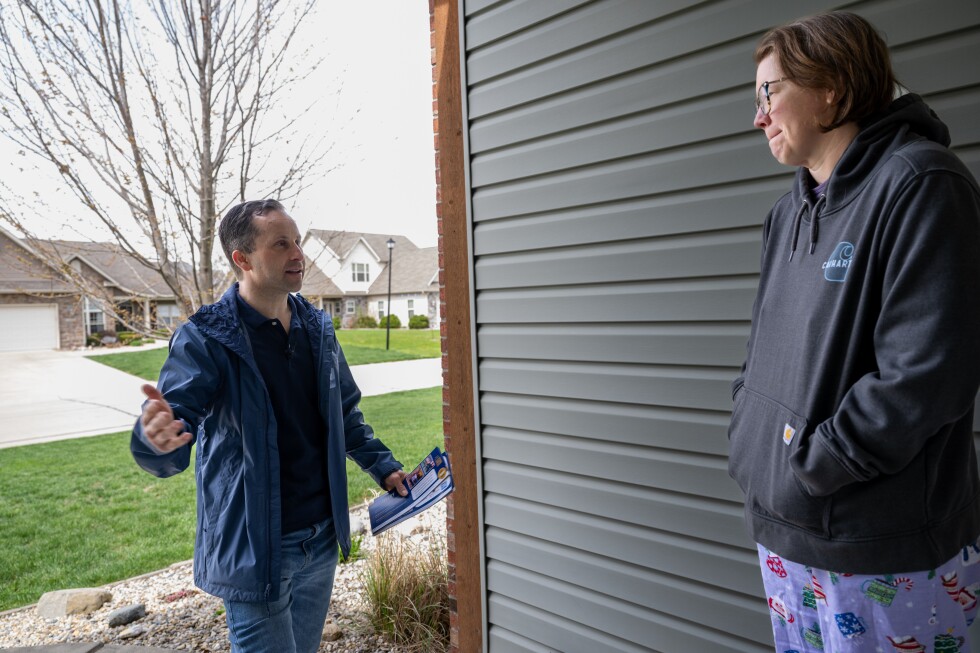
As the primary approaches, some voters appear skeptical of Trump’s intervention in local politics. Julie Wise, a 48-year-old hospital worker who describes herself as a conservative and voted for Trump previously, isn’t convinced she should vote against her state senator just because Trump demands it.
“I’m not going to say that ‘because this is what the president wants, this is how I’m going to vote,'” Wise told reporters from her front step.
Beckie Eikenberg, a 47-year-old pharmaceutical company employee who voted for Trump, questioned whether the former president should have influence over Indiana’s congressional map. “He doesn’t necessarily know what’s going on within our state. He’s not here. He doesn’t see the day to day,” she said.
For his part, Deery maintains his vote against redistricting wasn’t about defying Trump or his allies. “I don’t work for them,” Deery said. “I work for my voters, my constituents.”
The outcome of these primaries could signal whether Trump’s influence extends deep enough into state politics to punish officials who don’t fall in line with his demands – a precedent that could reshape how state-level Republicans approach their responsibilities nationwide.
Fact Checker
Verify the accuracy of this article using The Disinformation Commission analysis and real-time sources.

10 Comments
This is a fascinating case study in the power dynamics within the GOP. Trump’s willingness to aggressively challenge incumbent state senators who defied his demands suggests he’s not willing to cede any ground. It will be interesting to see if his endorsed candidates can overcome the incumbents’ name recognition and local support.
You make a good point. The incumbent state senators likely have strong local ties and support, so it will be a real test of Trump’s influence to see if he can unseat them. This is shaping up to be a closely watched primary battle.
The scale of the spending in these state-level primaries is really remarkable. Over $4 million in opposition ads against the incumbent state senators is an extraordinary amount for such local races. It shows just how high the stakes are for Trump and his allies.
Absolutely, the level of spending is staggering for these state senate races. It really underscores how important these contests are in the broader battle for control of the Republican Party.
Fascinating to see Trump’s involvement in this Indiana primary race. It really shows the extent of his influence within the Republican Party. I’m curious to see how this power struggle plays out and whether the incumbent state senators can withstand the onslaught of opposition spending.
You’re right, this is a high-stakes battle for control within the GOP. Trump is clearly flexing his muscles and it will be interesting to see if his endorsed candidates can unseat the incumbents.
This is an unusual dynamic, with a former president so actively involved in a state-level primary race. It speaks to Trump’s continued grip on the Republican base and his determination to shape the party in his image. I’ll be watching the results closely.
Agreed, it’s an unusual move for Trump to be so deeply involved in a state-level race. But given his continued influence, it’s not surprising that he’s trying to exert his control over the party’s direction.
It’s remarkable to see a former president so directly involved in a state-level primary race. Trump’s efforts to oust the incumbent state senators who defied his demands show how determined he is to maintain control over the Republican Party. This will be an important test of his continued influence.
Absolutely, this is a high-stakes power struggle that could have far-reaching implications for the GOP. Trump is clearly not willing to cede any ground, even at the state level, as he tries to shape the party in his image.