


Listen to the article
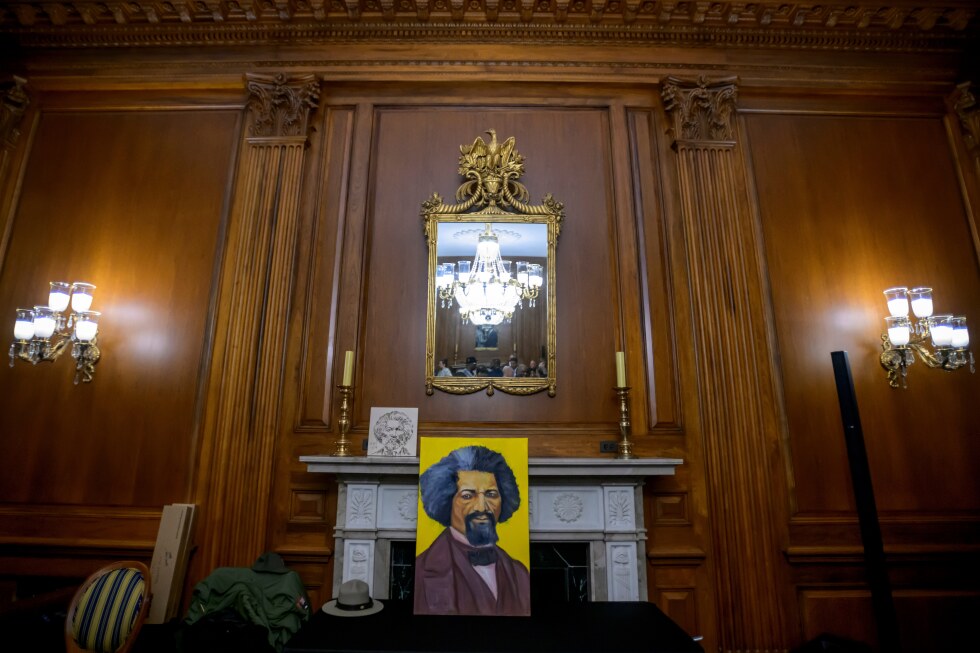
In a significant bipartisan gesture amid Washington’s political divisions, the press gallery overlooking the U.S. House chamber has been renamed to honor Frederick Douglass, the renowned abolitionist, writer and presidential adviser.
The initiative, led by Rep. Byron Donalds, R-Fla., emerged from discussions with his staff about meaningful ways to commemorate prominent Americans, particularly Black Americans, throughout the Capitol. The dedication comes during Black History Month and coincides with the centennial of the earliest national observance of Black history.
“When we talk about Frederick Douglass, we are talking about a man who possessed a profound and unshakable faith in Americans, in America’s family,” Donalds remarked during the dedication ceremony.
House Speaker Mike Johnson underscored the significance of the recognition, stating, “It’s an important thing for us to give honor where honor is due. That’s a biblical admonition. Frederick Douglass is certainly deserving of that honor.”
The commemoration holds particular historical resonance as Douglass himself documented congressional proceedings from the chamber during the Civil War. His powerful speeches and correspondence with President Abraham Lincoln and Republican lawmakers played a crucial role in building support for the abolition of slavery.
The ceremony drew a diverse assembly of prominent Black conservatives, lawmakers, activists, and faith leaders. The Library of Congress contributed to the occasion by displaying artifacts from Douglass’ life.
Rep. Burgess Owens, a Utah Republican who is Black, emphasized the importance of highlighting American success stories. “This is what we did when I was growing up. We knew about our Black heroes,” Owens said. “When we stop telling the good, then people start thinking that we’re not the country that is the promise that we gave.”
The bipartisan effort found common ground at a time when discussions about race, history, and democracy have become increasingly contentious in America. Last year, President Donald Trump signed executive orders targeting the teaching of history in the Smithsonian Institution and U.S. K-12 schools, claiming they had fallen under “the influence of a divisive, race-centered ideology.”
Critics have argued that such policies, along with the removal of certain public displays related to race and efforts to curtail diversity programs, risk whitewashing American history. Supporters, however, contend these measures correct what they see as an overly critical narrative about America’s past.
Rep. Steve Horsford, a Nevada Democrat who collaborated with Donalds on the gallery renaming, highlighted the value of cross-aisle cooperation. “I wouldn’t be here if it were not for the desire to want to work across the aisle, to not just recognize our history and culture, but to solve our problems that people face today,” Horsford said.
Born into slavery in Maryland, Douglass escaped to New York as a young man. He taught himself to read and write, becoming one of America’s most influential abolitionists. After emancipation, he purchased an estate in Washington’s Anacostia neighborhood, now preserved as a national park.
Throughout his life, Douglass delivered numerous influential speeches that resonated deeply across America. His 1852 oration “What to the Slave Is the Fourth of July?” powerfully critiqued the contradiction between the nation’s founding principles and its embrace of slavery.
In an 1867 essay, Douglass advocated for Black men’s voting rights and pushed for more aggressive Reconstruction efforts in the South. “What, then, is the work before Congress? It is to save the people of the South from themselves,” he wrote, calling for the enfranchisement of formerly enslaved people to help build “a common liberty and a common civilization.”
Douglass, who did not know his actual birth date, chose to celebrate his birthday on Valentine’s Day because his mother called him her “little Valentine” before they were forcibly separated during his childhood.
Donalds praised Douglass for his capacity to “love this country enough to tell the truth about it,” describing his journey “from the slavery fields to the world stage” as “one of the greatest narratives of perseverance in U.S. history.”
The newly installed plaque at the press gallery entrance now stands as a permanent tribute to Douglass’s enduring legacy in American history and the ongoing pursuit of equality.
Fact Checker
Verify the accuracy of this article using The Disinformation Commission analysis and real-time sources.

8 Comments
The timing of this dedication during Black History Month and the centennial of the earliest national observance makes it all the more meaningful. Kudos to Congress for this thoughtful gesture.
The fact that Douglass himself documented congressional proceedings from this chamber during the Civil War makes this renaming even more poignant. It’s a fitting way to honor his legacy.
This is a great bipartisan gesture to honor Frederick Douglass’ legacy and contributions to American history. It’s meaningful to recognize prominent Black leaders like him in the halls of Congress.
I’m glad to see Congress coming together on this initiative to commemorate Douglass during Black History Month. Renaming the press gallery is an appropriate tribute to his work as a renowned writer and presidential adviser.
Absolutely. It’s important to celebrate the achievements of influential Black Americans like Douglass, especially in prominent government spaces.
Interesting that the initiative was led by a Republican, Rep. Byron Donalds. It’s good to see lawmakers from both parties come together to celebrate an important civil rights figure like Douglass.
Yes, that’s a positive sign. Recognizing Black history should be a nonpartisan issue, and this renaming shows Congress can still find common ground on some matters.
While the political divisions in Washington can be stark, this bipartisan recognition of Black history is a welcome display of unity. Kudos to the representatives who made this happen.