


Listen to the article
In a heated political exchange, House Majority Leader Hakeem Jeffries has denounced Republicans’ proposed election security legislation as a form of voter suppression, setting the stage for another partisan battle over voting rights.
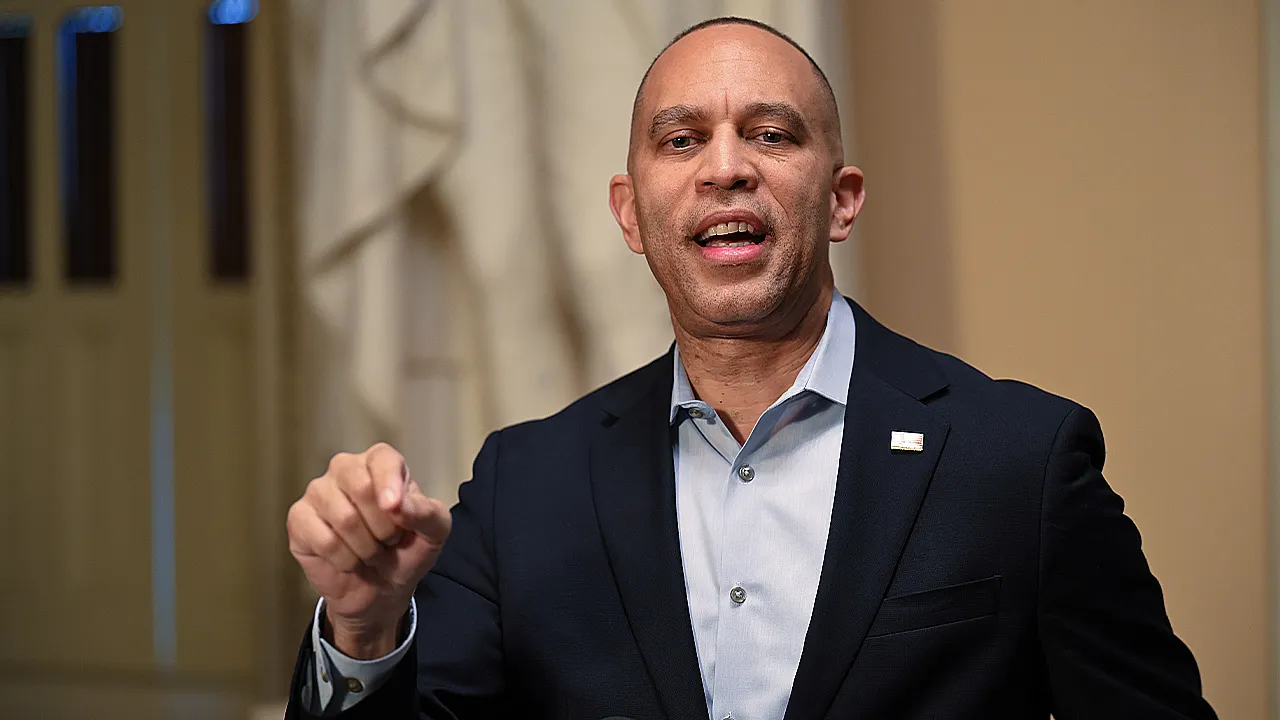
Speaking during his weekly press conference on Monday, Jeffries took aim at the GOP-led SAVE America Act, which is expected to come up for a vote as early as Wednesday. “Republicans have adopted voter suppression as an electoral strategy. That’s what the so-called SAVE Act is all about,” the New York Democrat stated.
According to Jeffries, this latest version of the bill is “worse than” its predecessor, the Safeguarding American Voter Eligibility (SAVE) Act, which passed the House in April 2025 with unanimous Republican support and backing from four Democrats.
The new legislation, spearheaded by Rep. Chip Roy (R-Texas) and Sen. Mike Lee (R-Utah), builds upon the original SAVE Act’s requirement for proof of citizenship during voter registration by adding a federal voter ID mandate. This provision would require voters to present identification when casting ballots in national elections.
Jeffries expressed particular concern about a provision that would facilitate information-sharing between state election officials and federal authorities to verify citizenship on current voter rolls. He characterized this as giving the Department of Homeland Security unprecedented access to voting records nationwide.
“This version, as I understand it, will actually give DHS the power to get voting records from states across the country. Why would these extremists think that’s a good idea?” Jeffries questioned. He further criticized the potential involvement of Immigration and Customs Enforcement (ICE), saying, “Who’d want DHS and ICE, who have been brutally, viciously and violently targeting everyday Americans, to have more data about the American people?”
Republican lawmakers have justified the legislation by pointing to concerns about non-citizen voting, particularly in light of increased immigration under the Biden administration. However, there is no validated evidence to date that non-citizen voting has influenced the outcome of any federal election.
Despite the partisan divide on Capitol Hill, voter ID requirements have consistently shown strong public support. A Pew Research Center poll from August 2025 revealed that 83% of Americans favor government-issued photo ID requirements for voting, with only 16% opposing such measures.
The legislative battle highlights a fundamental disagreement between the parties on election security. Republicans frame their proposals as necessary safeguards against potential fraud, while Democrats view them as barriers to participation in the democratic process, particularly for marginalized communities.
Jeffries predicted that even if the bill passes the House, it would face insurmountable obstacles in the Senate, where current rules require at least some Democratic support to overcome a filibuster. “It’s not going to pass. If it squeaks by the House, it’s dead on arrival in the Senate. They’re wasting time,” he stated.
This legislative impasse has prompted some House conservatives to push Senate Majority Leader John Thune (R-S.D.) to eliminate the 60-vote threshold needed to overcome a filibuster. So far, Thune has not committed to changing the Senate’s procedural rules.
The debate over the SAVE America Act represents the latest chapter in America’s ongoing struggle to balance election security concerns with voting access. As the vote approaches, both sides appear entrenched in their positions, reflecting the deep polarization that continues to characterize American politics, particularly on issues related to voting rights and election administration.
Fact Checker
Verify the accuracy of this article using The Disinformation Commission analysis and real-time sources.

8 Comments
While election security is vital, policies that create barriers to voting raise serious concerns about voter suppression. I hope lawmakers can find a middle ground that upholds democratic principles without disproportionately disenfranchising certain groups.
Absolutely, this issue requires carefully weighing multiple priorities and perspectives. An inclusive, evidence-based approach is essential to upholding the integrity of our elections.
Voter ID laws are a complex topic with merits and drawbacks on both sides. I’d encourage looking at objective data and analyses to better understand the potential impacts, both positive and negative. Finding the right balance is key.
Allegations of voter suppression are troubling, regardless of party affiliation. Protecting the right to vote while ensuring election integrity is a delicate balance. I hope our representatives can find a bipartisan solution that works for all citizens.
It’s concerning to hear allegations of voter suppression, regardless of political affiliation. Ensuring fair and accessible elections is fundamental to a healthy democracy. I hope both sides can find common ground and work together on this important issue.
Agreed, this is a critical issue that deserves nuanced, good-faith debate. Partisan grandstanding won’t help – we need pragmatic solutions that protect the integrity of our elections.
Voter ID laws are a complex issue with valid concerns on both sides. While election integrity is important, we should ensure policies don’t disproportionately disenfranchise vulnerable communities. A balanced, bipartisan approach that protects voting rights is crucial.
I agree, this is a sensitive and divisive topic. Reasonable people can disagree, but the goal should be to uphold democratic principles while addressing legitimate security concerns.