


Listen to the article
New Mexico’s Historic Women Markers Program Expands to Classrooms
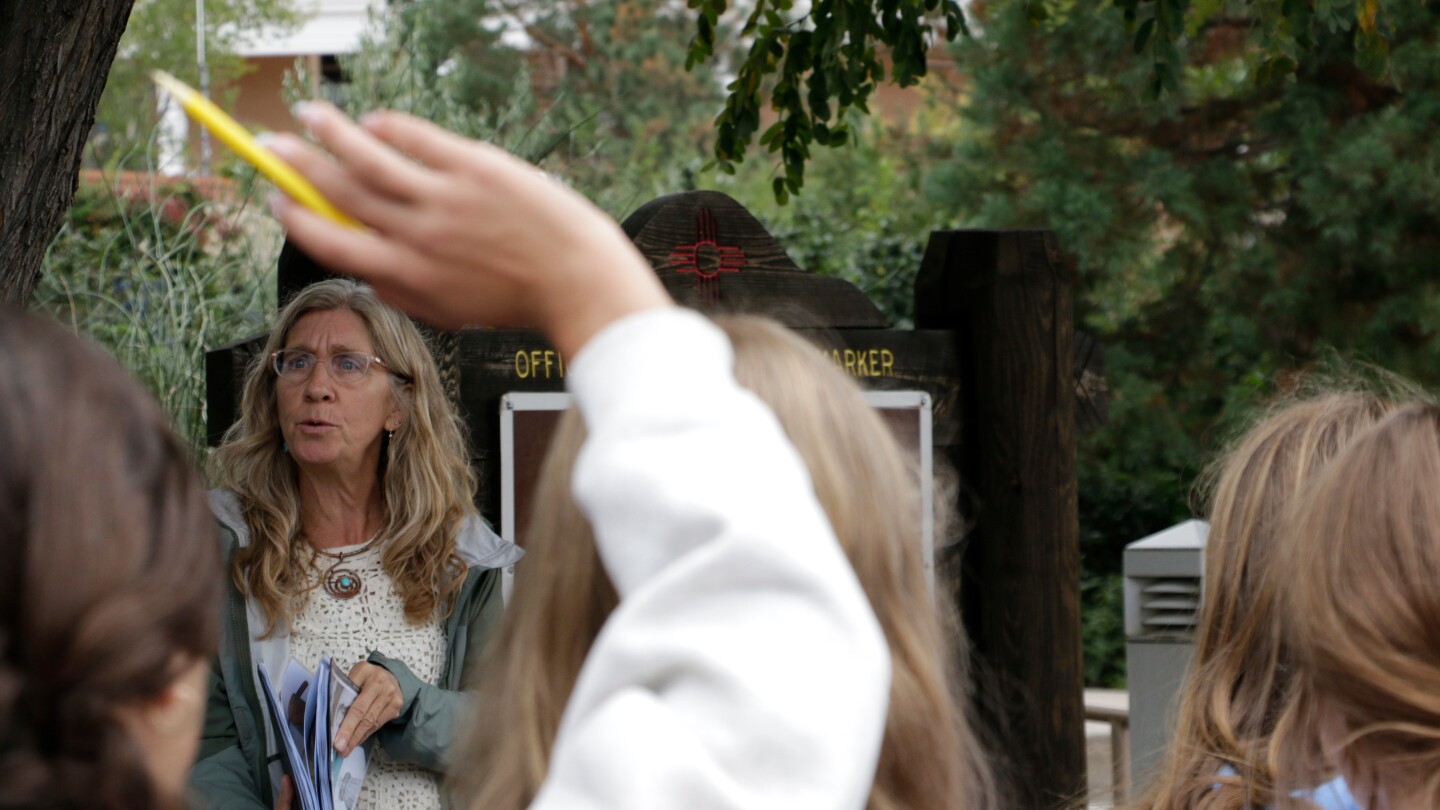
On a recent field trip through Santa Fe, seventh grader Raffi Paglayan discovered a new hero in Katherine Stinson Otero, one of America’s first female pilots who later became a prominent architect in New Mexico. Paglayan’s enthusiasm reflects the success of a longstanding initiative that has placed nearly 100 roadside historical markers across the state celebrating women’s contributions to New Mexico’s rich history.
“She seems pretty cool,” Paglayan remarked with a smile after learning about Stinson Otero, who began as a skywriter and pilot before contracting tuberculosis while serving as an ambulance driver during World War I. After moving to New Mexico for her health, she established a second successful career as an architect.
This encounter is exactly what the New Mexico Historic Women Marker Program has been working toward for decades. Now, the initiative is expanding beyond highways and into classrooms with a comprehensive curriculum based on its extensive research.
“It’s just so essential that all students, not just female students, but every student has the ability to recognize and see the significance of the people that have done so much work to create what we have,” explained Lisa Nordstrum, education director and middle school teacher who organized Paglayan’s field trip.
The program’s origins trace back to the 1980s when Pat French, a founding member of the International Women’s Forum – New Mexico, noticed a glaring absence of women on the state’s historical roadside markers. In 2006, her group secured state funding to collaborate with the New Mexico Department of Transportation to address this imbalance.
The research team methodically visited counties and Native American communities across New Mexico, collecting stories about influential women throughout the region’s history. Their work spans from precolonial times through Spanish and Mexican territorial periods and into statehood, creating a comprehensive historical narrative that had previously gone untold.
Today, these women’s stories appear on six-foot roadside signs throughout New Mexico and in an online database accessible to all. While some markers honor widely recognized figures like modernist painter Georgia O’Keeffe and New Mexico’s first female Secretary of State Soledad Chávez de Chacón, many highlight local women whose significant contributions had been overlooked.
“There is just a sense of justice about it,” said program director Kris Pettersen. “These women put all this effort in and made all these contributions, and they were unrecognized, and that’s just wrong.”
One such example commemorates Evelyn Vigil and Juanita Toledo, who revived the lost Pecos Pueblo pottery techniques in the 1970s. This traditional art form had disappeared when the indigenous Pecos Pueblo population was devastated by disease and conflict by the 1890s.
Other markers honor collective groups, such as healers and female military veterans. The program acknowledges that New Mexico’s complex history includes the conflicts of colonization and territorial disputes, noting that indigenous women had been defending their homes and societies for centuries before European settlement.
With nearly 100 markers now established, the program has temporarily paused creating new ones to maintain the existing markers and focus on educational initiatives.
About a decade ago, Nordstrum recognized the same issue in education that French had identified on roadside markers – women were largely absent from standard state history curricula. After discovering the marker program’s online biographies, she began incorporating these stories into her seventh-grade teaching.
In 2022, the program secured state funding to hire Nordstrum to develop a comprehensive K-12 curriculum based on these women’s biographies. “We have women that wouldn’t be in any textbook,” Nordstrum noted, highlighting the unique value of the program’s research.
The funding was renewed in 2024 with bipartisan support. Republican state Rep. Gail Armstrong, one of the legislation’s co-sponsors, emphasized the importance of historical accuracy and completeness for all New Mexico residents.
“History, good or bad, should not be changed. It needs to be remembered so that we don’t make the same mistakes again and so that we can celebrate the good things that have happened,” Armstrong stated.
By bringing these previously overlooked stories from roadside markers into classrooms, the program aims to provide a more complete picture of New Mexico’s history, ensuring that the contributions of women from all backgrounds are recognized and remembered by future generations.
Fact Checker
Verify the accuracy of this article using The Disinformation Commission analysis and real-time sources.

18 Comments
The cost guidance is better than expected. If they deliver, the stock could rerate.
Good point. Watching costs and grades closely.
Good point. Watching costs and grades closely.
If AISC keeps dropping, this becomes investable for me.
Good point. Watching costs and grades closely.
Nice to see insider buying—usually a good signal in this space.
Good point. Watching costs and grades closely.
Good point. Watching costs and grades closely.
Interesting update on From roadways to classrooms, this New Mexico program is bringing women’s history out of the shadows. Curious how the grades will trend next quarter.
Good point. Watching costs and grades closely.
Silver leverage is strong here; beta cuts both ways though.
I like the balance sheet here—less leverage than peers.
Interesting update on From roadways to classrooms, this New Mexico program is bringing women’s history out of the shadows. Curious how the grades will trend next quarter.
Interesting update on From roadways to classrooms, this New Mexico program is bringing women’s history out of the shadows. Curious how the grades will trend next quarter.
Good point. Watching costs and grades closely.
Nice to see insider buying—usually a good signal in this space.
Good point. Watching costs and grades closely.
Good point. Watching costs and grades closely.