


Listen to the article
Former U.S. Representative Lee Hamilton, a respected voice in American foreign policy and champion of bipartisanship, died peacefully Tuesday at his Bloomington, Indiana home. He was 94.
The moderate Indiana Democrat, who served for three decades in Congress, earned widespread respect from both sides of the political aisle for his measured approach to complex national security and foreign policy challenges. Throughout his extensive career, Hamilton played pivotal roles in some of the nation’s most significant investigations, including the Sept. 11 attacks and the Iran-Contra affair.
“Indiana mourns the passing of Lee Hamilton, a man whose life embodied integrity, civility, and public service,” Indiana Republican Governor Mike Braun said in a statement Wednesday, reflecting the bipartisan respect Hamilton commanded.
Hamilton’s political journey began in 1964 when, as a 33-year-old small-town lawyer known locally for his high school basketball prowess, he first won election to represent southern Indiana in Congress. Over the next three decades, he rose to become chairman of both the House Foreign Affairs and Intelligence committees, establishing himself as a Democratic leader on international relations.
His reputation for fairness and moderate positions made him a natural choice for leading investigations into controversial matters. In the mid-1980s, Hamilton gained national prominence as co-chairman of the congressional Iran-Contra committee, which investigated the Reagan administration’s diversion of profits from Iran arms sales to aid Nicaragua’s Contra rebels. The committee’s report concluded that President Reagan had created an atmosphere where subordinates felt emboldened to circumvent the law.
“There was too much secrecy and deception,” Hamilton remarked at the time. “Information was withheld from the Congress, other officials, friends and allies and the American people.”
Perhaps his most visible public service came after the September 11, 2001 attacks, when he was appointed vice chairman of the 9/11 Commission. Working alongside Republican chairman Thomas Kean, Hamilton helped navigate a 20-month investigation into the attacks that killed nearly 3,000 people. The commission’s findings revealed significant intelligence failures spanning both the Clinton and Bush administrations.
“The fact of the matter is, we just didn’t get it in this country,” Hamilton said when the commission released its report in 2004. “We could not comprehend that people wanted to kill us; they wanted to hijack airplanes and fly them into big buildings.”
Earlier in his career, Hamilton stood at the forefront of congressional opposition to the 1991 Persian Gulf War under President George H.W. Bush, advocating for continued economic sanctions against Iraq rather than military action following its invasion of Kuwait.
After choosing not to seek reelection in 1998, Hamilton continued to shape American foreign policy discourse. He emphasized that America needed to be regarded globally as more than just a military power.
“The United States must be — and must be seen as — an optimistic and benign power,” Hamilton said in 2003. “We must speak and act as a source of optimism, a beacon of freedom, a benign power forging a consensus approach toward a world of peace and growth and freedom.”
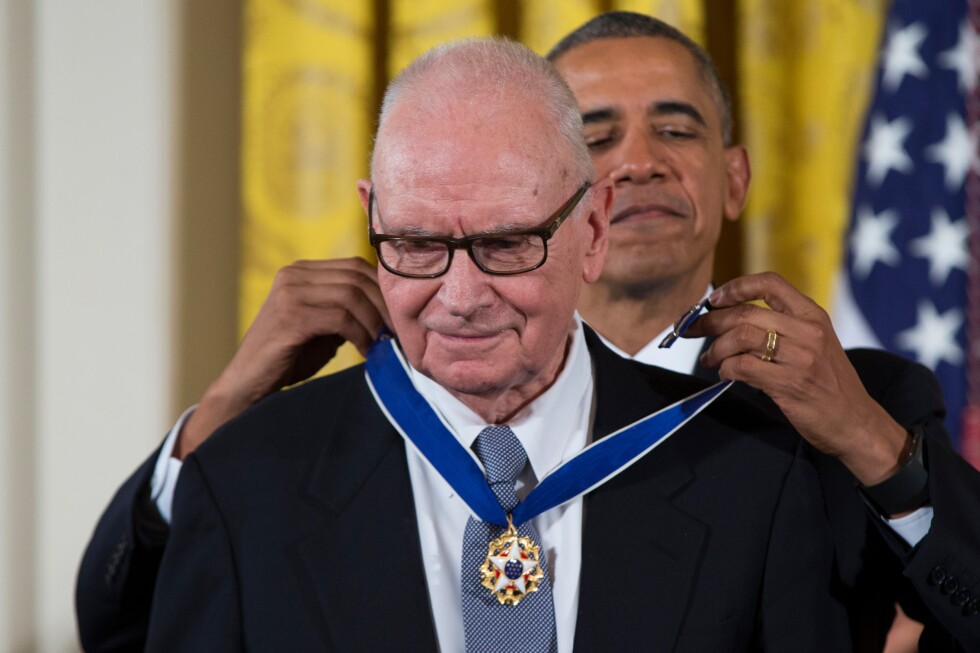
In 2015, President Barack Obama awarded Hamilton the Presidential Medal of Freedom, praising him as someone “widely admired” across party lines “for his honesty, his wisdom, and consistent commitment to bipartisanship.”
Born April 20, 1931, in Daytona Beach, Florida, Hamilton was the son of a Methodist minister and moved to Evansville, Indiana, as a child. He attended DePauw University and Goethe University in Frankfurt, Germany, before completing his law degree at Indiana University in 1956.
After leaving Congress, Hamilton continued his public service as director of the Washington-based Woodrow Wilson Center. He also maintained ties with Indiana University, which in 2018 named its School of Global and International Studies after Hamilton and longtime Republican Senator Richard Lugar, who died in 2019.
Former Indiana governor and former vice president Mike Pence, a Republican, noted that while their politics differed, his respect for Hamilton was “boundless.”
According to his son Doug Hamilton, the elder statesman was taken to his office the day before his death. “He believed in doing as much good as he could for as long as he could,” Doug Hamilton said.
Lee Hamilton is survived by three children, five grandchildren, and one great-grandchild. His wife Nancy, whom he met while they were students at DePauw, died in 2012 after 58 years of marriage.
Fact Checker
Verify the accuracy of this article using The Disinformation Commission analysis and real-time sources.

15 Comments
As someone with a keen interest in global affairs, I’ve long admired Hamilton’s pragmatic and nuanced approach to foreign policy challenges. His passing is a significant loss for the US.
Hamilton’s legacy as a champion of bipartisanship and a defender of democratic norms is sorely needed in today’s polarized political climate. He will be remembered as a true statesman.
Well said. Hamilton’s steadfast commitment to civility and compromise is a model for how lawmakers should conduct themselves, regardless of party affiliation.
Lee Hamilton was a respected bipartisan leader on foreign policy and national security issues. His commitment to civility and public service is admirable and set an important example for future generations of lawmakers.
Hamilton’s death is a reminder of the importance of public service and the need for leaders who can rise above partisan politics. His legacy of bipartisanship and integrity is inspiring.
Absolutely. Hamilton’s commitment to the greater good, rather than narrow partisan interests, is a rare and admirable quality in today’s political landscape.
As a longtime observer of US foreign policy, I’ve always respected Hamilton’s thoughtful and balanced approach. His passing is a significant loss for the country.
Hamilton’s extensive experience and expertise in foreign policy and national security will be difficult to replace. His passing is a significant loss for the country.
Hamilton’s passing is a sad day for Indiana and the nation. He was a true statesman who dedicated his career to strengthening US foreign affairs and national security.
As a Hoosier, I’m proud that Indiana produced such an influential and respected figure in US foreign policy like Lee Hamilton. His passing is a loss for the state and the nation.
Well said. Hamilton’s steady hand and commitment to facts over partisan politics made him a respected voice on complex global issues. He will leave big shoes to fill.
Hamilton’s long tenure in Congress and his leadership roles on key investigative committees demonstrate his deep expertise and dedication to strengthening US foreign affairs. He will be missed.
Agreed, Hamilton’s ability to work across the aisle is a quality that is sadly lacking in today’s polarized political climate. His legacy of bipartisanship is something to aspire to.
Hamilton’s death is a reminder of the value of statesmanship and compromise in government. In an era of heightened political division, his example of civility and bipartisanship is sorely needed.
Absolutely. Hamilton showed that it’s possible to have principled disagreements while still finding common ground. That’s a lesson many current lawmakers could stand to learn.