


Listen to the article
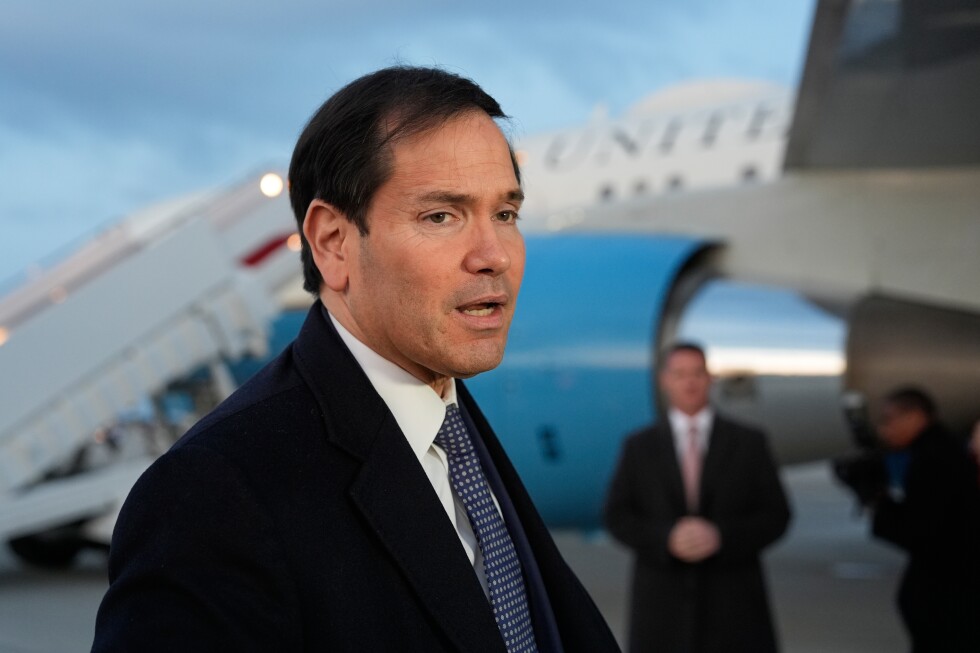
Secretary of State Marco Rubio is leading a large U.S. delegation to the Munich Security Conference this week, where European leaders are seeking reassurance amid strained transatlantic relations under President Donald Trump’s administration.
The annual gathering comes one year after Vice President JD Vance delivered a controversial speech at the same venue, where he criticized many of America’s closest European allies for allegedly undermining Western civilization with progressive domestic policies while failing to invest adequately in their own defense.
According to U.S. officials, Rubio plans to adopt a less confrontational tone when he addresses the conference on Saturday, though his message will carry similar philosophical underpinnings. Before departing for Europe, Rubio acknowledged the importance of U.S.-European relations while signaling a shift in approach.
“We’re very tightly linked together with Europe,” Rubio told reporters. “Most people in this country can trace both, either their cultural or their personal heritage, back to Europe.” However, he added a clear caveat: “We live in a new era in geopolitics, and it’s going to require all of us to reexamine what that looks like.”
Following Munich, Rubio will visit Slovakia and Hungary. Officials indicate that America’s top diplomat intends to focus on areas of common interest, including the Middle East, Ukraine, and challenges posed by China—an economic powerhouse seeking to exploit the uncertainty in U.S.-European relations.
For many European leaders, Rubio’s visit represents a potential respite after months of controversial statements from Trump targeting allies across Europe, Canada, and the Indo-Pacific region. The president’s recent comments about taking control of Greenland from NATO member Denmark and various insults directed at foreign leaders have particularly unsettled European capitals, prompting questions about America’s reliability as an ally.
When asked about Greenland, Rubio responded with diplomatic ambiguity: “You know, we’re working on that. We feel good about it.”
Claudia Major, a senior vice president at the German Marshall Fund in Berlin, characterized Vance’s 2023 speech as “really a shock moment” that signaled a fundamental shift in U.S. foreign policy. “It was perceived as the first very clear statement of what the new Trump administration was about,” namely that “Europeans are not partners any longer.”
“There is a big doubt whether the basis of trust is still there and whether we still share the same vision for the trans-Atlantic relationship,” Major explained. “The longer this kind of estrangement goes, the more difficult it will be to re-find a solid relationship.”
Munich Security Conference chairman Wolfgang Ischinger echoed these concerns, describing transatlantic relations as being “in a significant crisis of confidence and credibility.” Nevertheless, he expressed hope that Rubio and the dozens of U.S. lawmakers attending the conference might offer a more constructive outlook.
European responses to the Trump administration’s approach have varied considerably. German Chancellor Friedrich Merz, whom Rubio will meet Friday, has attempted to chart a middle course, acknowledging the need for Europe to “learn the language of power politics” by taking greater responsibility for its security and pursuing technological independence. However, Merz emphasized that “as democracies, we are partners and allies and not subordinates” of the United States.
Other leaders have adopted more confrontational stances. French President Emmanuel Macron and Canadian Prime Minister Mark Carney appear increasingly disenchanted with the current administration. Both nations recently opened consulates in Nuuk, Greenland’s capital, in a symbolic show of support for both Greenland and Denmark.
Macron warned this week that U.S.-European tensions could intensify following the “Greenland moment,” describing the Trump administration as “openly anti-European” and seeking the European Union’s “dismemberment.”
“When there’s a clear act of aggression, I think what we should do isn’t bow down or try to reach a settlement,” Macron told several European newspapers. “I think we’ve tried that strategy for months. It’s not working.”
Carney, who received applause for pushing back against Trump during a speech at the World Economic Forum in Davos last month, has championed forming trade alliances with countries outside the U.S., including China—a move that has drawn new threats from Trump.
For many Europeans, Trump’s interest in Greenland echoes unsettling historical patterns of power politics where military force overshadows diplomacy. Fiona Hill, a Russia expert who served on Trump’s National Security Council during his first term, drew a stark parallel: “Greenland is to Trump as, essentially, Ukraine is to Putin, although obviously without the devastating war at this stage.”
Meanwhile, European nations remain skeptical of Trump’s “Board of Peace,” a 27-member group of world leaders initially created to handle the Gaza peace agreement but potentially expanding to address other conflicts. Germany, France, Britain, Italy, Norway, and Sweden have either declined to join or remain noncommittal ahead of the board’s first fundraising meeting for Gaza scheduled for February 19 in Washington.
Fact Checker
Verify the accuracy of this article using The Disinformation Commission analysis and real-time sources.

8 Comments
Interesting to see how Rubio navigates the strained US-EU relations at the Munich conference. His focus on shared cultural and historical ties with Europe could help bridge divides, but the ‘new era’ comments suggest a shift in approach.
It’ll be important for Rubio to strike the right balance – acknowledging common ground while also addressing areas of divergence. Europe will be looking for reassurance during this delicate geopolitical period.
Rubio’s acknowledgment of shared cultural/historical ties with Europe is a good starting point, but the ‘new era’ comments suggest some tricky trade-offs ahead. Striking the right balance will be crucial for maintaining strong transatlantic relations.
The mining and commodities sectors are closely watching the Munich conference, as global trade and supply chain issues have major implications. Rubio’s tone and messaging could impact confidence and investment in these critical industries.
Agreed. Stability and predictability in US-EU relations are crucial for the mining and energy sectors to thrive. Rubio will need to find a way to ease European concerns without compromising core US interests.
With tensions high, this conference is an opportunity for Rubio to help rebuild trust between the US and its European allies. His approach to issues like defense spending and progressive policies will be closely scrutinized.
As a key player in the mining and commodities space, I’m curious to hear Rubio’s perspective on how the US and Europe can collaborate more effectively on energy security and sustainable resource development. Strengthening those ties could benefit everyone.
The mining and energy sectors are closely watching this conference, as geopolitical tensions can significantly impact global supply chains and investment. Rubio’s messaging will be important for providing stability and reassurance to these critical industries.