


Listen to the article
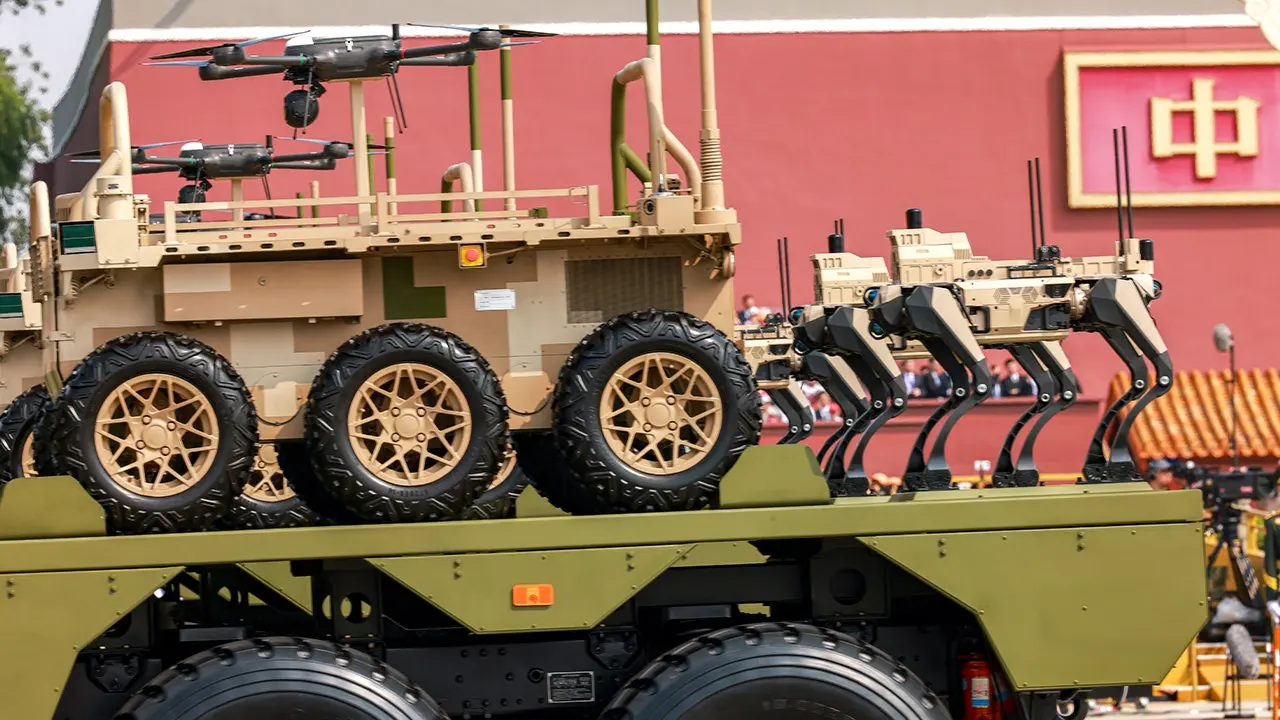
China is developing AI-enabled “robot wolf packs” designed to transform how future conflicts are fought, according to a new analysis from the Foundation for Defense of Democracies (FDD). These quadruped robots could play a critical role in scouting, logistics, and potentially combat operations, including a possible Taiwan invasion scenario.
The report details how the People’s Liberation Army (PLA) is moving beyond mere technology demonstrations and beginning to integrate these robotic systems into coordinated battlefield units. This represents a significant step in China’s pursuit of what it terms “intelligentized warfare” – the integration of artificial intelligence, robotics, and autonomous systems directly into frontline military operations.
“China is not just modernizing its military,” the report states. “It is reimagining how future wars will be fought.”
These robotic platforms are primarily being tested for reconnaissance and support roles, where they move ahead of human troops to map terrain, identify threats, and transport supplies through hazardous environments. The quadruped design allows them to navigate challenging conditions, including stairs and debris-filled urban settings, that would impede wheeled or tracked vehicles.
Chinese military demonstrations have also showcased the robots operating in coordinated groups, significantly extending a military unit’s operational reach without risking human personnel. Some Chinese military reporting has depicted armed variants operating alongside troops during simulated assaults, though many of these capabilities remain unverified by independent sources.
The FDD analysis identifies a Taiwan conflict as the most likely scenario where such systems would be deployed. An amphibious invasion would require Chinese forces to operate in contested coastal zones and dense urban terrain – precisely the conditions where unmanned systems could prove advantageous by clearing routes, absorbing initial casualties, and maintaining operational momentum as human troops push inland.
The development of these robotic systems could potentially allow Chinese commanders to sustain offensive operations while significantly reducing risks to personnel, thereby lowering both the political and military costs of conflict for Beijing. This capability is particularly concerning for military planners focused on Taiwan’s defense.
While the U.S. military is also developing robotic and autonomous systems, analysts suggest China’s ability to leverage its commercial technology sector could provide advantages in scaling production and deployment. The integration between China’s civilian technology companies and military development programs has been a focus of concern for Western security experts.
Despite their rapid development, these robotic systems face significant limitations. They rely heavily on communications links and battery power, making them vulnerable to electronic warfare, jamming, cyber interference and logistical disruptions. They are also susceptible to conventional small arms fire and environmental factors like smoke or debris that can compromise their sensors.
The report notes that human operators currently remain in the decision loop for lethal actions, limiting the systems’ autonomy in actual combat. However, the trajectory of development suggests increasing autonomy over time.
In response to these developments, the FDD recommends U.S. policymakers prioritize countering China’s autonomous systems, including developing strategies to disrupt robotic platforms and strengthening domestic technology capabilities in this domain. Military analysts warn that as unmanned systems become more integrated into combat operations, they could fundamentally alter the pace, risk calculations, and potential outcomes of future conflicts.
This development represents the latest advancement in the ongoing technological competition between major powers, with autonomous systems emerging as a critical domain that could significantly influence military balance in the Indo-Pacific region.
Fact Checker
Verify the accuracy of this article using The Disinformation Commission analysis and real-time sources.

9 Comments
China’s focus on ‘intelligentized warfare’ highlights the rapid pace of technological change in modern military affairs. These robotic platforms could provide significant advantages in reconnaissance, logistics, and possibly combat. However, their deployment raises important questions about human control and accountability.
Fascinating development in China’s pursuit of AI-enabled warfare. These quadruped robots could significantly transform battlefield tactics and logistics. I wonder how effective they’ll be in urban combat scenarios and what countermeasures might be developed to disable them.
This development in China’s military modernization efforts is a significant step towards the future of warfare. The integration of AI, robotics, and autonomous systems into frontline operations represents a major shift in how conflicts may be fought. The implications, both technological and geopolitical, deserve careful consideration.
The shift towards ‘intelligentized warfare’ is a concerning trend that warrants close monitoring. While the tactical advantages of these robotic systems may be significant, their widespread deployment could have destabilizing effects on regional security dynamics, particularly in flashpoint areas like the Taiwan Strait.
I agree. The increased use of autonomous military technology, if not properly regulated, has the potential to escalate tensions and increase the risk of miscalculation during crises.
From a purely technological standpoint, the development of these AI-driven ‘wolf pack’ drones is an impressive feat of engineering. Their potential applications in scouting, supply transport, and even combat operations are quite remarkable. That said, the geopolitical implications are worrying and merit close scrutiny.
The integration of AI and robotics into frontline military operations is a concerning trend. While the capabilities of these ‘wolf pack’ drones may offer tactical advantages, I hope their use will be constrained by international laws and norms around autonomous weapons systems.
I agree, the ethical implications of increasingly autonomous military technology need to be carefully considered. Proper oversight and control mechanisms will be crucial.
The emergence of these ‘wolf pack’ drones highlights the rapid pace of technological change in the military domain. While their potential tactical advantages are noteworthy, the ethical and legal ramifications of increasingly autonomous weapons systems must be thoroughly examined to ensure they are deployed responsibly and in accordance with international norms.