


Listen to the article
After the U.S. Catholic bishops issued a statement opposing mass deportations, conservative Catholic advocacy group CatholicVote has responded with criticism, arguing that some church leaders have created “confusion” about the church’s stance on immigration enforcement.
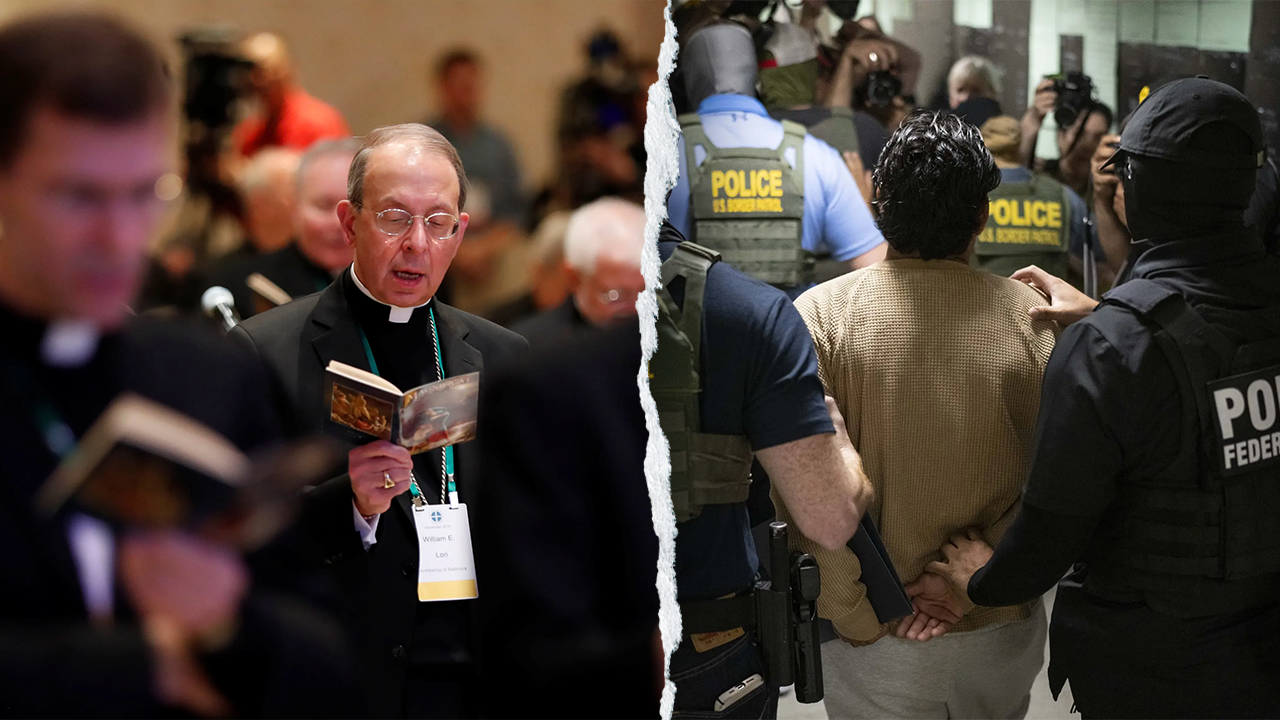
The U.S. Conference of Catholic Bishops (USCCB) released a “special pastoral message on immigration” on Wednesday, stating they felt “compelled now in this environment to raise our voices in defense of God-given human dignity.” The bishops explicitly stated, “We oppose the indiscriminate mass deportation of people,” while also calling for “an end to dehumanizing rhetoric and violence, whether directed at immigrants or at law enforcement.”
In their message, the bishops expressed concern about the “climate of fear and anxiety around questions of profiling and immigration enforcement,” as well as “the conditions in detention centers and the lack of access to pastoral care.” They noted their distress when meeting “parents who fear being detained when taking their children to school” and families separated from loved ones through deportation.
CatholicVote countered with its own report titled “Immigration Enforcement and the Christian Conscience” a day later. The report argues that “despite what some Church leaders in America have indicated, a faithful Catholic can support strong and humane immigration law enforcement — by means such as physical barriers, detention and deportation — without violating the teaching of the Church.”
The organization’s report challenges the notion that lenient border policies are inherently more compassionate, suggesting instead that weak enforcement often has “a terrible human toll” by empowering criminal cartels and harming both Americans and immigrants. It also defends family separations resulting from deportation, comparing them to prison sentences for other offenses and placing the responsibility on “those family members who broke the law.”
CatholicVote President Kelsey Reinhardt told Fox News Digital that the organization aims to “foster a more complete conversation on immigration and give moral standing and freedom of conscience for Catholics and Christians who recognize a need to secure the border and the importance of the rule of law.”
Reinhardt emphasized that the responsibility to regulate borders “is not a caveat tacked onto an otherwise humanitarian manifesto; it is an integral part of Catholic doctrine.” She argued that the collapse of lawful order has created conditions where “exploitation flourishes, cartels thrive, and millions of migrants are pushed into a shadow-world without legal recourse or clear prospects.”
The report further contends that “there is no such thing as an official ‘Catholic position’ on the practical details of immigration policy.” Instead, it characterizes individual Catholics’ positions on immigration enforcement as “a matter of prudential political judgment,” which it says falls under the responsibility of Catholic laypersons rather than bishops.
This exchange highlights a significant division within American Catholic circles regarding immigration policy. While the bishops emphasize compassion and dignity for migrants, CatholicVote focuses on law enforcement and border security as essential components of a moral approach to immigration.
The debate comes at a politically charged moment, with immigration remaining a central issue in American politics. CatholicVote made headlines earlier this year by endorsing former President Donald Trump, its first-ever political endorsement. The group’s founder, Brian Burch, now serves as Trump’s ambassador to the Vatican.
The USCCB did not immediately respond to Fox News Digital’s request for comment on CatholicVote’s criticisms.
This theological and political disagreement reflects broader tensions within American Catholicism about how to balance humanitarian concerns for migrants with questions of national sovereignty, security, and the rule of law—a debate likely to continue as immigration policies evolve under the new administration.
Fact Checker
Verify the accuracy of this article using The Disinformation Commission analysis and real-time sources.

14 Comments
This is a sensitive topic where the church has to balance its principles with the political realities. I can see both sides – the bishops’ concern for human dignity, but also the need for consistent messaging from church leadership.
Agreed. It’s a delicate balance, and the church has to be thoughtful in how it navigates these waters without appearing to take partisan stances.
It’s a complex issue with valid concerns on all sides. The bishops raise important points about the human impact of deportation policies, but CatholicVote also has a valid perspective on the need for clear, consistent messaging from church leaders on such a contentious topic.
I agree, this is a delicate balance to strike. The church should advocate for humane treatment while also supporting the rule of law.
The bishops’ statement seems well-intentioned, but I can understand CatholicVote’s criticism about potential mixed messaging. Immigration is a thorny issue and the church has to walk a fine line in advocating its principles.
That’s a fair point. The church should strive to be a moral voice, but also recognize the practical realities and complexities involved in enforcing immigration laws.
This is a complex and sensitive topic where the church has to walk a fine line. I can see the validity in the bishops’ concerns, but also the need for unambiguous messaging from church leadership on such a divisive political issue.
Agreed. The church should advocate for humane treatment while also supporting the rule of law. It’s a delicate balance they have to strike.
Immigration enforcement is a challenging issue without easy answers. I can understand the bishops’ desire to highlight the human toll, but clear, unambiguous messaging from church leaders is also important on such a divisive political topic.
Well said. The church should strive to be a moral voice, but also recognize the complexities involved in enforcing immigration laws.
Immigration is a thorny issue without easy answers. I can understand the bishops’ desire to highlight the human impact, but they also need to be mindful of not creating confusion with mixed messaging.
Well said. The church should strive to be a moral voice, but also recognize the complexities involved in enforcing immigration laws and the need for clear, consistent positions.
This highlights the difficulty in finding the right approach on immigration. The bishops raise valid humanitarian concerns, but CatholicVote also has a point about the need for consistent messaging from church leadership.
Agreed. It’s a complex issue where reasonable people can disagree. The church should aim to be a unifying voice while acknowledging the difficult tradeoffs.