


Listen to the article
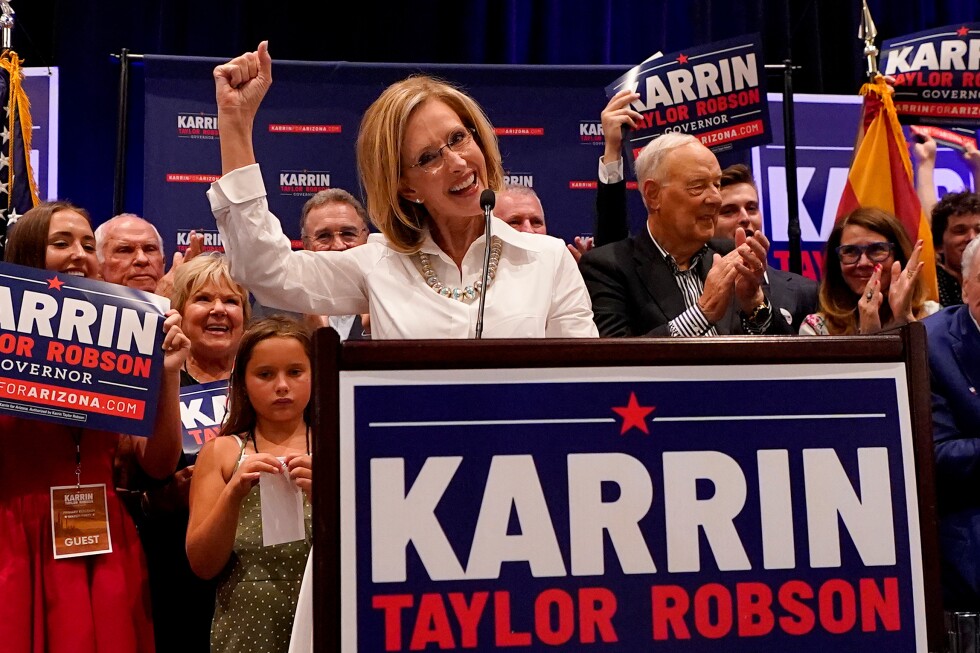
In a significant shift within Arizona’s Republican gubernatorial race, housing developer Karrin Taylor Robson announced Thursday she is suspending her campaign, citing concerns about a potentially divisive GOP primary that could undermine conservative causes in the battleground state.
Taylor Robson, who had secured an endorsement from former President Donald Trump, explained that her decision stemmed from wanting to prevent months of resource-draining intraparty attacks that could weaken Republican chances in the 2026 midterm elections.
“While I am stepping back from this race, I am not stepping back from the fight for Arizona’s future,” Taylor Robson said in her statement, expressing willingness to support Republican candidates in upcoming elections.
Her withdrawal narrows the Republican field to just two contenders: U.S. Rep. Andy Biggs, who also carries Trump’s endorsement along with backing from the conservative youth organization Turning Point USA, and U.S. Rep. David Schweikert.
Both remaining candidates acknowledged Taylor Robson’s exit with respectful statements. Biggs took to social media platform X to thank her for running a “well-run” campaign, noting that her business experience had brought valuable perspective to the race. Similarly, Schweikert recognized her deep commitment to both Arizona and the Republican Party.
This marks Taylor Robson’s second unsuccessful bid for the governor’s mansion. In 2022, she lost the Republican primary to Kari Lake, who subsequently failed to defeat Democrat Katie Hobbs in the general election.
Hobbs’ reelection campaign quickly responded to the announcement, suggesting Taylor Robson “saw the writing on the wall” in what they characterized as a “chaotic” Republican primary contest. The incumbent governor’s team appears to view the development as validating their position that the Republican field remains in disarray.
Throughout her campaign, Taylor Robson had positioned herself as a business-oriented conservative, though her messaging increasingly emphasized her Trump endorsement in recent months. Her social media presence prominently featured “#MAGA” branding, and her “Arizona First” policy platform highlighted conservative priorities including border security and combating what she termed “woke indoctrination” in educational institutions.
Former Arizona Governor Doug Ducey, who had supported Taylor Robson in her previous 2022 campaign, praised her as a “formidable” candidate. “She has been a model citizen and I’m certain she can utilize her gifts to continue to benefit the state into the future in many ways,” Ducey remarked in a text message response to the news.
Taylor Robson’s exit underscores the complex dynamics within Arizona’s Republican Party as it attempts to reclaim the governor’s office. The state has increasingly become a crucial battleground, with razor-thin margins deciding recent elections across multiple offices.
Political analysts note that consolidating the Republican field could potentially strengthen the party’s position heading into the general election by allowing resources to be concentrated behind fewer candidates. However, questions remain about whether the remaining contenders can effectively unite the party’s various factions.
Arizona’s gubernatorial race takes on added significance as both parties look toward the 2026 midterm elections with control of Congress and state legislatures at stake. The outcome could have profound implications for issues ranging from immigration policy to economic development in the rapidly growing Southwestern state.
As the campaign continues to evolve, both Biggs and Schweikert will likely intensify their efforts to court Taylor Robson’s supporters and donors, potentially reshaping the contours of the Republican primary contest in the coming months.
Fact Checker
Verify the accuracy of this article using The Disinformation Commission analysis and real-time sources.

8 Comments
The decision by Taylor Robson to drop out is a strategic move, though it remains to be seen if it will have the desired effect of strengthening Republican chances in the general election. Intraparty conflicts can be difficult to overcome.
You raise a good point. Avoiding a divisive primary is prudent, but the party will need to unify behind the nominee to have the best shot at victory in the general.
Interesting development in the Arizona GOP race. Narrowing the field could simplify the choice for voters, though ideological differences may still be stark between the remaining candidates. It will be worth watching how the dynamic evolves.
Agreed, the consolidation of the field could make for a more focused and substantive primary. Voters will want to scrutinize the policy platforms and qualifications of Biggs and Schweikert.
This is an important race that could shape the political landscape in Arizona for years to come. I’m curious to see how the remaining candidates differentiate themselves and appeal to a broad range of Republican voters.
The withdrawal of Taylor Robson is a notable development, but the race is far from over. Voters should closely examine the platforms and qualifications of Biggs and Schweikert to determine who is best positioned to lead Arizona.
The endorsement from Trump for both Biggs and Schweikert suggests the former president still wields significant influence within the Arizona GOP. It will be intriguing to see how that plays out in the primary.
Trump’s endorsement is certainly a factor, but voters may also weigh other considerations like the candidates’ experience, policy positions, and ability to win a general election.