


Listen to the article
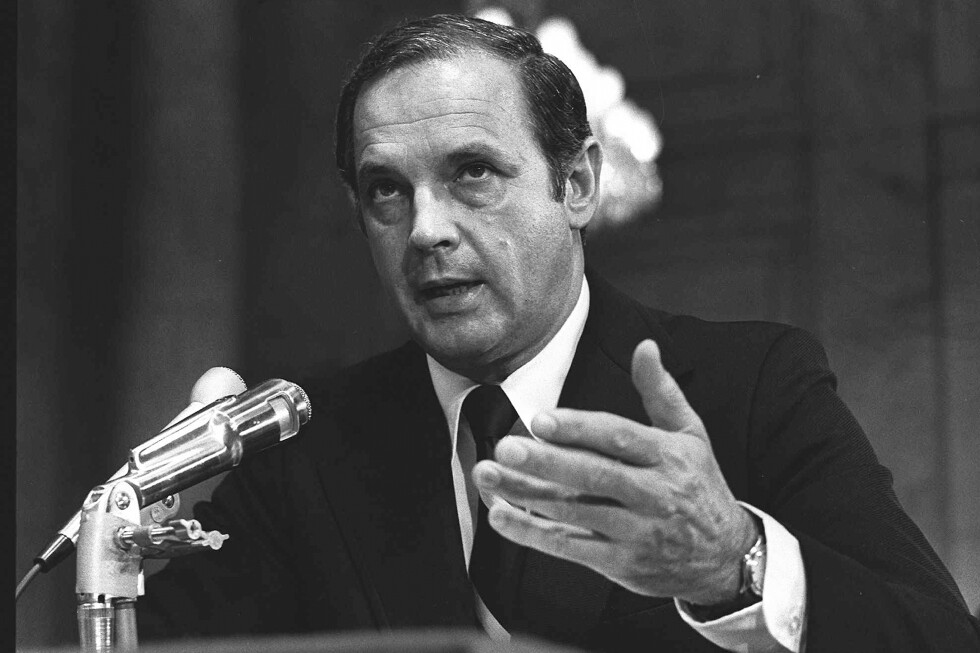
Alexander Butterfield, the White House aide whose testimony about Richard Nixon’s secret taping system accelerated the president’s downfall during the Watergate scandal, has died at the age of 99, according to his wife, Kim, and former White House counsel John Dean.
“He had the heavy responsibility of revealing something he was sworn to secrecy on, which is the installation of the Nixon taping system,” Dean told The Associated Press. “He stood up and told the truth.”
Butterfield served as deputy assistant to President Nixon from 1969 to 1973, overseeing a voice-activated taping system installed in multiple White House locations, including the Oval Office, Cabinet Room, Nixon’s office in the Executive Office Building, and Camp David. The system was designed to record all conversations when the president was present.
The revelation of this taping system, made public during Butterfield’s testimony before the Senate Watergate Committee on July 16, 1973, stunned Washington and dramatically altered the trajectory of the investigation. Until that moment, investigators had been relying primarily on witness testimony. The existence of actual recordings promised irrefutable evidence about what Nixon knew regarding the 1972 break-in at Democratic Party headquarters and subsequent cover-up.
Butterfield later acknowledged the personal weight of his disclosure. “I didn’t like to be the cause of that, but I felt that I was, in a lot of ways,” he reflected in a 2008 oral history for the Nixon Presidential Library and Museum.
The tapes became the focal point of a year-long legal battle that concluded when the Supreme Court unanimously ruled in July 1974 that Nixon had to surrender the recordings to the Watergate special prosecutor. What they revealed proved devastating – Nixon’s involvement in the cover-up was explicit, and the recordings captured his unfiltered views, including vulgar language and bigoted racial and religious comments.
Less than a month after the Supreme Court ruling, facing certain impeachment by the House, Nixon resigned on August 9, 1974, becoming the first and only U.S. president to step down from office.
Butterfield’s path to this pivotal historical moment began through a college connection. A UCLA friend of H.R. Haldeman, Nixon’s chief of staff, Butterfield had reached out about opportunities in the new administration. Working under Haldeman, he served as Cabinet secretary and helped manage White House operations.
By 1973, Butterfield had moved on to become administrator of the Federal Aviation Administration when Senate committee staffers questioned him during their Watergate investigation. The inquiry about a possible taping system had been prompted by former White House counsel John Dean’s testimony suggesting that his conversations with Nixon might have been recorded.
Butterfield’s honest response set in motion events that would lead to Nixon’s resignation. At the time, he didn’t fully anticipate the consequences. “I guess I didn’t foresee that the president might be put out of office or impeached,” he told the Nixon Library. “I guess I couldn’t conceive of Nixon being forced out of office. It had never happened before.”
After his testimony, Butterfield believed he faced political retribution. He was dismissed as FAA administrator in 1975, which he attributed to an agreement between Nixon and Ford staff members. Following his government service, he worked as a business executive in California and later earned a master’s degree from the University of California, San Diego.
Born April 6, 1926, in Pensacola, Florida, Alexander Porter Butterfield attended UCLA before joining the Navy. He later earned degrees from the University of Maryland and George Washington University. His military career included 20 years in the Air Force, where he achieved the rank of colonel, serving as an instructor during the Korean War and later in various military representative roles.
In later years, Butterfield didn’t mince words about his former boss. While acknowledging Nixon’s foreign policy achievements, he described him as “not an honest man” and “a crook,” believing Nixon was aware of the Watergate break-in beforehand and orchestrated the cover-up.
When Nixon finally resigned, Butterfield recalled “cheering… just cheering” because “justice had prevailed.” He added, “I didn’t think that it would for a while. This guy was the ringleader.”
Butterfield’s testimony stands as one of the most consequential moments in American political history, demonstrating how a single truthful disclosure can dramatically alter the course of events at the highest levels of government.
Fact Checker
Verify the accuracy of this article using The Disinformation Commission analysis and real-time sources.

9 Comments
This is a fascinating and pivotal moment in history. Butterfield’s testimony about the White House taping system was a watershed event that exposed the corruption at the highest levels of government. It’s a testament to his integrity that he chose to reveal this information, despite the personal risks involved.
Butterfield’s role in the Watergate scandal is a complex and nuanced story. While his testimony was pivotal, it’s important to acknowledge the broader context of political tensions and power struggles that led to this moment. Nonetheless, his courage in speaking truth to power is undeniable and worthy of recognition.
It’s interesting to consider how Butterfield’s decision to disclose the taping system might have been influenced by his background in the mining and energy industries. Perhaps his experience in those sectors gave him a unique perspective on the importance of transparency and accountability in government.
That’s a good point. Butterfield’s professional experience may have instilled in him a strong sense of ethical responsibility, which he then applied to his role in the Nixon administration. His actions demonstrated a commitment to the public interest that transcended partisan loyalties.
Butterfield’s passing is a significant loss, but his legacy as a truth-teller who helped uncover one of the biggest political scandals in American history will endure. His courage and integrity should be an example for all public servants, regardless of their background or political affiliation.
Well said. Butterfield’s willingness to put his principles first, even at great personal cost, is a testament to the power of individual moral conviction in the face of institutional corruption. His actions ultimately strengthened the democratic process.
Butterfield’s actions had far-reaching consequences for the Watergate investigation and ultimately led to Nixon’s resignation. His willingness to stand up and tell the truth, even when it was politically inconvenient, is truly admirable.
Agreed. Whistleblowers who put principles above personal interests play a crucial role in maintaining the integrity of democratic institutions. Butterfield’s legacy serves as an inspiration for public servants to uphold their ethical obligations, even in the face of immense pressure.
The Watergate scandal and Butterfield’s role in it serve as a cautionary tale about the dangers of unchecked power and the need for robust checks and balances in government. It’s a reminder that even the highest-ranking officials must be held accountable for their actions.