


Listen to the article
Immigration Crackdown in Minnesota Ends After Deadly Two-Month Operation
The Trump administration has concluded a controversial immigration enforcement operation in Minnesota that spanned two and a half turbulent months, resulting in approximately 4,000 arrests and two fatal shootings by federal officers.
Operation Metro Surge, described by the Department of Homeland Security as the “largest immigration enforcement operation ever,” targeted the Minneapolis-St. Paul metropolitan area, which houses the nation’s largest Somali community. The operation began on December 1 following weeks of inflammatory rhetoric from President Donald Trump, who claimed immigrants from Somalia were “completely taking over the once great State of Minnesota” and later referred to Somali residents as “garbage” during a Cabinet meeting.
Minnesota’s Democratic Governor Tim Walz strongly opposed the president’s characterization, stating that Trump had slandered all Minnesotans and that his expressions of contempt for the Somali community were “unprecedented for a United States president.”
According to U.S. Census Bureau data, approximately 260,000 people of Somali descent live in the United States, with about 84,000 residing in the Minneapolis area. Most of these residents are American citizens.
The operation quickly became contentious. On December 9, federal agents used pepper spray to disperse protesters who blocked their vehicles during identity checks in a predominantly Somali neighborhood. When agents approached a city-owned senior housing complex, protesters blew whistles to alert residents and confronted the agents, who responded with pepper spray.
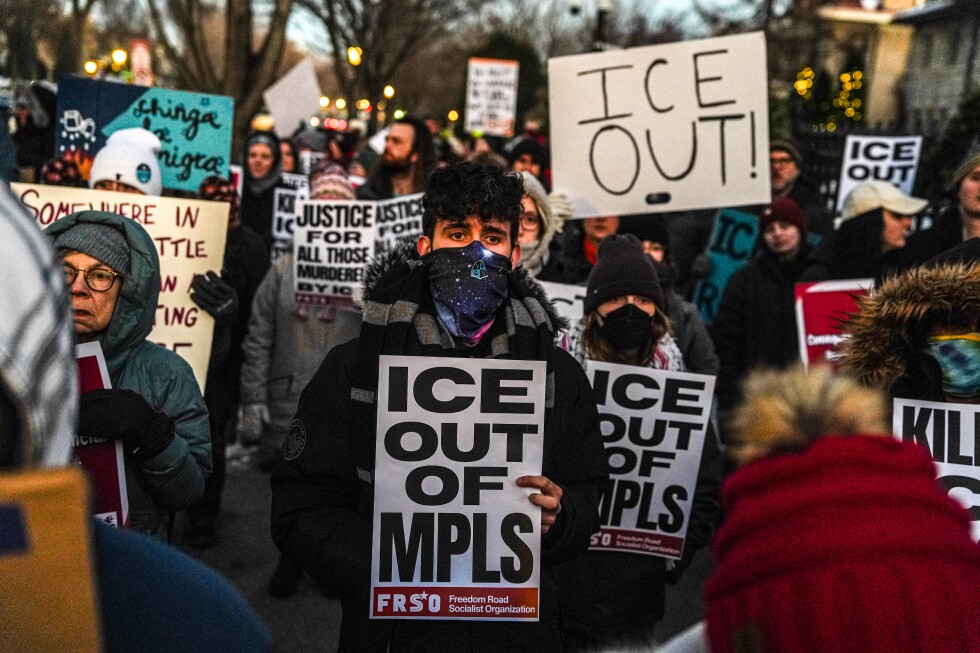
This pattern of protests became common throughout the Twin Cities in subsequent weeks, with residents organizing networks to help immigrants, warn about approaching agents, and document immigration officers’ actions.
The administration linked the operation to an ongoing Minnesota housing services fraud investigation. First Assistant U.S. Attorney Joe Thompson claimed that as much as $9 billion in federal funds may have been stolen in what he described as a multilayered fraud scheme, resulting in charges against at least 92 people.
Trump repeatedly connected these fraud cases to Minnesota’s Somali community. According to the U.S. Attorney’s Office for Minnesota, 82 of the 92 defendants in the child nutrition, housing services, and autism program schemes are Somali Americans. Following allegations of fraud at Somali-run day care centers posted by right-wing influencers, both Department of Homeland Security Secretary Kristi Noem and FBI Director Kash Patel announced an intensification of immigration operations in Minnesota.
The situation escalated dramatically on January 7 when Renee Good, a 37-year-old U.S. citizen and mother of three, was shot and killed by an Immigration and Customs Enforcement officer. Good’s killing, recorded by witnesses, sparked nationwide outrage.
Noem claimed the incident was an “act of domestic terrorism” against ICE officers, and Vice President JD Vance stated that the officer fired in self-defense because Good allegedly tried to hit him with her vehicle. These explanations were challenged by Minneapolis Mayor Jacob Frey, Governor Walz, and others based on video evidence of the confrontation.
Videos recorded by bystanders contradicted the administration’s narrative. The footage shows the officer firing first while standing in front of the vehicle and then twice more while positioned at the side of the car, at arm’s length from the driver’s window. It remains unclear from the videos whether the car made contact with the officer before shots were fired.
On January 24, another U.S. citizen, Alex Pretti, a 37-year-old intensive care nurse at a VA hospital, was shot and killed by a U.S. Border Patrol officer in Minneapolis. Pretti, who had no criminal record, was a licensed gun owner with a permit for concealed carry.
Bystander videos show Pretti with only a phone in his hand as he stepped between an immigration agent and a woman after the agent shoved her. The officer pushed Pretti in the chest and pepper-sprayed both him and the woman. At least seven officers then forced Pretti to the ground. Although he appeared to resist, agents disarmed him. A Border Patrol officer then fired a first shot followed by several more into Pretti’s back after a pause. Use-of-force experts later said the video undermined federal authorities’ claim that the officer fired defensively.
The operation faced additional criticism when a 5-year-old boy named Liam Conejo Ramos was taken by federal agents along with his father to a detention facility in Texas on January 20. Columbia Heights Public Schools Superintendent Zena Stevnik alleged that federal agents took the child from a running car in the family’s driveway and instructed him to knock on his home’s door to see if others were inside, “essentially using a 5-year-old as bait.” The family had an active asylum case and had not been ordered to leave the country. Federal officials denied these allegations, and following a judge’s order, the child and his father were returned to Minnesota on February 1.
On January 26, the Trump administration reshuffled leadership of Operation Metro Surge, with Border Patrol commander Greg Bovino and some agents leaving Minneapolis. Trump announced that his border czar, Tom Homan, would take charge of the operation.
After a series of controversial arrests, including those of independent journalists Don Lemon and Georgia Fort in connection with a January 18 protest at a St. Paul church, Border Czar Tom Homan finally announced the end of Operation Metro Surge on February 12. The formal conclusion was unusual, as immigration officials typically do not announce the end of similar operations in other cities.
Fact Checker
Verify the accuracy of this article using The Disinformation Commission analysis and real-time sources.

10 Comments
The President’s inflammatory rhetoric towards the Somali community is deeply troubling. As leaders, we must promote unity and understanding, not division and intolerance.
I agree, such divisive language from the President is very disappointing and counterproductive. We need more compassion and less scapegoating of immigrant communities.
The scale and aggressive nature of this operation raise serious questions. While security is important, these tactics seem heavy-handed and likely to erode trust between law enforcement and immigrant populations.
You make a fair point. Striking the right balance between public safety and civil liberties is critical. Overreach can backfire and create more problems than it solves.
This crackdown seems to be more about politics than public safety. Stoking fear and targeting immigrant communities is a dangerous game that erodes the social fabric of our nation.
This is a concerning development. Immigration enforcement operations should be conducted fairly and with respect for all communities. I hope lessons can be learned to improve future policies.
This situation underscores the need for comprehensive immigration reform that is humane, practical, and upholds American values of diversity and opportunity. Knee-jerk crackdowns are not the answer.
The tragic loss of life during this operation is heartbreaking. Enforcement actions must be carried out with the utmost care and restraint to prevent further escalation and harm.
Absolutely. The use of lethal force should always be an absolute last resort. De-escalation and conflict resolution training for officers is critical in these sensitive situations.
It’s concerning to see the Somali community, which has contributed so much to Minnesota, targeted in this way. We should be celebrating their achievements, not scapegoating them.