


Listen to the article
Vaccine Innovation Flourishes as Public Trust Wanes, Experts Warn
The United States stands at a critical crossroads in public health, with unprecedented vaccine innovation occurring alongside a troubling erosion of public trust and confidence in immunizations, according to a panel of leading experts in infectious disease, pediatrics, and public health.
“We’re witnessing an extraordinary era of vaccine innovation – new platforms, new protection, and new possibilities for disease prevention,” said William Schaffner, M.D., Professor of Preventive Medicine and Infectious Diseases at Vanderbilt University School of Medicine. “At the same time, we’re grappling with an unprecedented erosion of public trust and outbreaks of preventable diseases, such as measles.”
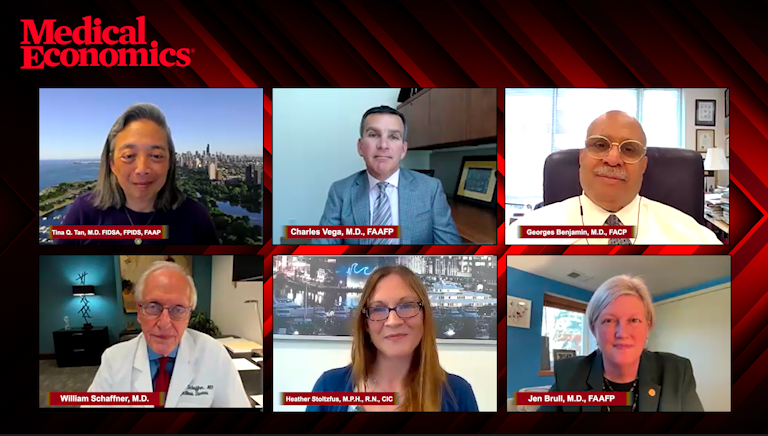
The panel, convened by Medical Economics and Infection Control Today in April 2025, brought together physicians, national policy leaders, and infectious disease specialists to address the complex landscape of vaccine acceptance in America.
Recent measles outbreaks have spread to more than 25 states, resulting in the deaths of two unvaccinated children – a stark reminder of what’s at stake when vaccination rates decline. According to multiple polls, parents increasingly view age-appropriate vaccination as less important with each passing year.
“We’re at a pivotal moment,” said Jen Brull, M.D., President of the American Academy of Family Physicians. “Vaccines continue to be one of the most powerful tools we have to protect public health. A 2024 study published in The Lancet estimated that vaccines have saved 154 million lives globally since 1974, most of them young children under 5.”
Yet despite this impressive record, panelists described a “tenuous” current position with vaccines in the United States, driven by misinformation and a broader erosion of trust in public health institutions.
Scientific Innovation Races Forward
On the positive side, vaccine development is experiencing a remarkable renaissance. Recent years have seen the introduction of new and improved vaccines against respiratory syncytial virus (RSV), mpox, pneumococcal infections, Lyme disease, dengue, cytomegalovirus (CMV), and chikungunya.
“The state of research and production of new vaccines is flourishing and exciting,” Schaffner said, noting that innovative delivery methods like microneedle patches and oral vaccines are also under development.
Tina Q. Tan, M.D., President of the Infectious Diseases Society of America, highlighted the diversity of vaccine platforms currently in development, including viral vector platforms, DNA vaccine platforms, synthetic virus platforms, and nanoparticle vaccine platforms.
“This is all very, very exciting because they’re all different platforms being looked at to produce safe and effective vaccines more rapidly,” Tan explained. She pointed to a new mRNA-based combination vaccine for human metapneumovirus and parainfluenza virus type 3 in development for infants and children as a particularly promising innovation.
Policy Challenges Undermine Progress
Despite these scientific advances, panelists expressed grave concerns about recent policy shifts that could hamper vaccination efforts. Georges Benjamin, M.D., Executive Director of the American Public Health Association, described how the infrastructure supporting vaccine delivery has been weakened.
“We had a very rational and science-driven process to evaluate vaccines, from the regulatory aspect through the FDA, and then to the CDC,” Benjamin said. “That’s been taken apart. We’ve had a lack of consistent, coherent messaging.”
Funding cuts to public health programs have disrupted federal, state, and local partnerships critical for vaccine delivery. Panelists also expressed concern about cuts to international programs through the United States Agency for International Development that had previously helped deliver vaccines to low and middle-income countries.
“The system needs to be rebuilt,” Benjamin emphasized.
The Front Lines: Rebuilding Trust One Conversation at a Time
Despite these challenges, panelists expressed optimism about physicians’ ability to rebuild vaccine confidence through personal connections with patients. According to the 2024 Edelman Trust Barometer, 83% of people say they trust doctors to tell them the truth about protecting public health.
“Trust is earned in drops and lost in buckets,” Brull noted, emphasizing the importance of listening carefully to patients’ concerns. “When a patient trusts me enough to open that conversation to tell me they are worried about a recommendation that I’ve made, I always approach that with listening. I assume good intent – most people want to do what is healthiest and best for them, their children, their families.”
Charles Vega, M.D., Clinical Professor of Family Medicine at the University of California, Irvine, echoed this approach, noting that personalizing the experience and talking from a personal perspective is more effective than citing statistics or government recommendations.
“Don’t stop trying,” Vega urged his fellow physicians. “How many times have you had that patient you talked about the vaccine with three times, four times… and suddenly just something clicks, and the patient says, ‘Fine, doc, I’ll get it.'”
Education Gap Fuels Hesitancy
Panelists identified a fundamental education gap as a key driver of vaccine hesitancy. Schaffner suggested that health curricula in middle and high schools often teach about vaccines only modestly and erratically, while preventable diseases themselves are rarely mentioned.
“If we went to high school seniors and asked them two simple questions: ‘What’s a vaccine? And how does a vaccine work?’ and hoped for simple declarative and correct responses, I don’t think we would get them very often,” Schaffner said.
Benjamin agreed, pointing to broader issues of health literacy in the population. “We have people who don’t know first aid, they really don’t understand the human body, human biology. The sciences have been deemphasized.”
The panelists suggested that professional medical societies could fill this education gap by serving as trusted sources of information for both the public and policymakers.
Path Forward Requires Collaboration
Looking ahead, the experts emphasized the importance of collaboration among healthcare professionals, medical societies, community stakeholders, and education systems to rebuild vaccine confidence.
“In these very tumultuous and chaotic times, the role and actions of physician specialty societies are now significantly more important than they ever have been,” Tan said. “Working collaboratively as a coalition of societies on a variety of issues provides a much stronger voice, and our message will have a much greater impact.”
Brull concluded with a hopeful message, citing a Chinese proverb: “The best time to plant a tree was 20 years ago. The second-best time is today. Vaccines are safe, they are effective, and they save lives, and today is the best day to get vaccinated if you haven’t had a chance to do so before now.”
Fact Checker
Verify the accuracy of this article using The Disinformation Commission analysis and real-time sources.

20 Comments
The panel’s warning is a wake-up call. We must act quickly to address the erosion of public trust and ensure that the benefits of vaccine innovation reach all members of our society.
Well said. Fostering open dialogue and building bridges between experts and the public will be crucial to overcoming these challenges.
Vaccine innovation is exciting, but the rise of preventable disease outbreaks is alarming. Addressing the root causes of vaccine hesitancy will require a multi-faceted approach.
Well said. A collaborative effort between health officials, community leaders, and the public is needed to turn this around.
It’s alarming to hear about the rise of preventable diseases like measles. We must take decisive action to combat misinformation and promote the importance of vaccination.
Absolutely. Protecting the health and safety of our communities should be our top priority.
Vaccines are a marvel of modern medicine, but we must remain vigilant against misinformation. Rebuilding public trust will be crucial to ensuring widespread adoption and protecting the vulnerable.
Agreed. Combating misinformation with facts from credible experts is the best path forward.
It’s concerning to hear about the erosion of public trust in vaccines. We must double down on science communication and education to counter these troubling trends.
Absolutely. Transparent dialogue between the public and medical experts is key to restoring confidence.
Vaccine innovation is a remarkable achievement, but it’s clear that we must also focus on restoring public trust. Combating misinformation and promoting science-based education will be key.
Absolutely. A comprehensive, multi-stakeholder approach is needed to address this complex issue effectively.
The panel’s insights highlight the complex challenges we face in public health. Striking the right balance between innovation and trust will be crucial going forward.
Agreed. We must remain vigilant and committed to evidence-based policymaking to overcome these obstacles.
It’s disheartening to hear about the measles outbreaks and the tragic loss of life. We must redouble our efforts to promote vaccination and combat the spread of dangerous myths.
Absolutely devastating. Protecting the vulnerable should be our top priority as a society.
Vaccine innovation is a remarkable achievement, but it’s meaningless if public trust continues to erode. We must find ways to bridge the divide and restore confidence in science.
Well said. Transparent dialogue and addressing the root causes of vaccine hesitancy will be key.
The panel’s warning about the critical state of public health is a wakeup call. We must act swiftly to stem the tide of misinformation and protect our communities.
Couldn’t agree more. Investing in science education and risk communication will be crucial to regaining public trust.