


Listen to the article
Analysis Reveals Inaccuracies in Tucker Carlson’s Discussion on Christians in the Holy Land
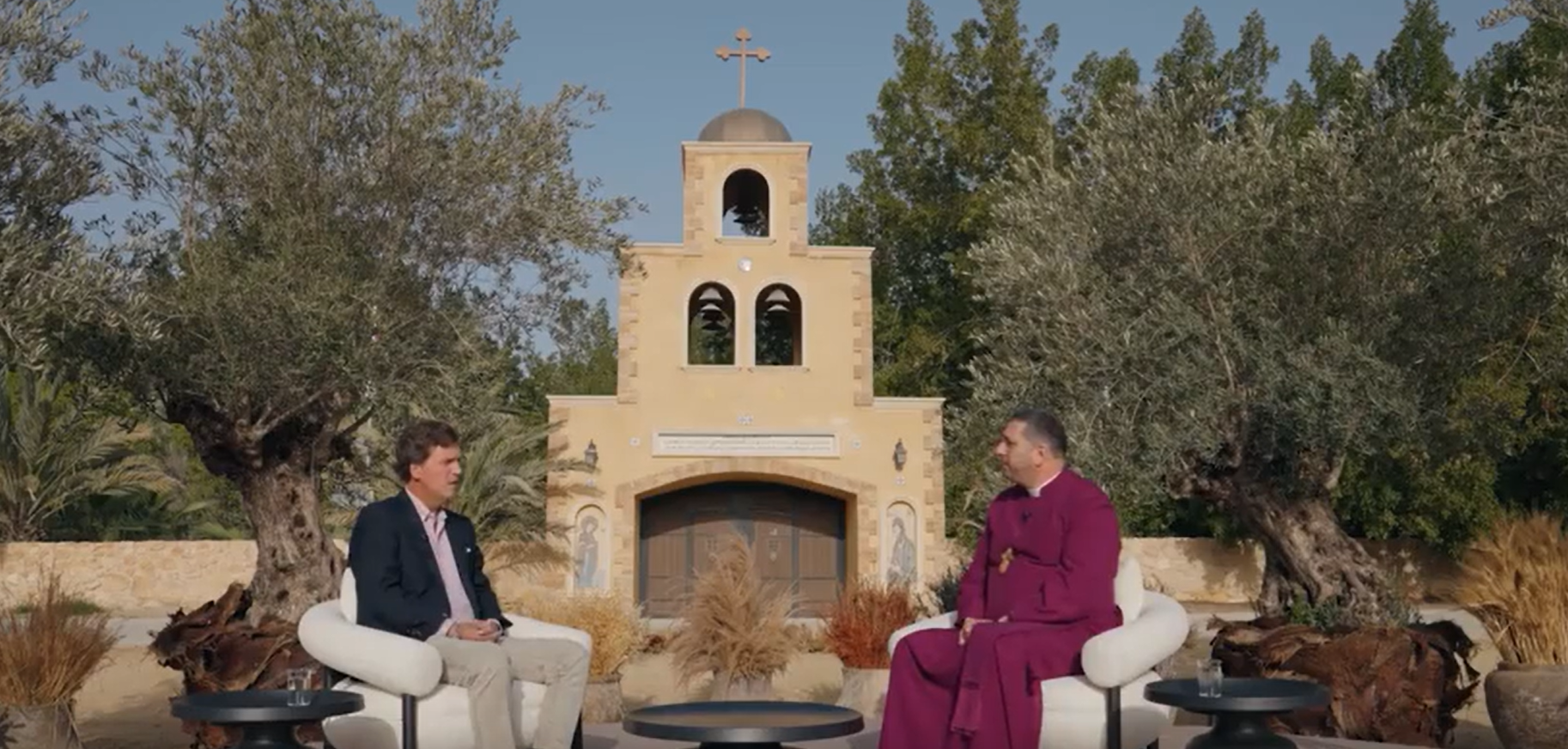
A recent episode of The Tucker Carlson Show featuring the Anglican Archbishop of Jerusalem, Hosam Naoum, has drawn criticism for presenting what fact-checkers describe as a distorted picture of Christians’ status in Israel and the broader Middle East.
During the Jordan-based interview, Carlson and Archbishop Naoum discussed the condition of Christians in the Holy Land, but their conversation contained numerous mischaracterizations regarding Christian demographics, Israeli policies, and historical events in the region.
Contrary to claims made during the broadcast that Christian populations are shrinking in Israel, official data from Israel’s Central Bureau of Statistics shows the Christian population in Israel stands at approximately 184,000 and is growing. In fact, the percentage of the Christian population in Israel increased by 0.7% from 2023 to 2024 alone.
While Carlson attributed Christian regional demographic decline solely to Israel’s establishment in 1948, historical records indicate this trend began before Israel’s founding. Moreover, in stark contrast to neighboring countries, Israel remains the only jurisdiction in the Middle East where the Christian population has grown in absolute numbers over recent decades.
The conversation notably omitted the significant decline of Christian populations in Palestinian-controlled areas. For example, Bethlehem, which was approximately 75% Christian before the 1993 Oslo Accords, saw its Christian population drop to about 10% after three decades of Palestinian rule. This decline has been attributed by some observers to harassment, violence, and property confiscation by extremist groups.
Public polling from the Palestinian Center for Policy and Survey Research has indicated that a significant percentage of Palestinian Christians feel discriminated against when seeking jobs or Palestinian Authority services, with nearly a third reporting they “do not see themselves integrated or feel hated by Muslim citizens.”
The discussion also presented a misleading impression of Christians’ social and economic standing in Israel. Recent analysis of Israel’s Central Bureau of Statistics data published in The Jerusalem Post described Israel’s Christian community as “marked by high educational attainment, strong female workforce participation, and demographic patterns that mirror trends seen in Christian communities across the developed world.” Christian students in Israel consistently achieve higher matriculation rates than the general population.
Carlson and the archbishop also misrepresented several historical events, including the circumstances of the 1948 and 1967 wars, a 2002 incident at the Church of the Nativity, and a 2023 explosion at Al-Ahli Hospital in Gaza. In each case, critical context was omitted that would have provided viewers a more complete understanding of these complex situations.
The discussion further contained questionable characterizations of Christian Zionism, suggesting that all Christian Zionists are motivated by eschatological beliefs and focused on converting Jews. Research by scholars of Christian Zionism indicates that most Christian Zionists ground their support for Israel in biblical authority, belief in God’s faithfulness, and recognition of Judeo-Christian shared values rather than end-times theology.
Many prominent Christian Zionist leaders and organizations have publicly disavowed active proselytizing of Jews in Israel, contrary to the impressions given during the broadcast. Organizations like Christians United for Israel (CUFI) and the International Christian Embassy Jerusalem have explicitly rejected proselytizing activities.
By presenting a one-sided narrative that demonizes Israel while idealizing Christian-Muslim relations in the region, critics argue that Carlson’s program failed to provide viewers with an accurate representation of the complex realities facing Christians in the Holy Land, ultimately making peace in the region less, not more, likely.
The broadcast serves as a reminder of the importance of comprehensive, balanced reporting on sensitive geopolitical and religious issues, particularly in regions as complex as the Middle East.
Fact Checker
Verify the accuracy of this article using The Disinformation Commission analysis and real-time sources.

7 Comments
The discussion of Christians in Israel seems to be a complex and nuanced issue. It would be helpful to hear perspectives from a range of reliable sources, not just a single interview, to get a more balanced understanding of the facts and trends.
The demographic shifts and challenges facing Christian populations in the Middle East merit serious, well-researched analysis. Resorting to simplistic narratives or unsubstantiated claims risks undermining efforts to understand and address the real issues at hand.
As with any complex geopolitical topic, I think it’s important to approach discussions about Christians in Israel and the Middle East with nuance and an openness to diverse perspectives. Relying on a single source risks presenting an incomplete or biased picture.
While it’s concerning if Christian populations are declining in the region, the reasons behind this seem to be multifaceted. Oversimplifying or mischaracterizing the situation doesn’t seem productive. Thoughtful, evidence-based analysis is needed to address this challenge.
Agreed, making claims without carefully examining the data and historical context could spread misinformation, even if unintentionally. A more thorough, impartial examination of the issue would be valuable.
It’s concerning to hear allegations of misinformation being spread about such an important and sensitive issue. Ensuring factual accuracy and balance in reporting on the status of Christian communities in the region should be a priority.
Agreed. Fact-checking and seeking out multiple authoritative sources is crucial when covering topics like this that have profound social and political implications.