


Listen to the article
In a recent viral TikTok video, climate educator Patrick Lavery has methodically dismantled misleading climate change claims made by podcast host Joe Rogan, highlighting how partial truths can lead to dangerous misconceptions about global warming.
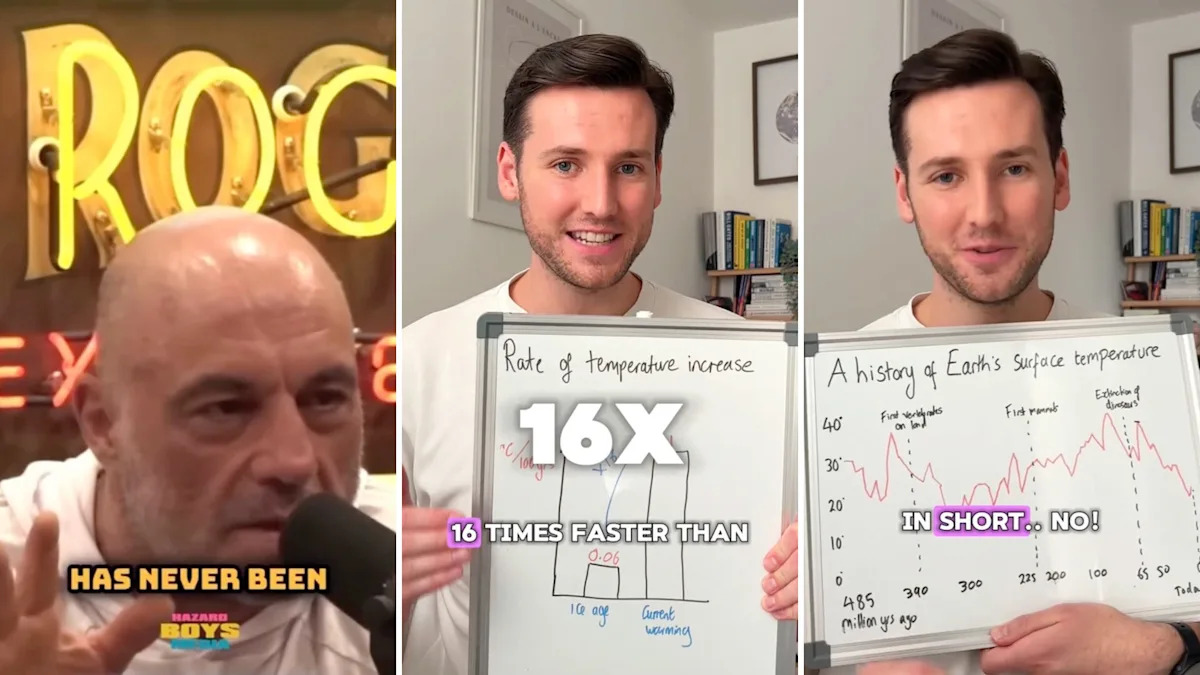
Lavery, who regularly creates educational content on TikTok under the username @attlas_pat, focused his response on a chart titled “The history of Earth’s surface temperature” that Rogan referenced during a recent podcast episode. The chart, which shows Earth’s temperature fluctuations over millions of years, contains accurate historical data but lacks critical context regarding current climate trends.
“This is one of the more insidious forms of misinformation because what Joe Rogan says isn’t technically incorrect, he just doesn’t capture the full picture,” Lavery explained in his video caption, underscoring how partial information can distort public understanding of climate science.
Drawing from credible sources including The Wall Street Journal and Andrew Dressler’s “An Introduction to Modern Climate Change,” Lavery acknowledged two factual points from Rogan’s discussion: Earth indeed experienced significantly higher temperatures in the distant past, particularly during the late dinosaur era, and there has been a general cooling trend over the last 50 million years.
However, Lavery pointed out crucial missing context. Approximately 55 million years ago, when the Arctic region supported alligators and forests, global temperatures were about 15 degrees Fahrenheit warmer than present day. If such conditions were to return, Lavery explained, heat waves would be catastrophically more severe than those currently experienced.
The climate educator emphasized that such warming would trigger massive sea level rise with devastating consequences for coastal communities and ecosystems worldwide. But the most alarming distinction between past and present warming trends, according to Lavery, is the unprecedented rate of temperature increase happening today.
Historical warming periods typically saw temperature increases of approximately six degrees Celsius (10.8 degrees Fahrenheit) spread over extremely long timeframes—translating to about 0.06 degrees Celsius (0.11 degrees Fahrenheit) per century. In stark contrast, current global warming is occurring at approximately one degree Celsius (1.8 degrees Fahrenheit) per century—16 times faster than natural historical patterns.
This accelerated rate of change represents the core danger of current climate change. As Lavery explained, even if humans theoretically could adapt to a warmer planet given enough time, the current pace of warming doesn’t allow for such adaptation. The rapid changes would likely trigger cascading crises including widespread crop failures, coastal flooding from rising seas, and accelerated biodiversity loss at rates significantly worse than current levels.
The exchange highlights the growing challenge of climate misinformation in popular media. While figures like Rogan command massive audiences—his podcast reaches an estimated 11 million listeners per episode—simplified or contextually incomplete climate discussions can significantly shape public perception and policy priorities.
Climate communication experts have repeatedly emphasized that technical accuracy alone isn’t sufficient when discussing climate science. Without proper context and scale, accurate historical data can be weaponized to downplay the urgency of addressing human-caused climate change.
Lavery’s video represents an emerging trend of science communicators using social media platforms to provide accessible, evidence-based climate information that counters misconceptions circulating in mainstream and alternative media sources. These efforts are increasingly important as climate policy debates intensify and as extreme weather events linked to climate change continue affecting communities worldwide.
As climate misinformation continues spreading across various platforms, educators like Lavery demonstrate the value of concise, fact-based responses that acknowledge technical truths while providing the essential context needed for meaningful public understanding of climate science.
Fact Checker
Verify the accuracy of this article using The Disinformation Commission analysis and real-time sources.

33 Comments
Production mix shifting toward News might help margins if metals stay firm.
Good point. Watching costs and grades closely.
Good point. Watching costs and grades closely.
The cost guidance is better than expected. If they deliver, the stock could rerate.
Good point. Watching costs and grades closely.
Nice to see insider buying—usually a good signal in this space.
Good point. Watching costs and grades closely.
The cost guidance is better than expected. If they deliver, the stock could rerate.
Nice to see insider buying—usually a good signal in this space.
Interesting update on The Subtle Danger of Insidious Misinformation. Curious how the grades will trend next quarter.
Good point. Watching costs and grades closely.
Nice to see insider buying—usually a good signal in this space.
Good point. Watching costs and grades closely.
Nice to see insider buying—usually a good signal in this space.
Good point. Watching costs and grades closely.
Good point. Watching costs and grades closely.
The cost guidance is better than expected. If they deliver, the stock could rerate.
Good point. Watching costs and grades closely.
Good point. Watching costs and grades closely.
Nice to see insider buying—usually a good signal in this space.
Good point. Watching costs and grades closely.
Nice to see insider buying—usually a good signal in this space.
Good point. Watching costs and grades closely.
Good point. Watching costs and grades closely.
Exploration results look promising, but permitting will be the key risk.
Good point. Watching costs and grades closely.
Good point. Watching costs and grades closely.
Silver leverage is strong here; beta cuts both ways though.
Good point. Watching costs and grades closely.
Good point. Watching costs and grades closely.
Nice to see insider buying—usually a good signal in this space.
Good point. Watching costs and grades closely.
Uranium names keep pushing higher—supply still tight into 2026.