


Listen to the article
Nature’s Lessons: What Fish and Bacteria Can Teach Us About Misinformation
Earlier this year, the National Academies of Sciences, Engineering and Medicine issued a stark warning about the proliferation of scientific misinformation. Social media platforms have become breeding grounds for falsehoods—from flat Earth theories to climate change denial—that can lead to widespread harm, undermining public health and environmental well-being.
“The stakes in understanding the origins, spread, and the impact of misinformation about science are high,” the authors cautioned in their report.
Now, a team of Cornell University researchers is suggesting an unexpected source of insight: the animal kingdom. In a study published Wednesday in the journal Interface, they propose that humans aren’t the only species battling misinformation—fish, flies, and even bacteria face similar challenges.
“I hope we can learn something from these natural systems,” said Andrew Hein, a computational biologist and co-author of the study. Hein’s interest in natural misinformation emerged through his research observing fish schools near coral reefs off the French Polynesian island of Mo’orea.
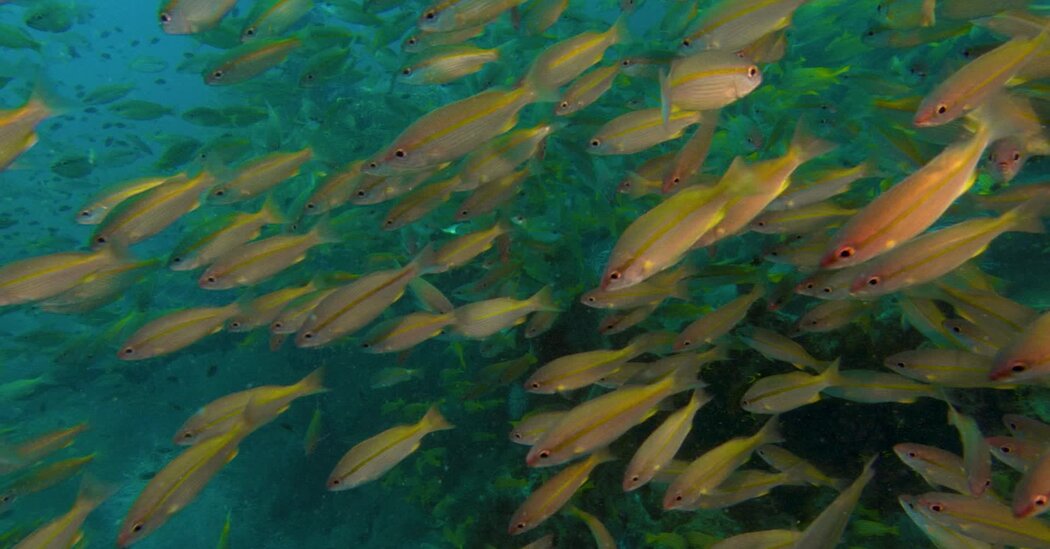
The researchers noticed that fish in schools benefit from collective awareness—when one fish detects a predator and changes direction, that information rapidly spreads through the entire group, allowing a coordinated escape. However, Hein was struck by how often false alarms occurred.
“It’s safe, there’s nothing going on,” he explained. “But all of a sudden, it will just flee for its life.” Other fish would notice this behavior and flee as well, creating what Hein recognized as “misinformation cascades”—eerily similar to how false information spreads across social media platforms.
This phenomenon isn’t limited to fish. The researchers discovered that animals living in large groups—from baboons to termites—constantly communicate information, creating opportunities for misinformation to infiltrate their social systems. Even bacteria send signals to each other about environmental threats, using shared information to mount collective defenses.
Studying misinformation in non-human species presents unique challenges. “It’s a really hard thing to study,” Hein noted. “You can’t ask a bacterium, ‘Did you believe what this other bacterium told you or not?'” The complexity of information networks in these societies further complicates research efforts.
To address these challenges, Hein’s team developed mathematical models applicable to any species. These tools allow researchers to estimate the accuracy of an organism’s beliefs and how information from others alters those beliefs. Their analysis led to a remarkable conclusion: misinformation appears to be a fundamental component of all natural communication systems—and a significant threat to survival.
This perspective challenges previous biological thinking, which often viewed misinformation as a minor inconvenience. While some researchers thought the occasional false alarm—like a fish darting away unnecessarily—represented only a small energy cost outweighed by predator avoidance benefits, Hein argues the stakes are much higher.
“The cost isn’t missing one lunch,” Hein explained. “It’s missing all lunches.” In other words, persistently reacting to false alarms can threaten an organism’s very survival.
Walter Quattrociocchi, a data scientist at Sapienza University of Rome who wasn’t involved in the study, agreed with this assessment. “It shows that misinformation is not an anomaly or a moral failure, but a structural consequence of communication systems operating under noise, limited context and imperfect decoding,” he said.
The researchers discovered that evolution has equipped species with defensive mechanisms against misinformation. In his fish research, Hein observed that while fish in small groups are highly sensitive to the movements of nearby fish, those in larger schools “dial back” this sensitivity. This adaptation doesn’t eliminate false alarms but prevents them from cascading through entire schools.
“I suspect that there have to be lots of mechanisms for dealing with misinformation in these social systems,” Hein said. “Otherwise they just would not be able to persist.”
Not all experts are convinced by the models proposed in the study. Cailin O’Connor, a misinformation expert at the University of California, Irvine, argued that they’re too simplistic to capture misinformation’s complex effects, since a single piece of information can influence multiple beliefs simultaneously.
The field of misinformation research faces significant political headwinds. The Trump administration has accused researchers of attempting to censor free speech, canceling research grants and blocking visas for international misinformation researchers coming to work in the United States.
These disruptions come amid ongoing academic debates about the nature of misinformation. Some researchers argue that narrowly true but misleading information poses a greater societal threat than obviously fake news.
O’Connor believes nature might offer valuable lessons for addressing human misinformation. Rather than focusing solely on making individuals better at evaluating online content—which has inherent limitations—she suggests we need systemic solutions.
“Stop trying to make people smart,” she said. “We’re only going to get so good. What we really need are good algorithms.”
Fish don’t combat misinformation through fact-checking; they adjust their sensitivity to incoming information. As Hein concluded, “We clearly need more ideas for how to cope with this problem as a social species. Maybe it’s possible to find some if we look at other species.”
Fact Checker
Verify the accuracy of this article using The Disinformation Commission analysis and real-time sources.

10 Comments
This is a timely and important study. Misinformation poses significant risks, from public health to environmental protection to financial markets. Glad to see researchers taking an interdisciplinary, comparative approach to understanding its underlying mechanisms. Looking forward to seeing the findings.
Fascinating study on how misinformation spreads in natural systems. I’m curious to learn more about the parallels between how fish, bacteria, and humans process and propagate false information. Understanding the underlying dynamics could help us develop more effective strategies to combat misinformation.
As someone who closely follows mining, energy, and commodity news, I’m very interested in how this research could apply to those industries. Inaccurate claims about reserves, production, or market trends can have significant financial and regulatory impacts. Curious to see if the study looks at misinformation in technical domains like these.
As someone who closely follows mining and commodity news, I’m concerned about the potential impact of misinformation in these technical fields. Inaccurate claims about, say, mineral reserves or production costs could sway investor decisions and market prices. Curious to see if this research examines misinformation in specialized domains like this.
Wow, I didn’t realize misinformation was such a widespread issue across the animal kingdom. It makes sense that natural selection would favor the ability to quickly spread information, whether accurate or not. Can’t wait to see what insights this research uncovers about the origins and spread of false facts in human society.
As someone with a background in mining and commodities, I’m very interested in how this research could apply to those industries. Inaccurate claims about mineral reserves, production costs, or market trends could have major financial impacts. Curious to see if the study examines misinformation in technical domains like this.
Fascinating to think about misinformation in the context of natural selection and evolutionary biology. I wonder if certain species are more prone to spreading false information due to their social structures, communication methods, or cognitive biases. Could be some interesting parallels to human social media dynamics.
Fascinating research that takes an interdisciplinary approach to understanding the complex issue of misinformation. Glad to see scientists examining how this phenomenon manifests across different species and natural systems. The parallels to human social media dynamics could yield some really valuable insights.
Interesting angle to look at the misinformation problem through an evolutionary lens. I wonder if there are specific cognitive biases or behaviors in various species that make them prone to believing and sharing misinformation. This could shed light on why humans seem so susceptible to falling for fake news and conspiracy theories.
Really fascinating to think about misinformation from an evolutionary biology perspective. I wonder if certain cognitive biases or communication behaviors that provide an advantage in natural systems also make species more prone to believing and spreading false information. Could be some interesting parallels to human psychology and social media dynamics.