


Listen to the article
In a rare escalation of diplomatic tensions, South African President Cyril Ramaphosa has strongly rebuffed claims made by the United States regarding the treatment of white South Africans, calling them “blatant misinformation” during a televised address on Sunday.
The sharp response comes after U.S. President Donald Trump has repeatedly promoted unfounded allegations of “white genocide” against Afrikaners—descendants of European colonizers who represent a minority population in South Africa. These claims have circulated among right-wing groups for years but lack factual basis according to human rights organizations and independent analysts.
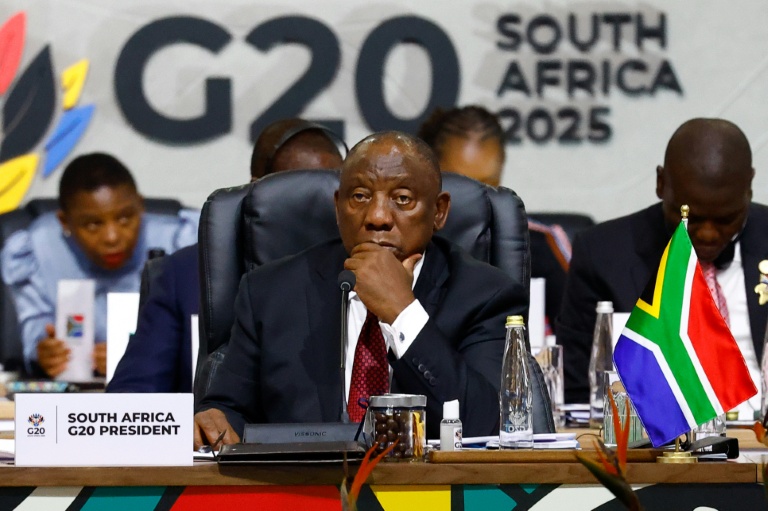
“The reasons the U.S. gave for its non-participation [in the G20 summit] were informed by baseless and false allegations that South Africa is perpetrating genocide against Afrikaners and the confiscation of land from white people,” Ramaphosa stated on the South African Broadcasting Corporation (SABC).
The diplomatic rift widened last week when the United States boycotted the G20 summit hosted in Johannesburg. Trump further announced on Wednesday that South Africa would not be invited to the next G20 meeting, which he intends to host at his family-owned golf course in Miami.
Ramaphosa did not mince words about the source of these allegations: “As a country, we are aware that the stance taken by the U.S. administration has been influenced by a sustained campaign of disinformation by groups and individuals within our country, in the U.S. and elsewhere.”
The controversy touches on South Africa’s complex land reform issues, which have been a contentious political topic since the end of apartheid in 1994. While the government has pursued policies aimed at addressing historical inequalities in land ownership, claims of widespread land seizures or targeted violence against white farmers have been repeatedly debunked by fact-checkers and research organizations.
The South African president warned that those spreading such misinformation are “endangering and undermining South Africa’s national interests, destroying South African jobs and weakening our country’s relations with one of our most important partners.”
The U.S. remains one of South Africa’s largest trading partners, with bilateral trade valued at approximately $17.8 billion in 2022, according to the U.S. Trade Representative’s office. The strained relationship could potentially impact economic ties, including South Africa’s participation in the African Growth and Opportunity Act (AGOA), which provides duty-free access to U.S. markets for eligible sub-Saharan African countries.
Despite the harsh rhetoric, Ramaphosa extended an olive branch by expressing South Africa’s willingness “to continue to engage in dialogue with the United States government, and to do so with respect and with dignity as equal sovereign countries.”
The confrontation highlights the growing challenges in U.S.-Africa relations under the Trump administration, which has shown less engagement with the continent than previous administrations. Analysts note that this approach contrasts sharply with increasing Chinese and Russian influence across Africa, particularly in resource-rich nations like South Africa.
South Africa, as Africa’s most industrialized economy and a member of the BRICS economic bloc alongside Brazil, Russia, India, and China, has been pursuing a more independent foreign policy in recent years, often positioning itself as a voice for the Global South in international forums.
The false narrative of “white genocide” in South Africa has been particularly persistent in certain media ecosystems despite repeated refutation. It gained renewed attention in 2018 when Trump first tweeted about the issue, prompting diplomatic tension at that time as well.
As both nations navigate this diplomatic impasse, regional stability advocates hope for a return to evidence-based dialogue that acknowledges South Africa’s complex social history while working toward mutually beneficial relations between the two democracies.
Fact Checker
Verify the accuracy of this article using The Disinformation Commission analysis and real-time sources.

32 Comments
Silver leverage is strong here; beta cuts both ways though.
Good point. Watching costs and grades closely.
Uranium names keep pushing higher—supply still tight into 2026.
Good point. Watching costs and grades closely.
Good point. Watching costs and grades closely.
Nice to see insider buying—usually a good signal in this space.
Uranium names keep pushing higher—supply still tight into 2026.
If AISC keeps dropping, this becomes investable for me.
Good point. Watching costs and grades closely.
Nice to see insider buying—usually a good signal in this space.
Good point. Watching costs and grades closely.
Good point. Watching costs and grades closely.
Silver leverage is strong here; beta cuts both ways though.
Good point. Watching costs and grades closely.
Good point. Watching costs and grades closely.
Production mix shifting toward News might help margins if metals stay firm.
Good point. Watching costs and grades closely.
Good point. Watching costs and grades closely.
Nice to see insider buying—usually a good signal in this space.
Good point. Watching costs and grades closely.
Good point. Watching costs and grades closely.
Uranium names keep pushing higher—supply still tight into 2026.
Good point. Watching costs and grades closely.
Good point. Watching costs and grades closely.
Uranium names keep pushing higher—supply still tight into 2026.
If AISC keeps dropping, this becomes investable for me.
Good point. Watching costs and grades closely.
Good point. Watching costs and grades closely.
Nice to see insider buying—usually a good signal in this space.
Good point. Watching costs and grades closely.
The cost guidance is better than expected. If they deliver, the stock could rerate.
I like the balance sheet here—less leverage than peers.