


Listen to the article
President Trump’s decision to bar South Africa from the 2026 G20 summit in Florida has sparked a diplomatic row, with South African officials accusing him of spreading misinformation about the country’s treatment of white farmers.
In a Truth Social post on Wednesday, Trump announced that South Africa would not receive an invitation to next year’s G20 meeting at his Doral golf club in Miami. He cited alleged persecution of white farmers as the reason for the exclusion and stated he would halt all U.S. payments and subsidies to the nation.
The office of South African President Cyril Ramaphosa responded with a strongly worded statement, expressing regret that “despite the efforts and numerous attempts by President Ramaphosa and his administration to reset the diplomatic relationship with the US, President Trump continues to be vindictive and seek to apply punitive measures against South Africa based on misinformation and distortions about our country.”
This latest clash follows Trump’s decision to boycott the recent G20 summit held in Johannesburg. According to Trump, his grievance was compounded when South Africa refused to transfer its G20 hosting responsibilities to a U.S. Embassy representative at the conclusion of the summit.
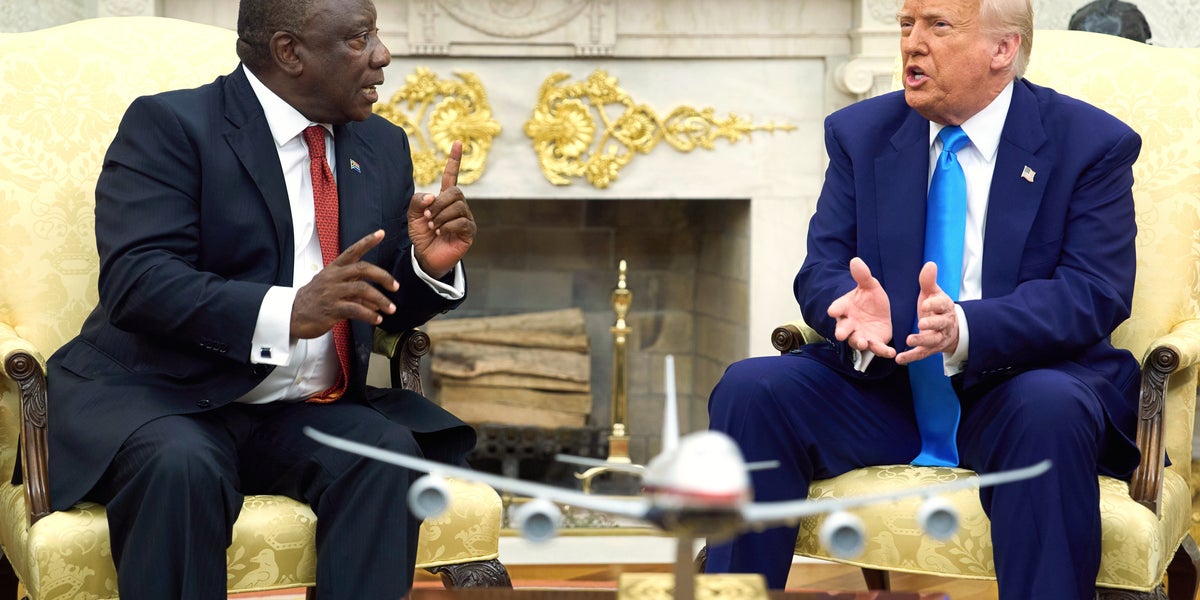
The disagreement has roots in a contentious White House meeting in May, where Trump surprised Ramaphosa with allegations about attacks on white farmers in South Africa. During that encounter, Trump showed a video depicting what he characterized as “Death, death, death, horrible death” in the country. When Trump claimed white farmers were being “executed,” Ramaphosa directly contradicted him, stating “they’re not.”
South African officials have consistently rejected Trump’s characterization of the situation, denying claims that white Afrikaner farmers are systematically being killed or having their land seized. These allegations, which have circulated in right-wing media for years, have been repeatedly debunked by fact-checkers and human rights organizations.
The dispute highlights growing tensions between the United States and South Africa, a nation that continues to grapple with the legacy of racial apartheid that officially ended in 1994. South Africa remains a significant regional power in Africa and an important strategic partner for many Western nations.
Trump’s fixation on this issue appears to have intensified since bringing Tesla CEO Elon Musk, who was born in South Africa, into his administration. Musk, who left South Africa as a young man, has been appointed to lead the newly created Department of Government Efficiency.
The president’s policy decisions reflect his position on this matter. While Trump suspended the broader U.S. refugee program in January, reports indicate that the few refugees currently entering the country are predominantly white South Africans.
In its response to Trump’s G20 announcement, South Africa emphasized that it “does not appreciate insults from another country about its membership and worth in participating in global platforms.” The statement underscores growing concerns about deteriorating diplomatic relations between the two nations.
The G20, comprised of 19 countries plus the European Union, represents the world’s largest economies. Being excluded from such a forum could have significant implications for South Africa’s global economic standing and diplomatic influence.
International relations experts note that such public disputes between heads of state are unusual in diplomatic circles, where disagreements are typically handled through private channels before escalating to public statements. The confrontational approach taken by both sides suggests a fundamental breakdown in diplomatic communication.
As the 2026 G20 summit approaches, questions remain about whether this position will hold and what implications it might have for broader U.S.-African relations during Trump’s second term.
Fact Checker
Verify the accuracy of this article using The Disinformation Commission analysis and real-time sources.

9 Comments
The allegations of persecution of white farmers in South Africa are concerning, but the US response of excluding the country from the G20 summit seems overly punitive. I wonder if there are underlying geopolitical factors at play here beyond just the agricultural issues.
Agreed, the diplomatic fallout seems disproportionate to the original grievances. There may be deeper tensions and power dynamics at work that are driving this conflict.
Interesting diplomatic dispute between the US and South Africa. It seems like there are accusations of misinformation and political maneuvering on both sides. As an observer, I’m curious to see how this plays out and whether it can be resolved amicably.
Yes, it’s a complex issue with both countries making claims. Hopefully they can find a way to move past this and strengthen their relationship going forward.
This dispute highlights the challenges of maintaining stable international relationships, even between long-standing allies like the US and South Africa. Navigating issues of race, land rights, and economic interests is clearly no easy task for political leaders on both sides.
As a mining and commodities investor, I’m watching this dispute closely. South Africa is a major producer of gold, platinum, and other key minerals. Any deterioration in US-SA relations could have ripple effects on global supply chains and commodity prices.
That’s a good point. Any disruption to South Africa’s mining and export capabilities could significantly impact global markets, especially for precious metals. This is certainly an issue worth monitoring.
The accusations of ‘vindictive misinformation’ by South Africa seem quite strong. I wonder if there is more to this story than is being reported in the media. It would be helpful to get a more balanced perspective on the underlying issues.
Agreed, there may be more nuance and context that is not being captured. It’s important to seek out multiple viewpoints before drawing conclusions on complex geopolitical disputes like this one.