


Listen to the article
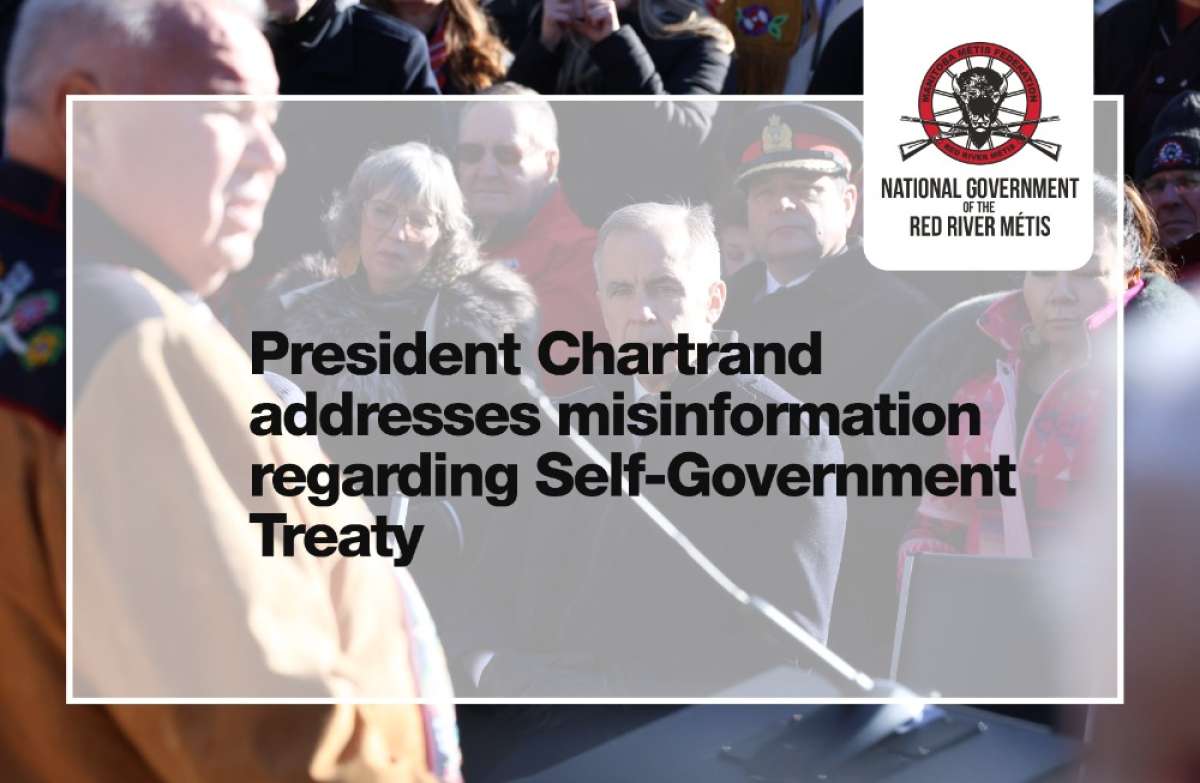
In a significant move to address growing concerns and misconceptions, Manitoba Métis Federation (MMF) President David Chartrand has publicly confronted what he describes as deliberate misinformation surrounding the Métis Government Recognition and Self-Government Agreement.
Speaking at a recent address, Chartrand emphasized the importance of understanding the historical and legal foundation of the agreement, which recognizes the Manitoba Métis as the “founders of Manitoba” and acknowledges their inherent right to self-government.
“What we’re witnessing is a concerning pattern of misinformation being spread about our self-government treaty,” Chartrand explained. “This agreement represents decades of struggle and negotiation to have our rights as a distinct Indigenous people recognized and respected.”
The self-government agreement, signed after years of negotiation with the federal government, affirms the Manitoba Métis Federation’s authority to govern in key areas affecting their community, including citizenship, language, culture, and internal operations. It also establishes a framework for future negotiations on additional jurisdictions.
Chartrand specifically addressed allegations that the agreement diminishes or threatens the rights of other Indigenous groups, calling such claims “fundamentally untrue” and “divisive.” He emphasized that the Métis self-government model operates in parallel with existing Indigenous governance structures, not in competition with them.
“Our self-determination does not come at the expense of any other nation’s rights,” Chartrand stated. “This agreement is about recognizing the unique place of the Métis Nation’s Manitoba Métis community in Canadian history and our constitutional rights as affirmed in Section 35 of the Constitution Act.”
The MMF President also clarified confusion regarding the agreement’s scope, explaining that it does not create new rights but rather provides a framework to implement existing constitutional rights that have been repeatedly affirmed by the Supreme Court of Canada in landmark cases like the Manitoba Métis Federation v. Canada decision of 2013.
Indigenous governance experts note that the Métis self-government agreement represents part of a broader trend in Canada’s evolving approach to Indigenous relations. Dr. Sarah Johnson, a professor of Indigenous studies at the University of Manitoba, explains that the agreement “reflects the federal government’s gradual shift toward recognizing the inherent rights of Indigenous peoples rather than treating these rights as delegated from the Crown.”
The agreement comes at a time when Indigenous self-determination is increasingly recognized internationally. The United Nations Declaration on the Rights of Indigenous Peoples, which Canada has endorsed, explicitly supports Indigenous peoples’ right to self-government and autonomy in matters relating to their internal affairs.
Economic implications of the agreement are substantial. The MMF has been developing capacity in areas of economic development, housing, healthcare, and education. With formalized self-government powers, the organization is positioned to implement more comprehensive community development strategies that could significantly improve socioeconomic conditions for Manitoba Métis citizens.
“This isn’t just about political recognition,” Chartrand noted. “It’s about creating tangible improvements in the lives of our people through self-directed governance and economic development.”
The MMF has launched a public education campaign to counter misinformation, including community information sessions and detailed documentation available through their official channels. Chartrand urged both Métis citizens and the broader public to seek information directly from the MMF rather than relying on secondhand accounts or social media discussions.
“Our doors are always open for those with questions about what this agreement means,” Chartrand said. “Transparency and understanding are essential as we move forward with implementation.”
As the MMF works to implement the self-government agreement, they face the challenge of balancing traditional governance practices with modern administrative requirements. The federation has been developing capacity-building programs to ensure effective governance structures are in place as they assume greater jurisdictional responsibilities.
Provincial and municipal governments across Manitoba are now working to establish new relationships with the MMF that recognize its enhanced status under the self-government agreement, though challenges remain in clarifying jurisdictional boundaries in certain policy areas.
Fact Checker
Verify the accuracy of this article using The Disinformation Commission analysis and real-time sources.

13 Comments
This is an important development in the recognition of Métis rights and self-governance. While there may be some misinformation circulating, it’s crucial that the historical context and legal basis for this agreement are properly understood.
Agreed. Establishing a formal framework for Métis self-government is a significant milestone that should be approached with open dialogue and good-faith efforts to address any lingering concerns or misconceptions.
This seems like an important step forward in recognizing Métis rights and self-determination. Addressing misinformation proactively is a wise move by President Chartrand to ensure the agreement’s intent and provisions are properly understood.
Agreed. Open communication and a facts-based approach will be crucial as this self-government agreement is implemented and its impacts are assessed over time.
As an observer, I’m curious to learn more about the specific provisions in this Métis self-government agreement and how they will impact the community’s autonomy and decision-making processes.
Same here. The details on the scope of jurisdictions and governance structures will be crucial in understanding the real-world implications of this historic agreement.
Appreciative of President Chartrand’s efforts to provide clarity and correct any misinformation around this historic Métis self-government agreement. Establishing recognized rights and self-governance is crucial for Indigenous communities.
Interesting to see the Métis Federation taking a proactive stance to address misinformation. Establishing a formal self-government agreement is an important milestone that deserves close attention.
Curious to learn more about the specific jurisdictions that will be under the Métis Federation’s authority as part of this self-government agreement. It seems like an important step in strengthening Indigenous sovereignty.
Me too. The details on the scope of jurisdiction and how it will be implemented in practice will be important to understand. Glad to see President Chartrand taking a proactive approach to address any misinformation.
Skeptical of any claims of misinformation until I can review the full text of the self-government agreement and understand the legal basis and negotiation process. Transparency is key on complex Indigenous rights issues.
This self-government agreement seems like a complex issue with a lot of nuance. I hope the public discourse on it can remain fact-based and constructive, avoiding unnecessary polarization.
Agreed. Open and honest dialogue, grounded in the legal and historical context, will be key to ensuring a successful implementation of this self-governance framework.