


Listen to the article
Pakistan’s Social Media Triumph in the 2025 Information War with India
In the digital battleground of modern warfare, Pakistan has demonstrated remarkable prowess in countering Indian propaganda during the May 2025 conflict between the two nations. Moving beyond traditional military engagement, this confrontation highlighted how information warfare has become a critical component of contemporary conflicts, with social media emerging as a decisive battlefield.
The conflict revealed a significant shift in warfare tactics, where narrative control and digital communication have become as important as military strategy. Pakistan successfully leveraged social media platforms to counter misinformation, manage public perception, and maintain credibility on the global stage during the crisis.
Over the past decade, Indian media has increasingly fallen under government influence, with the term “Godi Media” – coined by respected Indian journalist Ravish Kumar – describing news outlets closely aligned with Prime Minister Narendra Modi’s BJP government and its Hindutva ideology. Journalists in India have faced mounting political pressure, financial constraints, and online harassment, severely hampering independent reporting.
A revealing incident occurred in May 2025 when “The Hindu,” a prominent Indian newspaper, published and then hastily removed a report about three Indian fighter jets crashing in Jammu and Kashmir, Rambam, and Pampore. Despite Indian officials denying these events on May 6-7, the circulation of wreckage images contradicted the official narrative, exposing state influence over media reporting.
Indian news channels and online platforms spread fabricated stories claiming “imminent strikes” and “Pakistan’s heavy losses,” using manipulated visual content to bolster these false narratives. One particularly outlandish claim suggested Pakistan had attacked Amritsar, while digital missile tracking actually showed that four missiles were launched from India’s Adampur air base. Other sensationalist headlines announced the “destruction of Karachi,” “Islamabad fall,” and even the “arrest of General Asim Munir” – claims that were quickly debunked.
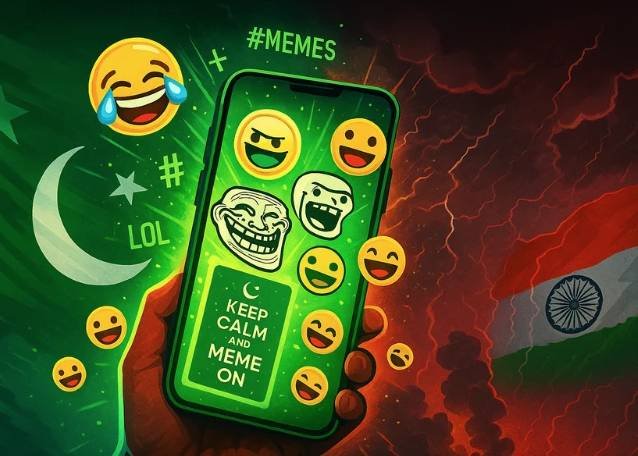
In response to this misinformation barrage, Pakistan deployed a surprisingly effective countermeasure: meme culture. Led primarily by digitally-native Gen-Z Pakistanis, this “meme war” became an innovative application of soft power. When Indian media claimed Karachi had been “destroyed,” Pakistani social media users responded with humor: “According to India we all are dead. This is my soul, and I’m tweeting from Heaven!”
Another viral Pakistani meme about downed Indian fighter jets cleverly referenced the famous movie title “Taaray Zameen Per” (stars razed to ground). These humorous responses served multiple purposes – countering false information, relieving public anxiety, and strengthening social cohesion during a period of heightened tension.
The Indian government also attempted to restrict Pakistani digital influence by blocking access to Pakistan government officials, actors, and celebrities as part of what they termed a “counter disinformation effort.” However, this approach proved less effective than Pakistan’s agile social media strategy.
Pakistan’s success in this information war stemmed from a combination of coordinated official messaging, active digital engagement, and the strategic use of humor as both a coping mechanism and a unifying force. Rather than allowing panic to spread, Pakistan’s social media community transformed potential fear into collective resilience.
The May 2025 crisis demonstrates that narrative control has become an essential element of modern national security and international relations. For countries facing similar challenges, Pakistan’s approach offers valuable lessons in countering misinformation campaigns while maintaining both domestic morale and international credibility.
As digital battlefields continue to evolve, the capacity to quickly respond to propaganda with clarity, creativity and coordination may prove just as vital as traditional military capabilities in future conflicts.
Fact Checker
Verify the accuracy of this article using The Disinformation Commission analysis and real-time sources.

9 Comments
The article’s insights into the role of social media and digital communication in modern warfare are quite compelling. Pakistan’s experience in the 2025 conflict with India demonstrates the importance of narrative control and public perception management in contemporary conflicts. This is an important development that will likely shape the future of geopolitics and conflict resolution.
Absolutely. The increasing prominence of digital battlegrounds in modern warfare is a significant shift that will require countries to continuously adapt their strategies and approaches. The implications for global stability and security are profound.
It’s fascinating to see how the digital realm has become a new frontier in modern warfare. Pakistan’s ability to leverage social media to counter Indian propaganda during the 2025 conflict is a testament to the evolving nature of information warfare. This is an important development that will likely shape future conflicts.
Absolutely. The shift towards narrative control and digital communication in warfare is a significant development that we’ll need to closely monitor going forward. The implications for global geopolitics and conflict resolution are profound.
The challenges faced by Pakistan’s digital movement in the 2025 conflict with India highlight the growing influence of government-aligned media and the need for transparent, credible information during times of crisis. It will be interesting to see how other countries adapt their strategies to navigate this evolving digital landscape.
Fascinating to see how digital warfare is reshaping modern conflicts. Pakistan’s social media tactics in the 2025 conflict with India highlight the importance of narrative control in today’s information landscape. It will be interesting to see how countries continue to adapt their strategies in this evolving digital battlefield.
You’re right, the role of social media in contemporary conflicts is critical. The ability to shape public perception and counter misinformation can be a decisive factor in the outcome.
The challenges faced by Pakistan’s digital movement are concerning, especially given the growing influence of government-aligned media in India. Maintaining credibility and transparency during information warfare will be crucial for Pakistan to succeed on the global stage.
Agreed. The erosion of press freedom and the rise of ‘Godi Media’ in India are worrying trends that could undermine the integrity of information during conflicts. Pakistan will need to navigate this complex landscape carefully.