


Listen to the article
Age, Partisanship, and the Online Misinformation Paradox
A puzzling trend has emerged in how older adults interact with false information online, according to recent research presented at the Shorenstein Center on Media, Politics and Public Policy’s Misinformation Speaker Series.
While adults over 60 demonstrate strong ability to identify falsehoods in controlled experiments, they paradoxically are more likely than younger adults to share and engage with misinformation on social media platforms.
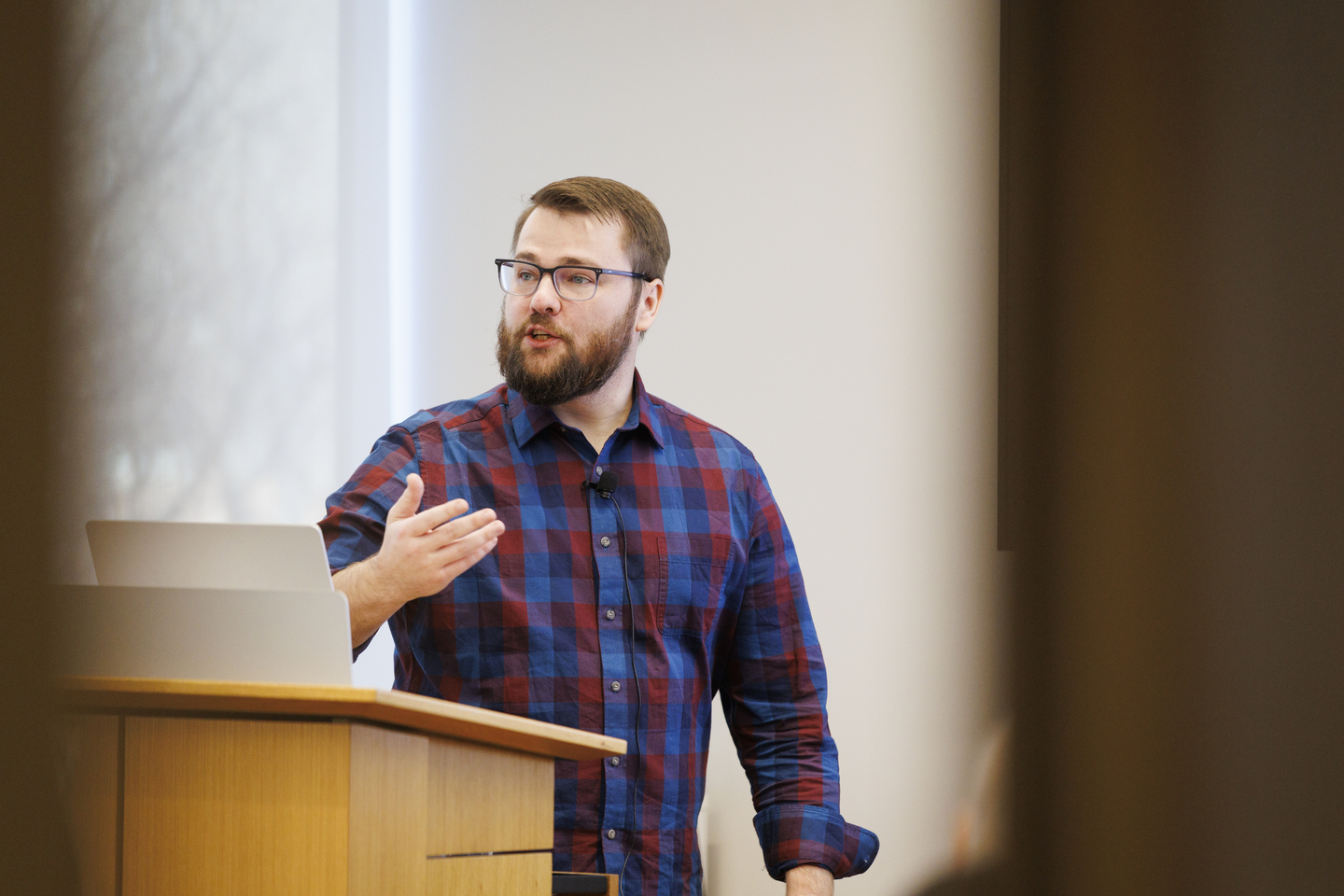
Ben Lyons, assistant professor of communications at the University of Utah who specializes in media, politics, and misinformation research, attributes this contradiction primarily to partisanship and what researchers call “congeniality bias” – the human tendency to accept information that aligns with existing beliefs while rejecting conflicting data.
“Older adults show a lot more congeniality bias,” explained Lyons, whose 2024 paper in Public Opinion Quarterly examined this phenomenon. “Older adults value accuracy, at least in their self-reports, but these age-linked political traits — interest and sophistication and intensity of partisan effects — might reshape what counts as accurate in practice, filtering truth through partisan identity.”
Lyons’ comprehensive study analyzed survey experiments involving approximately 10,000 respondents alongside internet usage data from roughly 4,500 individuals. The findings revealed that adults over 60 were generally as capable of identifying false headlines as younger demographics. Despite this capability, they demonstrated higher propensity to consume and share misleading content.
Common explanations for this behavior often point to declining digital literacy among older populations or cognitive deterioration affecting decision-making processes. However, Lyons’ research suggests a more nuanced reality.
“Digital literacy does in fact decrease with age, not surprisingly,” Lyons noted during his presentation. “But news literacy is always higher in these samples; news literacy increases with age.”
This distinction highlights an important dynamic: while older adults may have less familiarity with online environments and digital platforms, they typically possess greater understanding of news production processes and traditional media evaluation.
The research also challenges assumptions about cognitive aging as a primary factor in vulnerability to misinformation. While certain cognitive abilities may decline with age, such as episodic memory and processing speed, others often improve, including semantic memory, general knowledge, and emotional regulation—factors that could theoretically help in evaluating information accuracy.
Testing this theory, Lyons examined cognitive reflection, which measures an individual’s ability to override intuitive but incorrect initial responses. This ability actually increases with age, but interestingly, its correlation with discernment of false information weakens in older adults.
“Having greater cognitive reflection is associated with much more rejection of false news for younger adults,” Lyons explained. “And for older adults, we see much less of an effect of cognitive reflection on their discernment.” Similar patterns emerged when analyzing emotional reactivity to news content.
After eliminating these common explanations, Lyons’ research points more conclusively toward partisan identity and congeniality bias as the driving factors behind older adults’ engagement with misinformation.
“Older adults tend to rely more on prior knowledge, as a rule, as a general finding, to reduce cognitive load,” he said. “But their prior knowledge, based on this consistently stronger partisanship, at least in the political domain, is more likely to be politically biased.”
Despite these findings, Lyons emphasized an important contextual point: while the percentage of older adults sharing misinformation is higher relative to younger demographics, the absolute numbers remain small within the overall population.
The presentation concluded the Shorenstein Center’s fall 2025 Misinformation Speaker Series, with plans to resume the program in spring.
Fact Checker
Verify the accuracy of this article using The Disinformation Commission analysis and real-time sources.

14 Comments
Fascinating study on the age-related differences in how people engage with online misinformation. Partisanship and confirmation bias seem to play a big role. It’s a complex issue without easy solutions.
You’re right, the study highlights some troubling patterns. Educating older adults on media literacy and critical thinking could help, but addressing underlying partisan divides is key.
This is an important finding, especially as misinformation around mining, commodities, and energy issues can have real-world impacts. Encouraging skepticism and fact-checking, regardless of age or political affiliation, is crucial.
Agreed. Fact-based, impartial information is vital when it comes to complex topics like mining, energy, and commodities. Bridging divides and promoting media literacy is the challenge.
This is a concerning trend, especially for industries like mining and energy where misinformation can have real-world impacts. Addressing the underlying drivers, like partisanship, will be key to solving the problem.
You raise a good point. Combating misinformation in these sectors requires a multi-faceted approach that goes beyond just educating older adults. Tackling the root causes is essential.
The mining and energy sectors are rife with misinformation, so this study is quite relevant. Older adults may be more vulnerable, but everyone needs to be vigilant about verifying information online.
Absolutely. We all have to be careful about what we share, regardless of our age or political views. Maintaining a critical eye is crucial, especially for topics that can be so politically charged.
This is an important finding, especially as misinformation around mining, commodities, and energy issues can have real-world impacts. Encouraging skepticism and fact-checking, regardless of age or political affiliation, is crucial.
Agreed. Fact-based, impartial information is vital when it comes to complex topics like mining, energy, and commodities. Bridging divides and promoting media literacy is the challenge.
The mining and energy sectors are rife with misinformation, so this study is quite relevant. Older adults may be more vulnerable, but everyone needs to be vigilant about verifying information online.
Absolutely. We all have to be careful about what we share, regardless of our age or political views. Maintaining a critical eye is crucial, especially for topics that can be so politically charged.
Fascinating study on the age-related differences in how people engage with online misinformation. Partisanship and confirmation bias seem to play a big role. It’s a complex issue without easy solutions.
You’re right, the study highlights some troubling patterns. Educating older adults on media literacy and critical thinking could help, but addressing underlying partisan divides is key.