


Listen to the article
Information Void in Border Town Fuels Misinformation Crisis
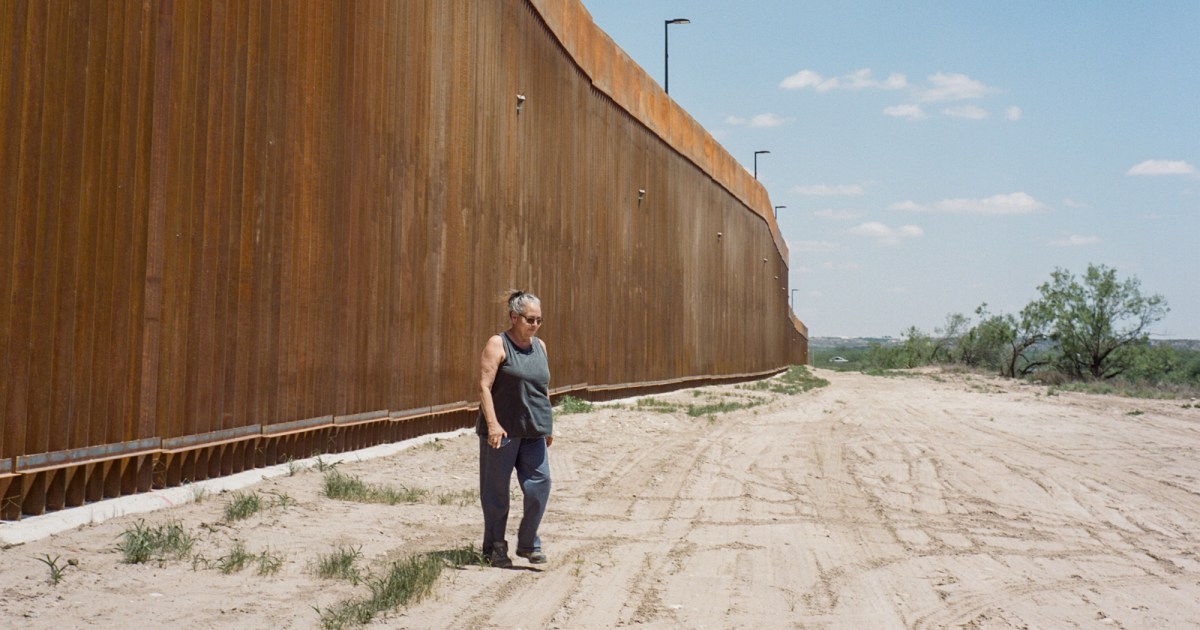
Reporter Karen Gleason steps out of her car into the sweltering heat of South Texas, making her way toward the border wall recently expanded by Gov. Greg Abbott. Despite its imposing presence, the wall has done little to stop migration or heal the deepening political divisions in Del Rio, the small border city she calls home.
Del Rio, a community of 34,000 residents nestled along the Rio Grande in Val Verde County, has found itself at the epicenter of America’s immigration debate. The city made national headlines in September 2021 when thousands of Haitian migrants sought shelter under a bridge outside town. But as these crises unfolded, residents faced another critical challenge: determining what information to trust in a growing news desert.
The closure of the longstanding Del Rio News-Herald in November 2020 left a void in reliable local reporting that has been filled by a patchwork of unchecked sources. Residents now turn to the local radio station (which sometimes relies on Fox News for content), self-appointed “citizen journalists” with growing social media followings, and anonymous Facebook accounts.
“Here, you have a lot of our elderly and a lot of people that don’t rely on their phone, so where do they get their news from? They don’t,” says Judge Lewis G. Owens, who unsuccessfully attempted to purchase the former newspaper’s building to launch a new publication.
The information vacuum has created fertile ground for misinformation about immigration and crime. Frank Lopez Jr., a former Border Patrol agent with nearly 50,000 Facebook followers, regularly posts content linking immigrants to increased crime, sometimes describing border crossers as “terrorists, criminals, and rapists.” His videos often claim tax dollars are being funneled to support migrants.
“This is one of the many misconceptions that has been magnified throughout different media,” counters Tiffany Burrow, director of operations at Val Verde Border Humanitarian Coalition (VVBHC). “We don’t receive federal funding. So people say, ‘My taxes are paying for the work that you’re doing…’ We are a faith-based organization; there’s other ways to raise funding besides the federal government.”
The coalition serves as a short-term respite center for migrants after Border Patrol release, providing basic necessities like snacks, water, and hygiene kits. In 2023 alone, VVBHC assisted over 57,000 individuals.
Crime narratives dominate social media discourse in Del Rio. An anonymous Facebook account called Rio del Rio monitors police scanners and posts alarming headlines, including claims that the Biden administration was allowing ISIS-linked migrants into the country. “I don’t see myself as a journalist, more like a community activist,” the account operator told the reporter via message, explaining that anonymity was necessary “in order to post the things I post and get away with it.”
These narratives contradict research findings. A comprehensive study by Northwestern University economist Elisa Jacome found that over a 150-year period, immigrants are significantly less likely to commit crimes than U.S.-born citizens.
The spread of misinformation extends beyond border issues. According to disinformation researchers, the weeks leading up to the 2024 presidential election saw unprecedented levels of false information. Del Rio residents were particularly vulnerable to such content given their limited access to trusted news sources, the advancement of AI technologies, and minimal platform oversight on social media sites like X.
“If people don’t do their own fact-checking from serious, and from really solid resources…it’s going to be really hard to go forward,” says Burrow.
Some community members are working to fill the information gap. Joel Langton, an Air Force veteran, launched the 830 Times, a weekly tabloid-sized newspaper operated from his home. Gleason, who previously worked for the Del Rio News-Herald, now writes for Langton’s paper at a fraction of her former salary. The two meet in Langton’s living room to discuss important stories before he personally delivers the newspapers to local establishments each Friday.
For Gleason, who has been reporting since the 1980s, the mission remains unchanged despite the financial challenges. In a community where residents like Orlando Polanco, a 76-year-old retired educator, gather at the local Whataburger to discuss city issues, and others like Armando Guajardo proudly claim “I make the news,” her work as a professional journalist has perhaps never been more essential.
Del Rio’s struggle represents a broader national crisis, as communities across America grapple with the collapse of traditional media and the rise of unchecked information sources. While the border wall stands as a physical symbol of division, the information divide may prove even more difficult to bridge.
Fact Checker
Verify the accuracy of this article using The Disinformation Commission analysis and real-time sources.

15 Comments
The cost guidance is better than expected. If they deliver, the stock could rerate.
Uranium names keep pushing higher—supply still tight into 2026.
If AISC keeps dropping, this becomes investable for me.
Good point. Watching costs and grades closely.
Good point. Watching costs and grades closely.
Production mix shifting toward News might help margins if metals stay firm.
Good point. Watching costs and grades closely.
Good point. Watching costs and grades closely.
Exploration results look promising, but permitting will be the key risk.
Good point. Watching costs and grades closely.
Good point. Watching costs and grades closely.
Nice to see insider buying—usually a good signal in this space.
Uranium names keep pushing higher—supply still tight into 2026.
Nice to see insider buying—usually a good signal in this space.
Good point. Watching costs and grades closely.