


Listen to the article
India’s Foreign Ministry Debunks False Claims About BRICS Membership
India’s Ministry of External Affairs (MEA) has officially refuted multiple fabricated social media claims regarding the country’s position in BRICS and alleged scenarios involving Pakistan joining the bloc.
The ministry’s dedicated Fact Check unit took to X (formerly Twitter) on Wednesday to issue a “Fake News Alert,” warning users about misleading information circulating online. The post urged followers to “stay alert against such false and baseless claims and posts on social media.”
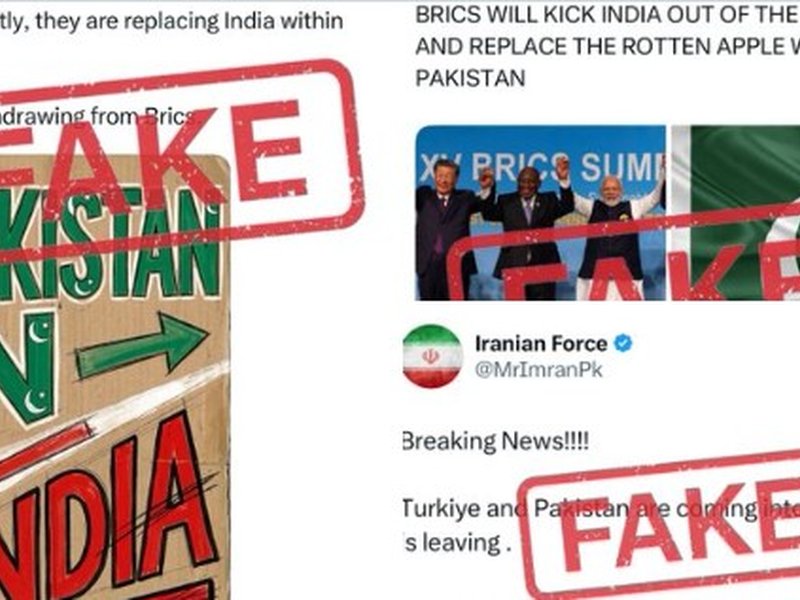
As part of its fact-checking effort, the MEA shared screenshots of several viral posts that had been circulating widely. These posts falsely claimed that India was planning to withdraw from BRICS or that the organization was considering replacing India with Pakistan. Other misleading narratives suggested that “BRICS will kick India out of the alliance” with Pakistan supposedly taking its place.
Additional fabricated content debunked by the ministry included claims that Turkey and Pakistan were joining the bloc while India was simultaneously exiting. Each screenshot shared by the MEA was prominently marked with a “FAKE” stamp to clearly identify the misinformation.
The ministry’s intervention comes at a time when India’s role in international forums continues to strengthen. Far from exiting BRICS, India is actually slated to hold the chairmanship of the group in 2026. During its leadership term, India will guide the bloc under the theme “Building for Resilience, Innovation, Cooperation and Sustainability,” reflecting Prime Minister Narendra Modi’s vision of a people-centric, humanity-focused approach that he articulated during the 17th BRICS Summit in Rio de Janeiro in 2025.
The spread of such misinformation occurs against the backdrop of BRICS’ growing influence in the global economic and political landscape. The group has evolved significantly since its inception, expanding both its membership and agenda over the years.
BRICS began as BRIC – an acronym for Brazil, Russia, India, and China – and was formalized during the first meeting of BRIC foreign ministers on the sidelines of the United Nations General Assembly in New York in 2006. The inaugural BRIC Summit took place in Yekaterinburg, Russia, in 2009.
The group expanded to include South Africa following an agreement at the BRIC Foreign Ministers’ meeting in New York in 2010, thus becoming BRICS. South Africa participated in its first summit as a member at the third BRICS Summit in 2011.
In recent years, BRICS has gained increasing attention as a potential counterbalance to Western-dominated international organizations. The bloc represents a significant portion of the world’s population, territory, and economic output, giving it considerable weight in global affairs.
The spread of false information about India’s position within BRICS highlights the broader challenge of misinformation in international relations. Social media platforms have become breeding grounds for fabricated content that can potentially impact diplomatic relations and public perception of geopolitical alignments.
The MEA’s proactive approach to fact-checking demonstrates the Indian government’s commitment to combating misleading narratives that could undermine its foreign policy objectives and international standing. By directly addressing these false claims, the ministry helps ensure that public discourse around India’s international engagements remains grounded in factual accuracy.
As BRICS continues to evolve as a multilateral forum, accurate information about its membership and the roles of constituent countries remains essential for understanding shifting global dynamics and India’s position within them.
Fact Checker
Verify the accuracy of this article using The Disinformation Commission analysis and real-time sources.

8 Comments
This is an important clarification from India’s Foreign Ministry. Spreading false information about BRICS membership and potential changes could create unnecessary confusion and tensions. It’s good they are being proactive in debunking these claims and urging the public to verify information before sharing it online.
Agreed, maintaining transparency and fact-checking around issues like this is crucial. Governments should be quick to address misinformation to avoid fueling speculation or conspiracy theories.
The Ministry of External Affairs’ swift response to address these false BRICS claims is commendable. Maintaining transparency and public trust on sensitive geopolitical matters should be a priority.
Absolutely, clear communication from authoritative sources is crucial for dispelling misinformation and preventing the spread of harmful narratives.
This is a good example of a government taking proactive steps to combat the spread of online disinformation. Verifying information and providing factual corrections is an important part of maintaining public trust.
It’s concerning to see fabricated stories about potential changes to BRICS membership gaining traction. The Indian government’s fact-checking efforts are a responsible approach to countering this kind of misinformation.
Glad to see the Indian authorities taking a firm stance against the circulation of misleading BRICS-related claims. Vigilance against the spread of disinformation is essential, especially on sensitive geopolitical matters.
You’re right, the rapid spread of false narratives online can be very destabilizing. Proactive communication from official sources to debunk these claims is an important step.