


Listen to the article
In the midst of a sustained federal immigration crackdown, Minneapolis journalists are navigating unprecedented challenges that have transformed their city and tested their newsrooms in ways distinct from previous crises.
“We’ve had political assassinations. We had a multi-fatality school shooting, and now the largest immigration crackdown in American history has all happened in Minneapolis in the last eight months,” said Liz Sawyer, a reporter at The Minnesota Star Tribune. “People are generally exhausted and overwhelmed both in the newsroom and in the community.”
The federal government launched “Operation Metro Surge” in early December, targeting Somali immigrants in the Twin Cities. The operation came after President Donald Trump referred to the Somali community as “garbage” and stated he does not want them in the country. Minnesota is home to over 80,000 Somali immigrants, most with legal status or U.S. citizenship.
What began as an expected deployment of about 100 federal agents has swelled to a reported 3,000 officers in the Twin Cities region, creating what Andrew Hazzard of Sahan Journal describes as an occupation.
“The scale of this presence of federal agents in Minneapolis and the Twin Cities is so insanely disproportionate to the size of our community in general, the size of our immigrant communities in particular,” Hazzard said. “We’re not Chicago or Houston or certainly not New York or LA. We’re not some massive, massive city.”
The situation has escalated dramatically with two fatal shootings by federal agents. ICU nurse Alex Pretti was killed after attempting to help a woman pushed to the ground by agents. In a separate incident, Renee Macklin Good, a mother and poet, was also shot and killed.
The sustained nature of this crisis differs markedly from the protests following George Floyd’s murder in 2020, which saw intense but relatively brief periods of unrest. While the Floyd protests represented Minneapolis confronting its history of racial inequity and policing, the current situation involves federal forces operating largely outside local control.
“What’s different about this — it has that same sort of sense of righteous rage — but it feels much more like an occupation currently,” Hazzard observed.
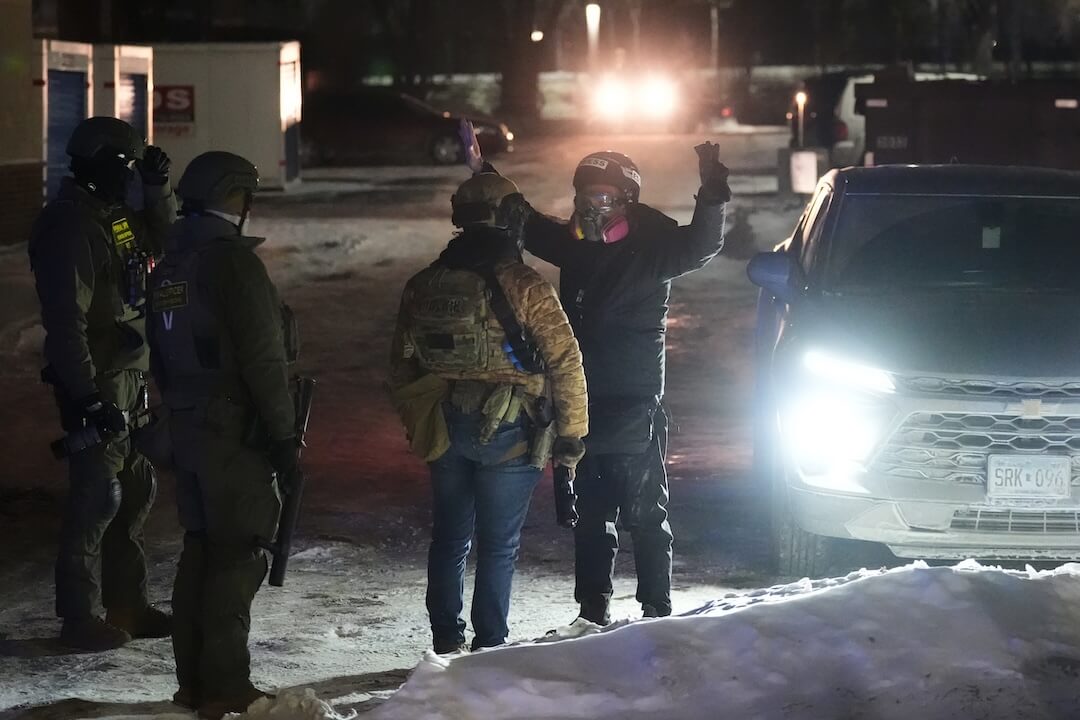
Local newsrooms have adapted their operations in response. The Star Tribune and Sahan Journal have invested in protective equipment like gas masks and eye protection for reporters. Journalists partner with colleagues in the field for safety, applying lessons learned during the 2020 protests.
The immigration enforcement operation has permeated every aspect of community life, requiring comprehensive coverage across all beats. At Minnesota Public Radio, Matt Sepic reports it’s “all hands on deck,” with education and health reporters covering how ICE activities impact their sectors. The Star Tribune has similarly mobilized reporters from across the newsroom to address the wide-ranging effects on business, tourism, and public safety.
Joey Peters, a politics reporter for Sahan Journal, which focuses on immigrant communities, described the heightened state of alert: “Day to day, we’re on alert that breaking news can happen. We expect breaking news to happen any day, multiple times a day.”
A particularly troubling development is what journalists describe as unprecedented levels of misinformation and disinformation, including from official government sources.
“What we’re dealing with now is just an onslaught of lies and disinformation,” said Sepic. “The highest levels of the United States government were engaging in a disinformation campaign to smear them as domestic terrorists. And as journalists that’s not something that we’re used to having to deal with.”
The proliferation of AI-generated and manipulated media presents additional verification challenges not present during previous crises. Sawyer explained that the Star Tribune has implemented rigorous verification procedures, including tracking down original videographers, metadata analysis, and multiple editorial reviews before publishing footage.
“We’re not just going to strip something from the internet that’s posted by some anonymous name and publish that,” Sawyer emphasized.
The situation has forced journalists to reconsider their approach to reporting on government statements. As Sepic put it: “I think the biggest lesson now — and too many news organizations have been pulling punches for too long as we’ve seen this rising tide of authoritarianism in this country — is we can’t be afraid to say that the government is lying when the government is lying, because that’s the whole point of the First Amendment.”
As federal operations continue, Minneapolis journalists remain committed to providing accurate information while navigating complex safety concerns and maintaining community trust in an environment where daily life continues unevenly under extreme pressure.
Fact Checker
Verify the accuracy of this article using The Disinformation Commission analysis and real-time sources.

20 Comments
The scale and intensity of the federal presence in Minneapolis is truly alarming. I’m worried about the impact this will have on the ability of journalists to do their jobs and inform the public.
Journalists need to be able to report freely and without fear of interference or reprisals. I hope they can find ways to overcome the obstacles and continue their important work.
This is a concerning situation for journalists in Minneapolis. Federal crackdowns on immigrant communities can have a chilling effect on media freedom and the public’s right to information.
Journalists need to be able to report freely without fear of reprisals. I hope they can continue their important work despite the challenging circumstances.
This federal crackdown in Minneapolis sounds like it is putting immense strain on the local journalism community. I hope they are able to find ways to effectively cover this story and keep the public informed.
Maintaining the integrity of their reporting will be critical during this challenging time. I wish the journalists in Minneapolis the best as they navigate this difficult situation.
This federal immigration crackdown in Minneapolis appears to be creating a climate of fear and uncertainty. Journalists need to be able to report freely without facing undue obstacles.
I’m curious to learn more about how the journalists in Minneapolis are adapting their approaches to cover this story effectively and responsibly.
The challenges faced by journalists in Minneapolis are deeply concerning. A free and independent press is essential for a healthy democracy, and I hope they can continue their work despite the difficult conditions.
I’m curious to learn more about the specific strategies journalists are using to overcome the obstacles created by the federal crackdown and ensure their reporting is not compromised.
This story highlights the important role journalists play in holding authorities accountable, even in the face of a heavy-handed federal presence. I admire the journalists in Minneapolis for their dedication.
It’s critical that journalists are able to report freely and without interference during this crackdown. The public deserves accurate and transparent information on this issue.
The situation for journalists in Minneapolis sounds incredibly challenging. I hope they can continue to fulfill their vital role in informing the public, even as the federal presence strains their resources.
It’s crucial that journalists are able to access information and sources without undue interference or intimidation during this crackdown. Their work is essential for a functioning democracy.
It’s troubling to hear about the toll this crackdown is taking on journalists and the community in Minneapolis. The freedom of the press is essential in times of crisis.
I hope the journalists can find ways to continue their important work and shine a light on what’s happening, despite the difficult conditions.
The federal crackdown in Minneapolis seems to be creating a hostile environment for journalists trying to report on this sensitive issue. I’m concerned about the impact on press freedom and the public’s right to information.
Journalists need to be able to do their jobs without fear of reprisals or obstruction. I hope they can find ways to continue their important work despite the challenging circumstances.
The scale of the federal presence in Minneapolis is alarming. I worry this could further strain an already tense situation and make it harder for journalists to do their jobs effectively.
Maintaining open access and lines of communication will be critical for journalists to report accurately on this story. I hope they can navigate these challenges with professionalism and integrity.