


Listen to the article
Deadly Bus Crash at Jerusalem Haredi Protest Triggers Wave of Misinformation
A peaceful protest turned tragic in Jerusalem on January 6, 2026, when tens of thousands of Haredi (ultra-Orthodox) demonstrators gathered to oppose mandatory military service in the Israel Defense Forces (IDF). During the demonstration, a civilian bus crashed through the crowd, killing one teenager and injuring three others, sparking an immediate police investigation.
The incident quickly became a target for manipulation online, with anti-Israel social media accounts spreading false narratives before mainstream media outlets had even reported the news. Two primary misleading storylines emerged: that the protest signaled Israel’s government was on the verge of collapse, and that Israeli authorities had deliberately killed the protesters.
The Haredi community has long held exemptions from the military draft that applies to most 18-year-old Israelis, a contentious issue currently being addressed in the Israeli Knesset. Such protests against conscription are not unusual in Israel’s political landscape, but social media users rapidly distorted the event’s significance.
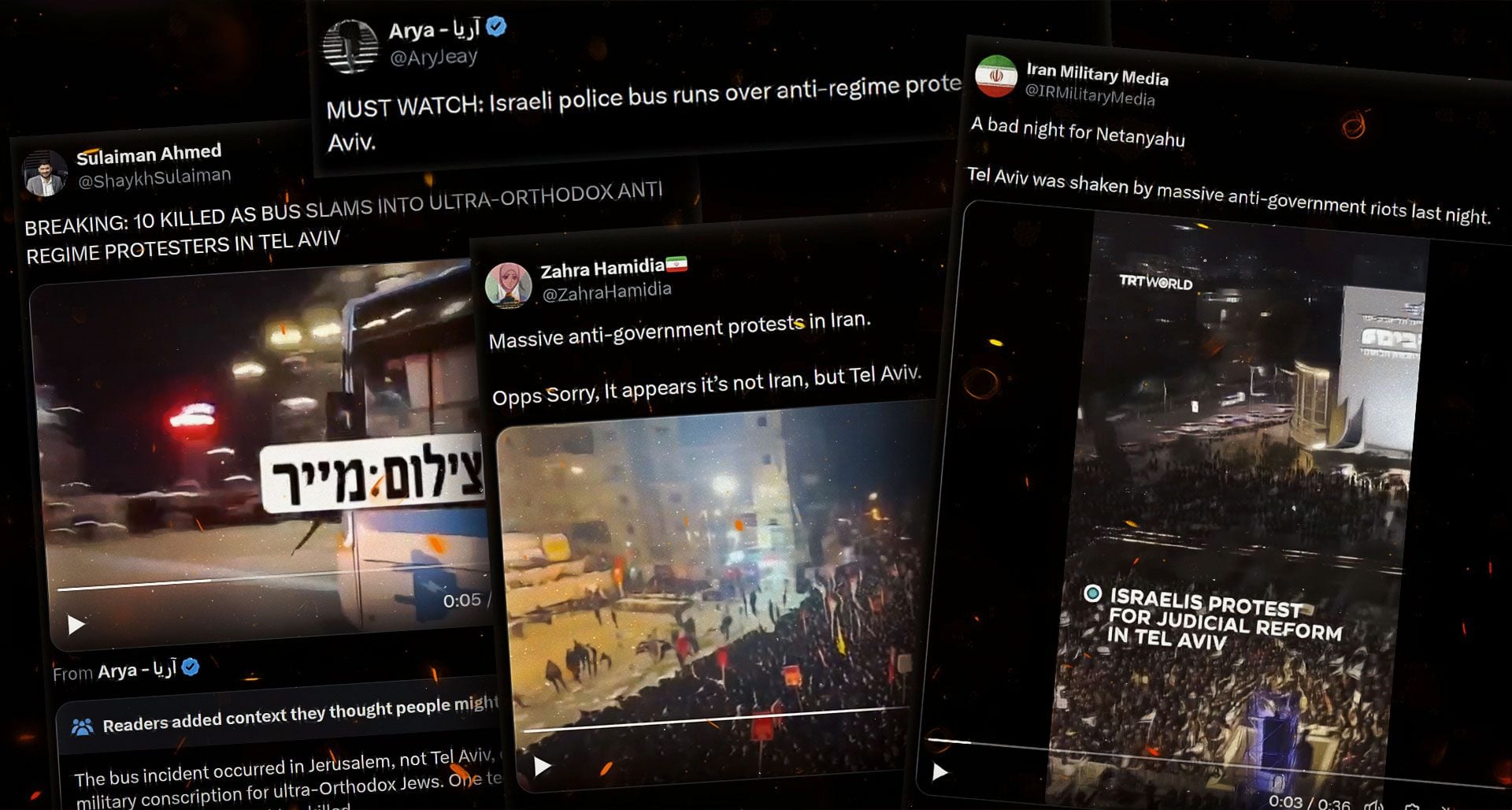
On X (formerly Twitter), multiple accounts falsely characterized the demonstration as evidence of governmental instability. An account called RKM shared protest footage with claims that Israel was approaching “civil war” due to “Gen-Z protests” amid “rising inflation, recession and corruption.” This false information received over 67,000 views and 1,500 shares.
Another popular anti-Israel account celebrated the supposed imminent “civil war,” while others drew misleading comparisons between the Haredi protest and anti-government demonstrations in Iran. One account, Zahra Hamidia, incorrectly located the protest in Tel Aviv rather than Jerusalem, posting: “Massive anti-government protests in Iran. Opps Sorry, It appears it’s not Iran, but Tel Aviv.”
Even more concerning were claims that Israeli authorities deliberately caused the fatal incident. An account claiming to belong to an Iranian researcher received nearly half a million views after falsely stating that an “Israeli police bus runs over anti-regime protesters in Tel Aviv.” In reality, the vehicle belonged to “Extra,” a civilian bus company, and the incident occurred in Jerusalem, not Tel Aviv.
Another account’s post reached 778,000 viewers with the completely fabricated claim that an “IDF soldier just RAN OVER Orthodox Jews with a bus,” adding that there were “over 30+ casualties.” This gross exaggeration came from an account that had previously posted overtly antisemitic content.
Many of the accounts spreading this misinformation appear to be supportive of the Iranian regime, with several using the incident to draw false equivalencies between Israel and Iran or to question Israel’s democratic status.
Media analysts note that this incident demonstrates the alarming speed at which misinformation can spread across social media platforms. Within 24 hours, these false narratives had collectively reached over a million users, many of whom may use social media as their primary news source.
The rapid proliferation of misinformation surrounding this tragic event underscores the growing challenge of information verification in an era where unverified claims can reach global audiences before traditional news outlets have time to report factual accounts.
Israeli authorities continue to investigate the circumstances of the bus crash while social media platforms face renewed questions about their role in enabling the spread of false information during breaking news events.
The incident highlights the importance of media literacy and verifying sources, especially when consuming news about politically sensitive regions through social media channels, where accounts with clear political agendas can quickly shape narratives before facts are established.
Fact Checker
Verify the accuracy of this article using The Disinformation Commission analysis and real-time sources.

29 Comments
I like the balance sheet here—less leverage than peers.
Good point. Watching costs and grades closely.
Good point. Watching costs and grades closely.
Silver leverage is strong here; beta cuts both ways though.
Good point. Watching costs and grades closely.
Good point. Watching costs and grades closely.
If AISC keeps dropping, this becomes investable for me.
Interesting update on Israeli Ultra-Orthodox Protest Violence Fuels Online Misinformation. Curious how the grades will trend next quarter.
If AISC keeps dropping, this becomes investable for me.
Good point. Watching costs and grades closely.
Good point. Watching costs and grades closely.
Nice to see insider buying—usually a good signal in this space.
Good point. Watching costs and grades closely.
Good point. Watching costs and grades closely.
I like the balance sheet here—less leverage than peers.
The cost guidance is better than expected. If they deliver, the stock could rerate.
Good point. Watching costs and grades closely.
Good point. Watching costs and grades closely.
Interesting update on Israeli Ultra-Orthodox Protest Violence Fuels Online Misinformation. Curious how the grades will trend next quarter.
Silver leverage is strong here; beta cuts both ways though.
Good point. Watching costs and grades closely.
Good point. Watching costs and grades closely.
Production mix shifting toward News might help margins if metals stay firm.
I like the balance sheet here—less leverage than peers.
Interesting update on Israeli Ultra-Orthodox Protest Violence Fuels Online Misinformation. Curious how the grades will trend next quarter.
Good point. Watching costs and grades closely.
Good point. Watching costs and grades closely.
Exploration results look promising, but permitting will be the key risk.
Good point. Watching costs and grades closely.