


Listen to the article
Israeli Foreign Ministry Faces Backlash Over False Claim About Gaza Journalist
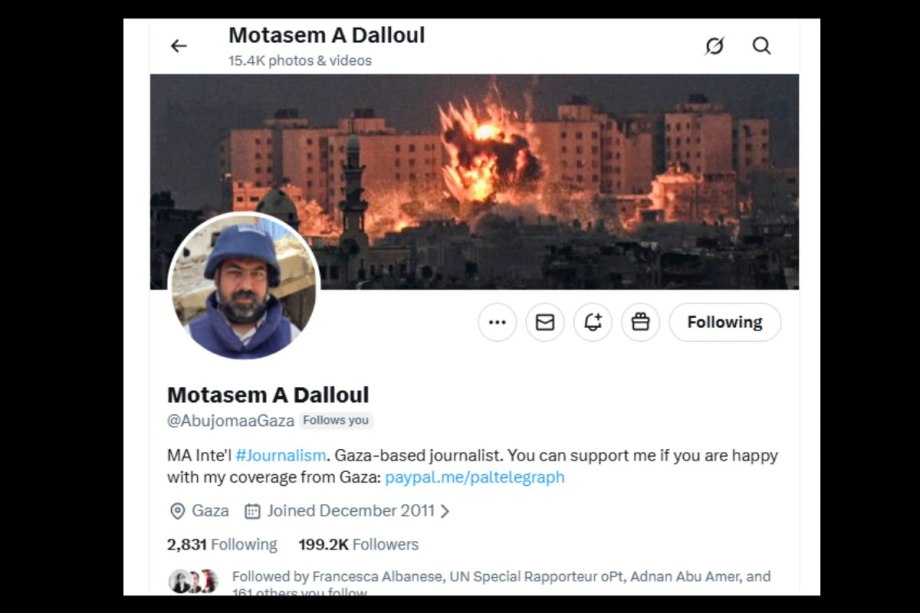
Israel’s Foreign Ministry has sparked controversy after publishing a tweet falsely claiming that Gaza journalist Motasem A Dalloul was reporting from Poland rather than Gaza. The accusation, which quickly gained traction online, has raised serious concerns about misinformation in conflict reporting.
In its post on X (formerly Twitter), the ministry wrote: “196,900 followers being lied to by fake ‘journalist’ claiming to be in Gaza. New X feature reveals his actual location is Poland. Reporting from Gaza is fake & not reliable.” The ministry based its allegation on X’s recently introduced “country of origin” label, a feature that attempts to display a user’s location based on IP-related signals.
Dalloul swiftly refuted the claim by posting video evidence from Gaza. “For those who claim I’m in Poland and posting from there, I just want to tell you: If you recognize buildings like these in Poland, please let me know. If you see tents and camps like this, tell me if there’s anything similar in Poland,” he stated, showing clearly identifiable Gaza scenes in his footage.
The journalist has established a reputation for documenting conditions in Gaza throughout the conflict and has previously reported that several of his family members, including children, were killed in Israeli airstrikes. His firsthand accounts have provided valuable on-the-ground information for international audiences seeking to understand the humanitarian situation.
Media experts have pointed out that X’s location labeling system has proven problematic since its rollout. Users across various countries have reported being incorrectly tagged as posting from foreign locations, calling into question the reliability of the feature. Despite these known issues, the Israeli Foreign Ministry has not issued any correction to its original accusation.
The incident has inadvertently highlighted a larger issue of online information manipulation in the Israel-Gaza conflict. Recent investigative reporting has revealed extensive networks of pro-Israel social media accounts operating from outside Israel, particularly from India.
A comprehensive investigation by The New Arab found that Indian right-wing and Hindu-nationalist social media networks have become “key amplifiers of pro-Israel disinformation and anti-Palestinian narratives.” The report characterized India as “leading a global pro-Israel disinformation ecosystem,” generating viral content that frequently targets Palestinians and circulates unverified claims.
Similar findings from Euronews and The Diplomat corroborate this pattern, documenting how accounts aligned with Hindu-nationalist politics regularly distribute videos and posts alleging Palestinians are staging injuries or fabricating atrocities—content that has often been subsequently debunked by fact-checking organizations.
NDTV has also reported on how conflict-related disinformation has evolved into a monetized industry on social media platforms, with influencers earning revenue through sensationalized or misleading content about the war.
The controversy surrounding the Israeli Foreign Ministry’s false claim against Dalloul exemplifies the increasingly complex information landscape surrounding the Israel-Gaza conflict, where verification challenges, algorithmic features, and coordinated disinformation campaigns all converge to complicate public understanding of events on the ground.
As of publication, neither the Israeli Foreign Ministry nor X has commented on the accuracy of the location tag applied to Dalloul’s account, leaving questions about accountability in official communication channels during ongoing conflict.
Fact Checker
Verify the accuracy of this article using The Disinformation Commission analysis and real-time sources.

9 Comments
This situation highlights the complexities and risks journalists face in conflict zones. It’s crucial that authorities avoid making unverified public claims that could compromise the safety and credibility of reporters on the ground.
Absolutely. The ministry’s actions seem reckless and could have serious consequences for journalists’ ability to cover events accurately and safely. They need to handle this matter more responsibly.
This case underscores the challenges journalists navigating complex geopolitical situations. The ministry should tread carefully and avoid actions that could jeopardize press freedom and the public’s trust in reporting from the region.
While the ministry may have concerns, accusing a journalist of faking their location without solid proof is extremely problematic. This type of tactic could set a dangerous precedent and must be addressed transparently.
It’s concerning to see the ministry make such a public claim without clear evidence. Journalists working in conflict zones face immense risks, and false allegations like this only serve to undermine their critical role.
The ministry’s actions raise serious questions about their motives and the integrity of their response. Journalists must be able to do their jobs without fear of unsubstantiated attacks on their credibility.
The use of new technology like location tracking to challenge journalists’ credibility is worrying. More transparency and verification is needed to avoid these kinds of disputes that could undermine reporting from sensitive areas.
Agreed. Journalists must be able to do their jobs without facing unsubstantiated accusations that could endanger them. The ministry should provide clear evidence to back up its claims.
This is a concerning case of potential misinformation. It’s important for journalists covering conflict zones to be able to work safely and report accurately. The ministry’s claims seem questionable given the visual evidence provided by the journalist.