


Listen to the article
Bangladesh’s Election at Risk from Digital Misinformation, Experts Warn
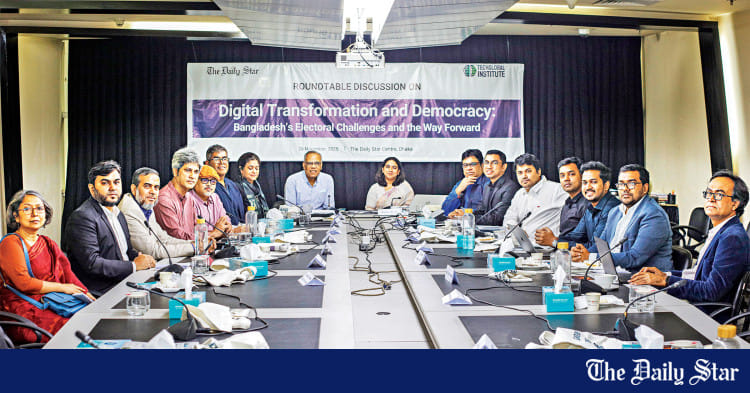
Experts, political leaders, and civil society representatives expressed grave concerns over the spread of online misinformation and social media misuse ahead of Bangladesh’s upcoming national election. Their warnings came during a high-level roundtable discussion on digital challenges to democracy held yesterday at The Daily Star Centre in the capital.
The event, titled “Digital Transformation and Democracy: Bangladesh’s Electoral Challenge and the Way Forward,” jointly organized by The Daily Star and The Tech Global Institute, highlighted multiple threats to electoral integrity in the digital age.
Barrister Sara Hossain, honorary executive director of BLAST, emphasized that accountability cannot be limited to political rhetoric. “We cannot only rely on what political parties say. We must look at the behavior of their people on the ground,” she said, noting that many political actors create an atmosphere of fear while competing for power.
Hossain pointed to troubling patterns of legal intimidation, including defamation cases and exploitation of religious sentiments. “We should look at who is filing these cases. If they belong to your political party, then your party should take action against them,” she urged, adding that courts alone cannot resolve these issues due to external pressures.
Data security emerged as a major concern during the discussion. Kamal Ahmed, consulting editor of The Daily Star, raised alarm about the National ID database, which is currently accessible to 183 institutions. “Election candidates will also need voter lists for their constituencies. If there are 1,200 candidates, each has the right to access the voter list… How do we ensure this access is not abused?” he questioned.
Ahmed criticized the government’s failure to properly engage with global tech giants like Meta and YouTube. “We expected the government to negotiate with these platforms. Their own codes of conduct already exist. Why are they not enforcing them?” he asked, noting that Bangladesh’s 80 million Facebook users should give the government leverage in demanding responsible platform behavior.
He particularly condemned the practice of granting legal indemnity to platforms for harmful content. “Which country gives them indemnity? The US does not. The UK and the European Union do not. Why should Bangladesh do it?” Ahmed demanded.
Women candidates appear particularly vulnerable to digital attacks. Sanjida Islam Tulee, a BNP-backed candidate for Dhaka-14, described how social media is being weaponized to spread misinformation targeting female politicians. She called on the Election Commission to implement stronger measures against fake accounts and establish clear rules for online campaigning.
The emergence of artificial intelligence tools has further complicated the information landscape. Zonayed Saki, chief coordinator of Gono Samhati Andolan, warned that “bots, fake accounts and edited posts could easily influence public opinion and damage reputations during elections.” He stressed that public awareness and critical thinking skills are essential defenses against coordinated digital manipulation.
Representatives from various political parties echoed these concerns. Ahsanul Mahboob Zubair from Jamaat-e-Islami advocated for strengthened legal frameworks alongside ethical leadership, while Khaled Saifullah of the National Citizen Party highlighted the dangers of AI-generated deepfake content, particularly targeting women.
Rehan A Asad, representing BNP’s research team, called for strict regulation of social media by the Election Commission and Bangladesh Telecommunication Regulatory Commission during the electoral period.
The UN Human Rights Office’s Md Zahid Hossain addressed the delicate balance between protecting freedom of expression while combating hate speech and misinformation—a challenge that democracies worldwide are grappling with in the digital age.
The roundtable, moderated by Tanjim Ferdous of The Daily Star, brought together a diverse group of stakeholders from political parties, civil society organizations, and the technology sector, reflecting the multi-faceted nature of digital challenges to electoral integrity in Bangladesh.
As the country approaches this critical election, the discussion highlighted the urgent need for a coordinated response from government institutions, political parties, tech platforms, and civil society to safeguard democratic processes in an increasingly complex digital landscape.
Fact Checker
Verify the accuracy of this article using The Disinformation Commission analysis and real-time sources.

8 Comments
Protecting the integrity of elections in the digital age is a global challenge. Bangladesh’s experience highlights the need for platforms, parties, and the public to work together to combat misinformation and uphold democratic principles.
Troubling to hear about the threats facing Bangladesh’s elections. Misinformation and social media misuse can undermine public trust, which is vital for a healthy democracy. I hope robust safeguards can be put in place.
Holding online platforms and political parties accountable for misinformation is crucial to protect election integrity. Bangladesh faces a tough challenge with digital threats, but transparency and accountability are key to addressing the problem.
You’re right, the misuse of social media and digital platforms poses serious risks to democratic processes. Robust safeguards and enforcement are needed to combat these issues.
It’s concerning to hear about the potential for online misinformation to disrupt Bangladesh’s upcoming elections. Stricter regulations and enforcement around digital campaigning and content moderation seem necessary to ensure a fair and credible vote.
Agreed. Political actors exploiting religious sentiments and using legal intimidation tactics to gain advantage is very worrying. Upholding the rule of law and protecting civil liberties will be critical.
This is a complex issue without easy solutions. Balancing free speech, security, and electoral integrity requires nuanced policymaking. I hope Bangladesh can find the right approach to safeguard its democratic process.
Agreed, it’s a delicate balance. Transparency, accountability, and inclusive stakeholder engagement will be crucial in developing effective policies to address these challenges.