


Listen to the article
Former Univision Anchor Creates One-Man Spanish News Network to Fill Critical Gap in Oregon
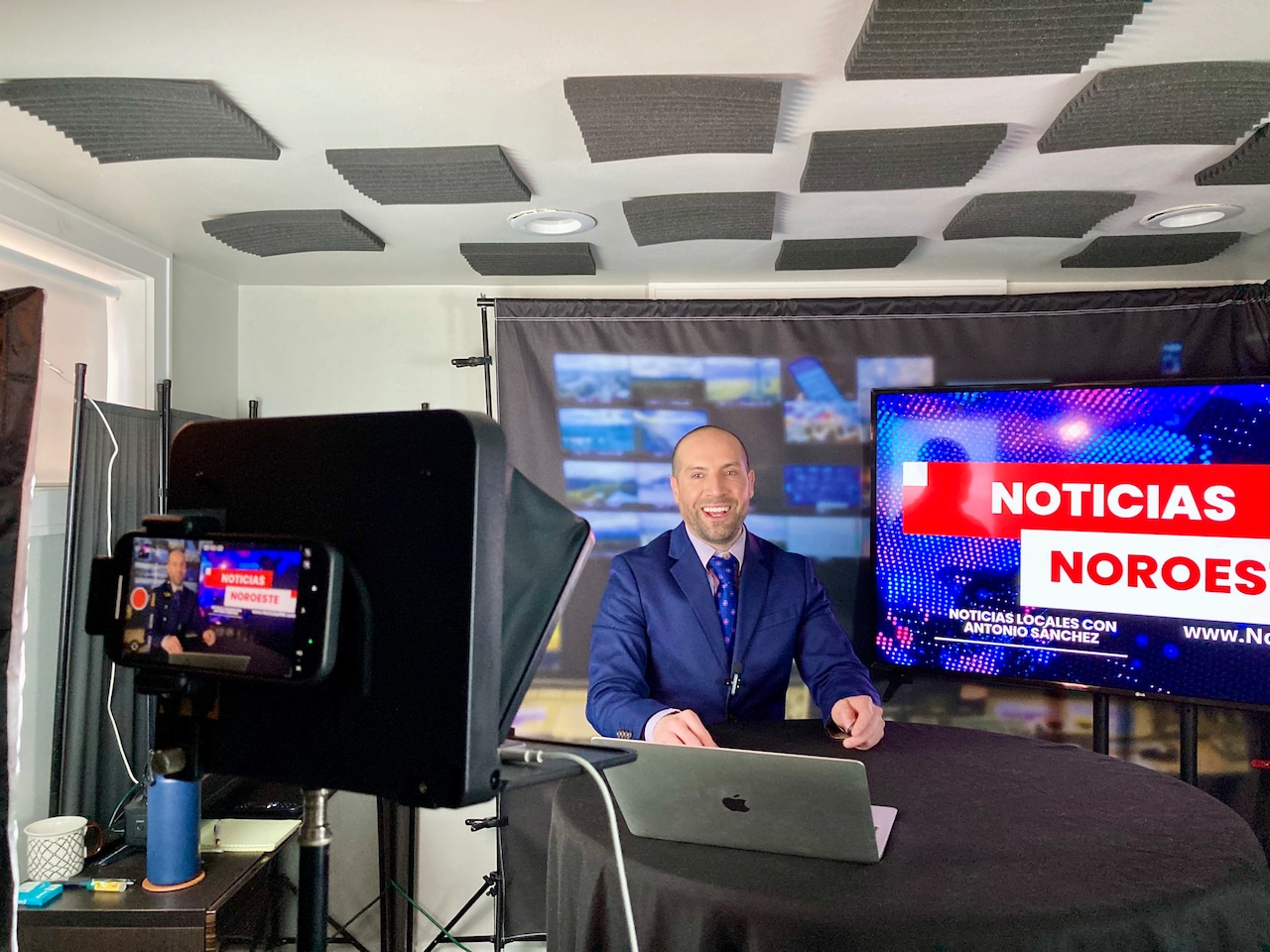
Every weekday, Antonio Sanchez transforms a soundproof basement room in Southeast Portland into a professional newsroom. Dressed in a suit, he positions his cellphone, adjusts a studio light, and prepares his DIY teleprompter before recording a polished Spanish-language newscast that has become a lifeline for Oregon’s Spanish-speaking community.
For nine months, the 45-year-old former Univision news anchor has operated Noticias Noroeste as a solo operation—researching, producing, and editing a daily digital news program that fills a critical void left when Oregon’s last Spanish-language television program shut down last winter.
“Influencers just want a video. I want the story. And I try to tell it in an unbiased way and try to reach the other side, always,” Sanchez told The Oregonian/OregonLive. “If you have a camera in front of you, you have a responsibility to be accurate.”
His mission addresses a significant demographic need. Latinos constitute 14% of Oregon’s population, with approximately 360,000 people speaking Spanish at home—roughly 8% of the state’s residents. In the Portland metropolitan area alone, about 270,000 people primarily communicate in Spanish.
Despite these numbers, Oregon suffers from a scarcity of traditional daily Spanish-language news sources. Univision no longer operates in the region, though Telemundo has recently established a presence in Portland and begun producing local content. Several Oregon-based online shows like TV-Jam and Elemento Latino primarily focus on entertainment, occasionally sharing immigration news.
The Oregonian/OregonLive translates some stories into Spanish weekly, but this coverage is not comprehensive, leaving a substantial information gap for Spanish speakers across the state.
Immigration Crackdown Amplifies Need for Reliable News
The need for balanced Spanish-language journalism has become increasingly urgent amid the current immigration enforcement climate. Masked federal agents have detained hundreds of people—both undocumented residents and U.S. citizens—on roadways, near schools and clinics, and in public spaces, typically without judicial warrants, as part of President Donald Trump’s deportation initiatives.
The ongoing crackdown has resulted in at least 560 arrests in the Portland area during October alone, according to federal authorities. The Migration Policy Institute reports that the vast majority of those detained are Latino. This heightened enforcement follows a significant September Supreme Court ruling that allows federal agents to consider factors such as apparent race, ethnicity, Spanish language use, or accented English when deciding whom to question or detain.
Latinos represent most of Oregon’s undocumented population of approximately 155,000 people, with two-thirds originating from Mexico and Central America. Most have deep community roots—70% have lived in the U.S. for more than 15 years, 35% are married to U.S. citizens or legal permanent residents, and nearly 40% live with at least one U.S.-citizen child under 18.
As fear has spread through the Latino community, social media has become flooded with unverified information and rumors. New Spanish-language social media influencers have emerged, some seeking to monetize the community’s urgent need for information. This barrage of unverified content has intensified fear, causing many families to remain at home and avoid work, school, and medical appointments.
“Misinformation thrives in a vacuum,” said Evelyn Kocher, spokesperson for the Portland-based nonprofit Latino Network. “The reason it is thriving right now is because people are trusting less and less in the traditional news media but also because the amount and the quality of local Spanish-language news sources has decreased.”
Building a News Service From Scratch
Sanchez has embraced the challenge of filling this void. Born in Calexico, California, on the Mexican border, he grew up immersed in Latino culture and speaking Spanish at home. His newscast incorporates colloquial expressions familiar to many Spanish speakers, creating an authentic connection with his audience.
At 17, Sanchez left home with minimal savings to attend San Diego State University, where he triple-majored in journalism, Spanish, and French. After working as a print journalist, he studied broadcast journalism and discovered his passion for local Spanish-language television. Before arriving in Portland, he worked as an anchor and video journalist at bilingual TV stations in San Diego, Dallas, Denver, and San Antonio.
When Sinclair Broadcast Group disbanded Sanchez’s Univision team in December and dropped its long-time network affiliation, Portland essentially became a news desert for Spanish speakers—just as Trump was returning to office.
“Based on what I knew about Trump during his first term, I knew it was going to be chaotic, especially for my community,” Sanchez said. “It was a moral situation. I realized the community was going to be misinformed. And I was like, I can’t just leave Portland, people depend on me.”
With help from friends, Sanchez quickly built a DIY studio with makeshift graphics, launching his self-produced half-hour newscast on January 20, Trump’s second inauguration day. “The most stressful day of my whole career,” Sanchez recalls, as he struggled to memorize segments without a teleprompter and produce television-quality news independently.
Nine months later, his audience continues to grow. Noticias Noroeste has accumulated over 100,000 followers across social platforms, with more than 281,700 YouTube views last month alone. His viewership averages 40,000 to 60,000 weekly, with the show posting to YouTube at 6 p.m. Monday through Friday.
Though earning only a “fraction” of his former Univision salary, Sanchez handles all aspects of production—from fielding calls and researching stories to recording, editing, and conducting interviews. He has reported extensively from ICE building protests and secured exclusive interviews with wrongfully detained immigrants who were later released.
Martha Herrera, a Spanish-speaking restaurant cook who has lived in Portland for 15 years, discovered Noticias Noroeste earlier this spring and became a loyal viewer.
“I watch the news because I want to be informed about what’s happening in the county, in the community and the state where I live,” Herrera said in Spanish. “We are living in a very difficult time. The whole country is on edge and people are afraid. That’s why it’s so important to have quality news.”
For Sanchez, accurate reporting often comes down to precise language. Social media influencers frequently use alarming terms like “redada” (raid) that trigger panic in the Latino community.
“When you say ‘raid’ in Spanish, it means a roundup. It has a shocking, traumatic context in the Latino community,” Sanchez explained. “The reality is, some people do have old records, even from 30 years ago. So what’s really happening is targeted immigration arrests with collateral arrests.”
Despite the challenges, Sanchez values the freedom to pursue in-depth stories and provide guidance to viewers who see him as both a trusted source of information and a community resource.
“It’s almost like I’m a journalist and a psychologist slash sociologist. I’m their navigator because they see me as an authority figure and someone who can help them,” Sanchez said. “It feels like they’re my family even though I have no connection to them.”
Fact Checker
Verify the accuracy of this article using The Disinformation Commission analysis and real-time sources.

5 Comments
This is an inspiring story about a former news anchor taking it upon himself to provide critical Spanish-language news coverage in Oregon. It’s great to see someone stepping up to fill an important gap in the local media landscape.
I agree, it’s admirable that he’s doing this as a solo operation. Local news in minority languages is so important for keeping communities informed.
It’s interesting that Oregon’s Spanish-speaking population is around 8% of the state’s residents, but their needs haven’t been adequately served by the media. This underscores the importance of diverse, community-focused journalism.
While it’s good that he’s providing this service, I hope he is able to maintain high journalistic standards and remain objective, as he states is his goal. Misinformation can spread just as easily through a one-person operation as a larger news organization.
That’s a fair point. Fact-checking and editorial oversight are crucial, even for a small independent outlet. Hopefully he has processes in place to ensure accuracy and balance.