


Listen to the article
California Ballot Envelope Design Sparks Unfounded Election Tampering Claims
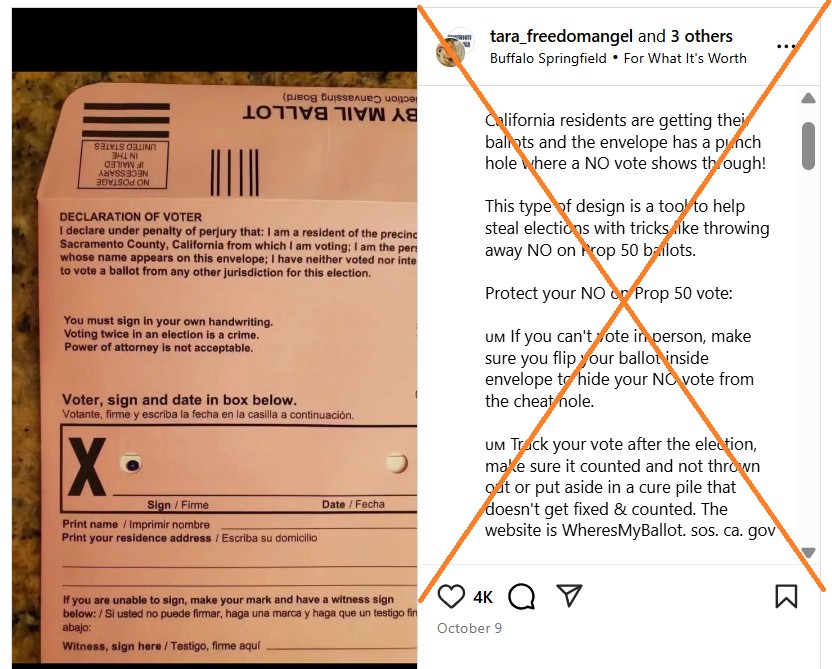
A special election in California has become the center of controversy after social media posts claimed that mail ballot envelopes were deliberately designed to expose how people vote on Proposition 50. The claims, which have spread widely across platforms, suggest that holes punched in ballot envelopes make “no” votes visible, potentially allowing election officials to discard ballots based on voter preference.
Election officials and independent experts have quickly moved to debunk these allegations, explaining that the envelope design represents a long-standing accessibility feature, not a mechanism for fraud.
California Secretary of State Shirley Weber’s office addressed the concerns in a statement, saying: “There is no need for any concern.” Officials explained that the holes serve as a guide for visually impaired voters to locate where they need to sign, enabling them to vote independently and privately.
Sacramento County, which was specifically highlighted in many social media posts, clarified on its website that “there is no way to determine how a voter voted through this small hole.” The county also noted that voters have multiple ways to insert their ballots into return envelopes, with only two configurations potentially making any marking visible through the hole.
Importantly, this design element is not new to this election cycle. Sacramento County has been using the same punched hole design since 2008, long before the current contentious proposition was conceived.
The controversy surrounds Proposition 50, also known as the Election Rigging Response Act, a constitutional amendment that would temporarily change congressional district maps ahead of the 2026 midterm elections. California Governor Gavin Newsom proposed the measure as a counterbalance to what Democrats characterize as partisan redistricting efforts in Texas, where Governor Greg Abbott redrew electoral districts in a manner that benefits Republicans.
With more than $140 million poured into the campaign, the stakes are high. The outcome will influence the congressional balance of power in future elections, potentially determining whether Republicans maintain control of the House of Representatives.
Whitney Quesenbery, chief program officer for the nonprofit Center for Civic Design, confirmed to AFP that the holes in ballot envelopes serve a legitimate purpose. Her organization recommends this design to help election jurisdictions comply with the Help America Vote Act, ensuring ballot accessibility for all voters.
“We always recommend this,” Quesenbery stated, explaining that the design serves multiple purposes. Beyond helping visually impaired voters locate signature lines independently, the holes also assist election workers in confirming that no ballots are left inside processed envelopes. Election officials commonly insert zip ties through the holes in empty envelopes to verify they’ve been properly processed, a practice documented in photos from elections in Washington and Utah.
California isn’t alone in implementing this design. Oregon, Washington, and Pennsylvania also utilize similar envelope features to enhance accessibility and ensure accuracy in ballot processing.
The controversy mirrors similar unfounded claims made during California’s 2021 recall election of Governor Newsom, which were debunked by fact-checkers at the time.
For voters concerned about ballot privacy, Sacramento County has published a video demonstrating how to properly fold and insert ballots into return envelopes to ensure vote selections remain concealed, regardless of envelope design.
As the November 4 special election approaches, election officials continue to emphasize that the ballot envelope design represents a standard accessibility feature used across multiple states and election cycles, not evidence of attempted election tampering.
Fact Checker
Verify the accuracy of this article using The Disinformation Commission analysis and real-time sources.

6 Comments
This seems like a classic case of misinformation and unfounded conspiracy theories targeting a legitimate accessibility feature. It’s good to see election officials quickly addressing these baseless claims and providing clear explanations about the purpose of the envelope design.
Agreed, it’s important to rely on official sources and independent experts rather than unsubstantiated social media posts. Transparency and accessibility in elections should be priorities, not fodder for conspiracy theories.
Disappointing to see these false claims spreading about something as straightforward as an accessibility feature. It’s reassuring to see the election officials and experts stepping up to provide the facts and context. We need more of that to counter misinformation.
Agreed, misinformation campaigns around elections can be very damaging. It’s crucial that the public has access to accurate, authoritative information from trusted sources to make informed decisions.
The holes in the ballot envelopes are clearly an accessibility feature, not some nefarious plot. I’m glad the officials have set the record straight – it’s crucial that all voters, including those with visual impairments, can exercise their right to vote privately and independently.
Exactly, these kinds of accessibility measures help ensure a more inclusive democratic process. Baseless claims of fraud only serve to undermine public trust in the integrity of elections.