


Listen to the article
Oklahoma Attorney General Accuses Tyson Foods of Misinformation Campaign in Watershed Litigation
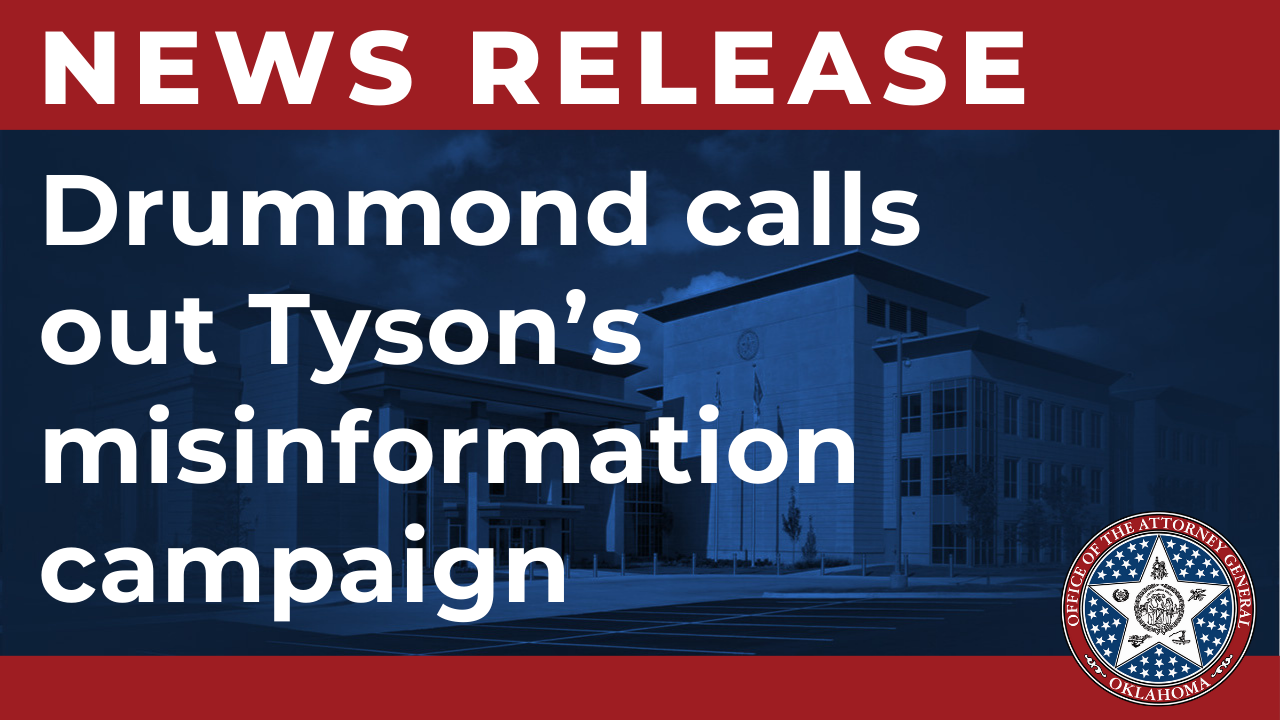
Oklahoma Attorney General Gentner Drummond has taken a firm stance against what he describes as deliberate misinformation from Tyson Foods regarding the state’s ongoing environmental lawsuit over pollution in the Illinois River watershed.
In a strongly worded statement released Tuesday, Drummond accused the poultry giant of orchestrating a campaign to mislead the public while using local farmers as leverage in their battle against environmental accountability.
“Tyson Foods is engaging in shameless gamesmanship, using Oklahoma’s hardworking farmers as pawns while threatening to withdraw contracts,” Drummond said. “Oklahomans deserve better than corporate intimidation tactics from a company that has repeatedly shown it prioritizes profits over people and environmental responsibility.”
The controversy centers around a lawsuit first filed in 2005, which aims to hold major poultry producers accountable for phosphorus pollution from chicken waste that has degraded the Illinois River watershed—a critical natural resource for the region’s ecology, recreation, and tourism economy.
In 2023, U.S. District Judge Gregory Frizzell ruled in favor of Oklahoma, determining that poultry companies had indeed contaminated the watershed. The judge ordered both sides to negotiate appropriate remedies, but these talks ultimately collapsed. Following a subsequent six-day evidentiary hearing, the court reaffirmed that the watershed remains environmentally impaired.
The state has proposed penalties exceeding $100 million against Tyson Foods, Cargill, George’s, Simmons, and Cal-Maine for violations of the Oklahoma Environmental Quality Code. Additionally, Drummond’s office has requested that these companies fund a comprehensive restoration plan for the damaged watershed.
Recent weeks have seen mounting pressure from local officials and state lawmakers urging Drummond to abandon or significantly reduce the scope of the litigation. This pressure campaign emerged after Tyson Foods warned it might scale back its Oklahoma operations if the lawsuit proceeded at full strength—potentially threatening jobs and economic stability in communities dependent on the poultry industry.
However, Drummond points to contradictory evidence: despite Tyson’s claims of potentially reducing operations, the company is reportedly seeking to increase its production capacity in the watershed by acquiring Cargill’s former processing plant in Springdale, Arkansas.
“Let’s be clear about what’s really happening here,” Drummond stated. “This isn’t about protecting farmers. It’s about protecting corporate profits at the expense of Oklahoma’s natural resources.”
The conflict highlights broader tensions between environmental protection and agricultural interests in rural America, where large food producers often wield significant economic influence. The poultry industry is vital to Oklahoma’s economy, particularly in the eastern part of the state, where it provides thousands of jobs and contracts with numerous family farms.
Environmental experts note that phosphorus pollution from poultry waste can cause algal blooms, decreased oxygen levels, and other ecological damage that threatens aquatic life and recreational use of waterways. The Illinois River watershed is particularly significant as it spans both Oklahoma and Arkansas, creating complex interstate environmental management challenges.
Drummond emphasized that the lawsuit specifically targets corporate poultry companies responsible for waste management practices, not individual farmers or growers. “Not one single farmer has been sued by the state, but these corporations continue to hide behind a false narrative, using hardworking farm families as human shields to avoid accountability,” he said.
The Attorney General’s office maintains that environmental protection and agricultural prosperity are not mutually exclusive goals. “A thriving poultry industry and clean water can absolutely coexist,” Drummond asserted. “What we cannot accept is allowing massive corporations to pollute our waterways without consequence.”
The case represents one of the most significant environmental enforcement actions in Oklahoma’s history and could set precedents for how agricultural waste management is regulated nationwide. A final ruling on penalties and remediation requirements is expected in the coming months.
Fact Checker
Verify the accuracy of this article using The Disinformation Commission analysis and real-time sources.

13 Comments
I’m curious to learn more about the specific claims and data the AG is using to accuse Tyson of misleading the public. It’s important to have a clear, fact-based understanding of the environmental issues at stake.
That’s a good point. Transparency and open dialogue are key to resolving these types of disputes. I hope the AG is able to provide detailed evidence to back up the allegations against Tyson.
This seems like a complex issue with valid concerns on both sides. I appreciate the AG’s strong stance against corporate intimidation tactics, but I wonder if there’s room for a more collaborative approach to address the environmental damage while also supporting local farmers.
You raise a good point. Finding the right balance between environmental protection and supporting local economies is challenging but critical. Hopefully the two sides can come together and find a solution that works for all stakeholders.
As someone who enjoys the Illinois River for recreation, I’m glad to see the AG taking such a firm stand. Poultry producers need to be responsible corporate citizens and do their part to address the environmental damage caused by their operations.
Absolutely. The natural beauty and ecological health of the Illinois River is a valuable public resource that should be protected for generations to come. Corporations like Tyson have an obligation to be part of the solution, not the problem.
While I sympathize with the local farmers who may be caught in the middle, I agree that Tyson needs to be held accountable for its role in the environmental degradation of the Illinois River watershed. Corporate profits should not come at the expense of natural resources.
This lawsuit has been going on for nearly 20 years – it’s high time for a resolution that protects the Illinois River watershed. I hope the AG’s strong stance will push Tyson to the negotiating table in good faith rather than resorting to intimidation tactics.
Phosphorus pollution is a serious issue that can have devastating effects on ecosystems. While I understand Tyson’s commercial interests, the AG is right to call out their alleged misinformation campaign. Environmental accountability should be a top priority for any major corporation.
Agreed. Corporations need to be held accountable for their environmental impacts, even if it means short-term financial pain. The long-term sustainability of the region’s natural resources should be the primary concern.
This seems like a classic case of a large corporation trying to bully its way out of environmental responsibility. I’m glad the AG is standing up to Tyson’s intimidation tactics and pushing for real, substantive solutions to address the pollution issues.
Absolutely. Corporations can’t be allowed to use their economic power to avoid accountability for environmental damage. The AG’s strong stance is an important step in protecting the public interest.
I hope this litigation leads to meaningful changes in how poultry producers manage their waste and environmental impacts. The long-term health of the Illinois River ecosystem should be the top priority, not short-term profits.