


Listen to the article
Stanford Leaders Discuss Higher Education Challenges in Era of Misinformation
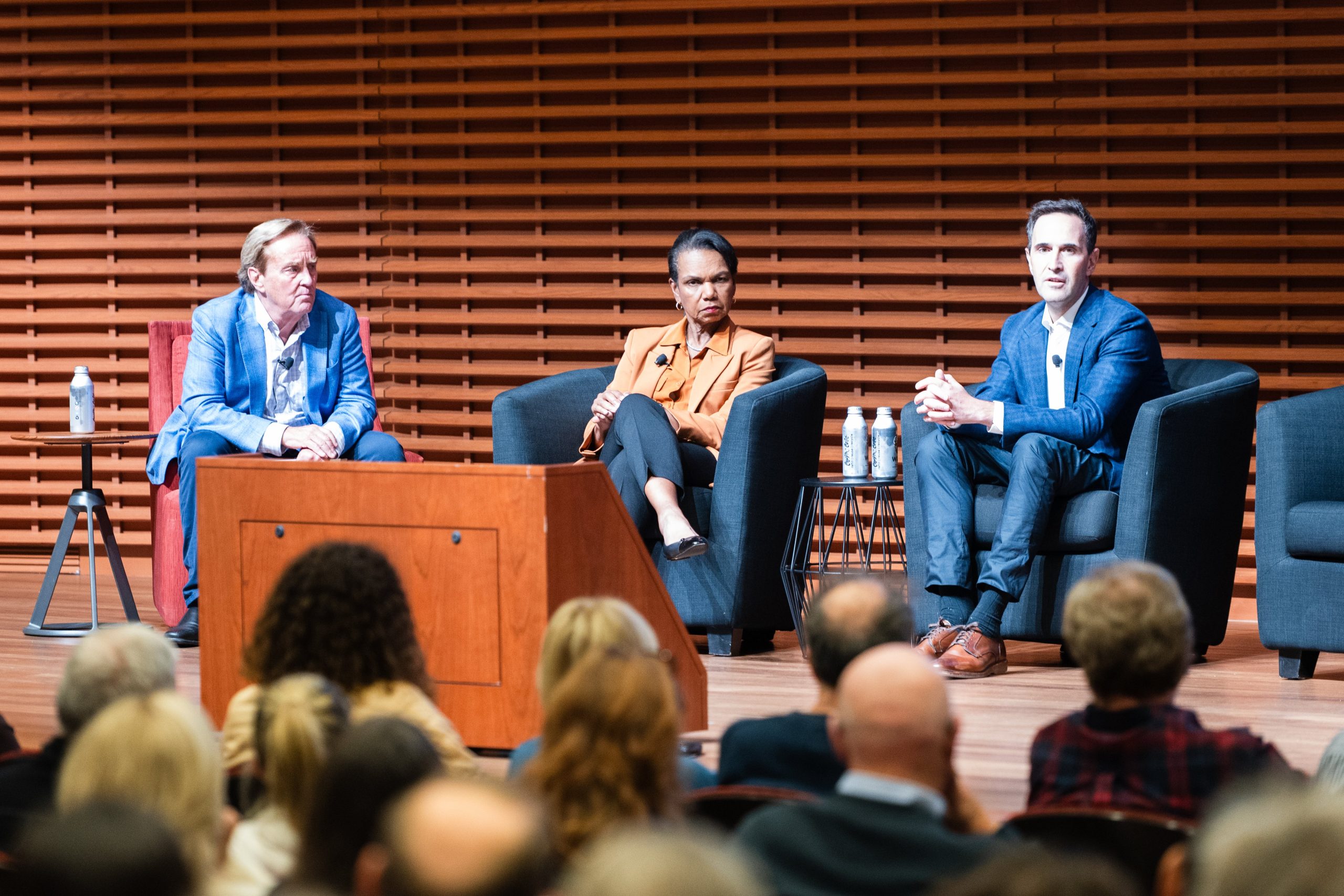
Stanford University President Jon Levin ’94 and Hoover Institute Director Condoleezza Rice engaged in a thoughtful dialogue about the state of American higher education during a panel discussion Monday evening. The event, part of the POLISCI 31 speaker series moderated by Common Sense Media CEO and professor Jim Steyer, addressed pressing issues facing university leadership amid what Steyer termed “the era of misinformation.”
Levin identified “multiple concerns” confronting university administrators today, including providing adequate resources for students from diverse backgrounds and advocating for higher education institutions as a collective. He emphasized what sets university research apart from corporate endeavors: “What makes university research different from [that of the] company is the freedom here… and it is this freedom that will make universities thrive for decades.”
Rice, who served as Secretary of State under President George W. Bush, emphasized the role of universities as marketplaces for ideas. She highlighted the crucial function of Stanford and similar elite research institutions as drivers of American innovation.
In discussing Stanford’s competitive position in Silicon Valley, Levin acknowledged that while major tech companies may have more computational resources, particularly GPUs, the university’s strength lies in its human capital. “The University does not have a private business model… We let people bounce into each other,” he explained, suggesting that Stanford’s collaborative environment fosters innovation differently than corporate settings.
The conversation shifted to broader challenges facing universities nationwide, with Steyer raising concerns about free speech controversies at Columbia University and federal threats to funding, as well as the Trump administration’s scrutiny of admissions practices and affirmative action.
Rice declined to speculate on hypothetical scenarios involving Stanford, stating, “I don’t answer to hypothetical questions.” However, she expressed being “appalled” by what she perceived as widespread misunderstanding of Middle East issues on college campuses, noting her extensive diplomatic experience in the region during her tenure as Secretary of State.
Both panelists stressed the importance of various aspects of diversity beyond racial considerations. Levin pointed to Stanford’s financial accessibility initiatives, where domestic students from the bottom 80% of U.S. income distribution pay no tuition, and 90% of students graduate debt-free.
Rice offered personal perspective, referencing her upbringing in a highly educated African American family. “Some of what has been defined as diversity… is actually exclusion,” she remarked. “Would I feel uncomfortable on a college campus [as an African American]? It is not just about race.”
The panel was enriched by student perspectives, including Daily Opinions managing editor Jennifer Levine ’28, Joe Nail MBA ’26, and Mandla Msipa ’26, who shared insights on campus political climate.
Levine advocated for robust exchange of diverse viewpoints, stating, “Student conversation is important… Their opinions should be [ready to be] challenged.” Msipa expressed appreciation for peaceful political engagement on campus, specifically mentioning advocacy tents for both Palestine and Israel that operated throughout the previous academic year.
Rice responded to discussion of campus protests by questioning, “I just wanted to ask [the protesters], from which river to which sea?” She emphasized the importance of students being well-informed about the causes they support.
Nail highlighted concerns about ideological homogeneity on campus, citing a 5.33-to-1 ratio of liberal to conservative students at Stanford. He shared an anecdote about being told by fellow students, “you are the first conservative I met who is not a fascist,” illustrating the polarization he’s experienced.
In closing remarks, Levin reminded the audience to consider the fundamental purpose of higher education. He suggested that while Stanford students come to learn and challenge orthodoxy, they should embrace the philosophy popularized in the show “Ted Lasso”: “be curious, not judgmental.”
Levin also affirmed Stanford’s commitment to international students, pledging compliance with federal immigration laws while taking additional measures to protect international students’ rights. “There is no way that this country would be the leading country of the world if it does not welcome immigrants,” he concluded.
Fact Checker
Verify the accuracy of this article using The Disinformation Commission analysis and real-time sources.
