


Listen to the article
BC Rights Commissioner Launches Campaign to Combat Misinformation and Protect Human Rights
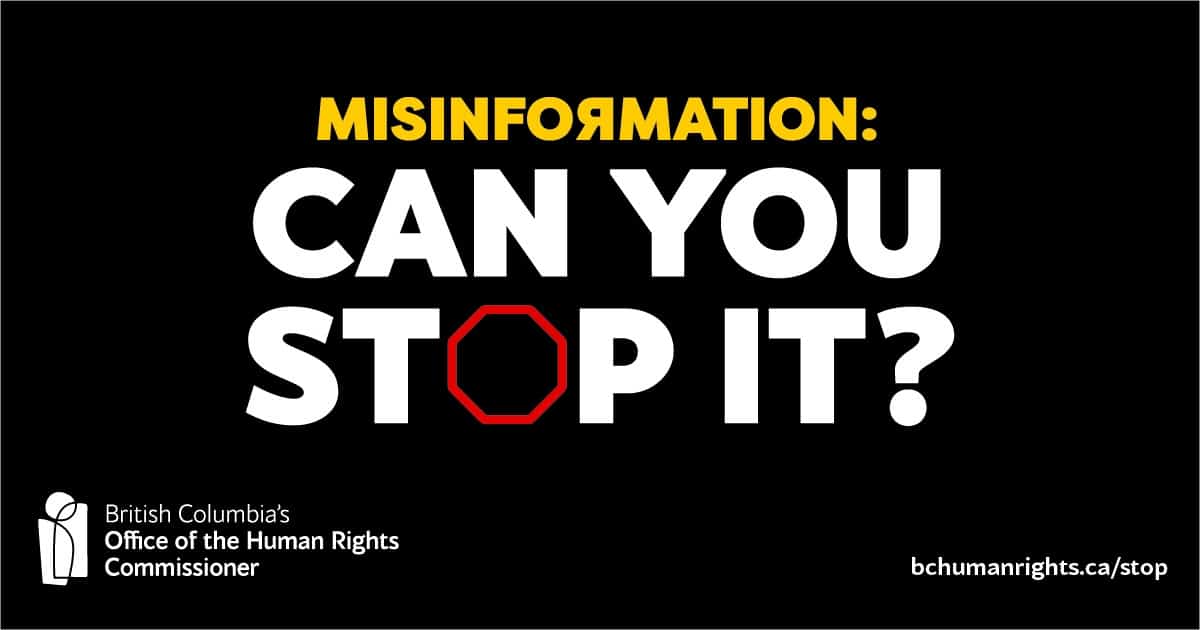
False and misleading information has become a major societal challenge, prompting British Columbia’s Human Rights Commissioner to launch a new awareness campaign. The initiative aims to educate the public about how misinformation and disinformation damage society and what individuals can do to prevent their spread.
Misinformation—false information shared unintentionally—and disinformation—false information deliberately shared to cause harm—both present significant threats to human rights and democratic institutions across the province.
“When misinformation spreads faster than truth, rights get trampled,” states the Commissioner’s campaign materials. The harmful effects extend beyond simple confusion, as misinformation often fuels discrimination and hate crimes by promoting stereotypes, biases, and conspiracy theories targeting specific communities.
The campaign highlights how misinformation undermines democratic processes by misleading voters and eroding trust in political leadership. The overwhelming volume of questionable information makes it increasingly difficult for citizens to identify reliable sources, leading to a general distrust in all information—including critical facts needed for informed decision-making.
In the Commissioner’s 2023 report “From Hate to Hope” and the 2024 report “Rights in Focus,” the office documented how misinformation contributes to discrimination and societal harm, particularly during periods of crisis like the COVID-19 pandemic.
The campaign identifies several tactics used by creators of disinformation, including algorithmic targeting on social media, creating convincingly realistic fake content, and deliberately provoking strong emotional responses that increase the likelihood of sharing. Many disinformation campaigns also exploit correlation by falsely attributing causation to coincidental events.
To combat these challenges, the Commissioner has introduced the “STOP” method, a four-step approach to help individuals identify and prevent the spread of misinformation:
- Share (only) when you’re sure: Verify information before passing it along
- Track down the truth: Confirm claims across multiple reliable sources
- Outsmart the outrage: Recognize when emotional reactions might be clouding judgment
- Poke at the point of view: Consider who is sharing the information and who benefits
The initiative emphasizes that individuals have the power to make a difference through small actions. By stopping the spread of misinformation, people can protect their friends and family from manipulation, shield marginalized communities from discrimination and hate, and safeguard democratic institutions.
The Commissioner is also encouraging community involvement through a mini-grant program for projects that raise awareness about misinformation. Eligible activities include visual art, multimedia productions, written works, and community gatherings. Selected projects will be featured on the Commissioner’s website and social media channels.
“You are part of a bigger story,” the campaign reminds British Columbians. “When we take action to stop the spread of mis- and disinformation, we push back against manipulation and protect each other’s rights.”
The campaign website provides additional resources and will be regularly updated with new information about the connection between misinformation and human rights violations. More details about the community grant program are available on the Commissioner’s “Community Amplifiers” webpage.
Fact Checker
Verify the accuracy of this article using The Disinformation Commission analysis and real-time sources.

8 Comments
This is an important issue that deserves more attention. Misinformation and disinformation can have real, harmful consequences for individuals and society. I’m glad to see the BC Rights Commissioner taking steps to raise awareness and provide guidance on combating these challenges.
Agreed, it’s critical that we find ways to empower people to think critically about the information they encounter online and elsewhere. Education and awareness campaigns like this one can make a real difference.
The stats on the speed at which misinformation spreads compared to truth are really alarming. Clearly, we need a multipronged approach to address this problem, from media literacy programs to stronger content moderation policies.
Absolutely. Misinformation often targets vulnerable communities, so protecting human rights has to be a key part of the solution. I hope this campaign can inspire more initiatives to combat these challenges.
Misinformation can be a real threat to democratic institutions by misleading voters and eroding trust. I’m glad to see the Commissioner highlighting this angle. Protecting the integrity of our political processes should be a top priority.
Agreed. Voter education will be key, so people can learn to identify and resist attempts to manipulate them with false or misleading information. This campaign could serve as a model for other regions facing similar challenges.
While the scale of the misinformation problem may seem overwhelming, this campaign demonstrates that taking proactive steps can make a real difference. I’m hopeful that it will inspire other jurisdictions to follow suit and tackle this critical issue head-on.
This is an important step, but the task of combating misinformation is daunting. I’m curious to learn more about the specific strategies and tools the BC Rights Commissioner plans to employ. Fact-checking, source verification, and media literacy will all be crucial.