


Listen to the article
Israeli-Palestinian conflict narratives on social media came under scrutiny Tuesday as former Secretary of State Hillary Clinton criticized the consumption of war-related content by young Americans, suggesting much of it amounts to propaganda or fabrication.
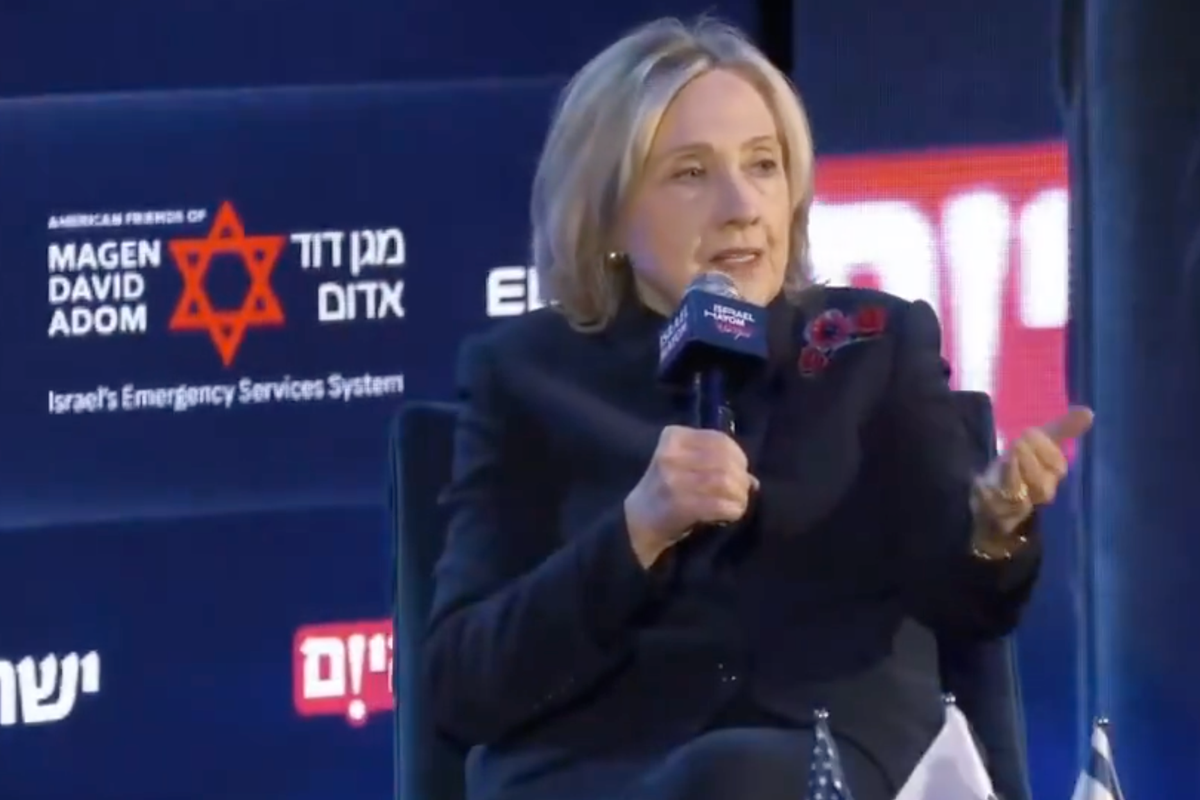
Speaking at a summit in New York City hosted by Israeli newspaper Israel Hayom, Clinton expressed concern about how younger generations are forming their opinions on the Gaza conflict primarily through platforms like TikTok.
“Smart, well-educated, young people from our own country, from around the world, where were they getting their information?” Clinton asked. “They were getting their information from social media, particularly TikTok.”
The former Democratic presidential candidate suggested this reliance on social media creates significant knowledge gaps about the historical context of the conflict. She claimed many young Americans, including young Jewish Americans, have limited understanding of the region’s complex history.
“It’s a serious problem for democracy, whether it’s Israel or the United States, and it’s a serious problem for our young people,” Clinton said, describing failed attempts to engage in “reasonable discussion” with younger people about the conflict.
Clinton’s comments come amid ongoing tensions and violence in Gaza, where imagery and footage of destruction have been widely shared across social platforms since October 7. She claimed some videos circulating online were “totally made up” or misrepresented their content, though she did not provide specific examples of which videos she believed were fabricated.
“More than 50 percent of young people in America get their news from social media,” Clinton noted, referencing data from the Reuters Institute’s June research. “They are seeing short-form videos, some of them totally made up, some of them not at all representing what they claim to be showing, and that’s where they get their information.”
The Reuters research confirms her statistic, finding that 54 percent of Americans now obtain news from platforms like Facebook, X (formerly Twitter), and YouTube, compared to television (50 percent) and news sites and apps (48 percent).
Clinton’s concerns echo those of other former Obama administration officials. Sarah Hurwitz, a former White House speechwriter, recently made similar remarks at a summit hosted by the Jewish Federations of North America, claiming that TikTok was “smashing our young people’s brains all day long with video of carnage in Gaza.”
Media experts have noted this shift toward social media consumption presents challenges for information integrity. Nic Newman, author of the Reuters research, warned that click-driven news ecosystems enable bad actors to “bypass traditional journalism in favor of friendly partisan media, ‘personalities,’ and ‘influencers'” who often receive special access but rarely provide critical analysis.
The criticism comes as pro-Palestinian demonstrations have continued at university campuses across the United States, with many young protesters citing images and videos from Gaza as motivating their activism. These protests have drawn both support and criticism from political figures across the spectrum.
Social media companies have faced mounting pressure to address misinformation about the conflict. Meta, TikTok, and other platforms have implemented various content moderation policies, though critics argue these efforts have been inconsistent and sometimes politically influenced.
The Gaza Health Ministry reports that thousands of Palestinians have been killed since the conflict began, though verification of casualties and circumstances remains challenging in the war zone, contributing to competing narratives about what is happening on the ground.
Clinton’s office did not respond to requests for further comment on specific examples of misleading content she referenced in her speech.
Fact Checker
Verify the accuracy of this article using The Disinformation Commission analysis and real-time sources.

12 Comments
Clinton raises an important issue, but her framing of it as a ‘serious problem for democracy’ seems hyperbolic. Social media’s influence on political views is complex and multifaceted. We need a more measured, evidence-based approach to addressing misinformation and polarization.
I agree that Clinton’s language is somewhat alarmist. While the spread of misinformation is concerning, characterizing it as a threat to democracy may be an overstatement. A more constructive approach would be to focus on improving media literacy and access to reliable information.
This is a complex, sensitive topic. While social media can play a role, I’m not sure Clinton’s criticism fully captures the challenge. Young people are seeking information, but the information landscape is fragmented and polarized. Addressing that is the real challenge.
That’s a fair perspective. The problem goes beyond any one platform. Improving access to balanced, in-depth reporting and educational resources on the Israel-Palestine conflict is key to cultivating more nuanced understandings among the youth.
This is a challenging topic without easy solutions. Clinton is right that social media can distort understandings of the Israel-Palestine conflict, but the roots of the problem are deeper. Improving critical thinking and research skills among young people is crucial to navigating these issues.
Agreed. Simplistic narratives and echo chambers on social media are symptoms of a larger educational and societal challenge. Developing a more holistic, interdisciplinary approach to teaching about complex geopolitical conflicts is key.
Clinton’s concerns about the role of social media in shaping views on the Israel-Palestine conflict are understandable. However, the issue is multi-faceted and requires a nuanced response that goes beyond finger-pointing at any single platform or medium.
Absolutely. Addressing misinformation and fostering greater understanding of this conflict requires a comprehensive strategy that encompasses media literacy education, improved access to reliable information sources, and open, constructive dialogue.
This is a concerning issue. Social media can create dangerous information bubbles, especially for young people trying to understand complex geopolitical conflicts. Fact-checking and historical context are critical to developing a nuanced understanding of the Israel-Palestine situation.
I agree. We need to find ways to promote media literacy and encourage young people to seek out authoritative, balanced sources when learning about these issues.
Clinton raises a valid point. TikTok and other social platforms can be echo chambers that amplify misinformation and simplistic narratives. Developing a more comprehensive grasp of the Israel-Palestine conflict’s origins and dynamics is important for informed discourse.
Absolutely. Nuance and historical awareness are often lacking in social media discussions of this issue. Improving digital literacy is crucial to countering the spread of propaganda and biased content.